
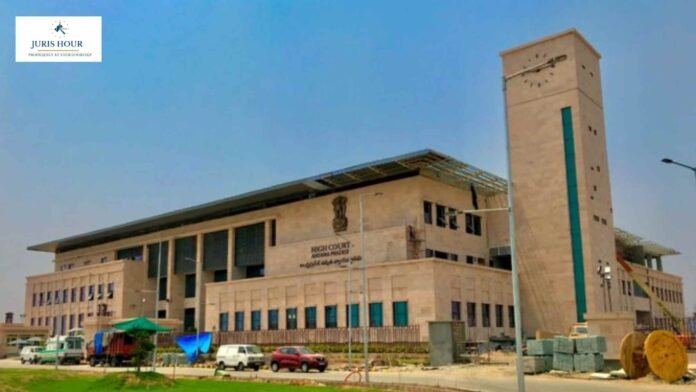
The Andhra Pradesh High Court has refused to grant bail to an accused in a case involving the alleged illicit manufacture and possession of a commercial quantity of psychotropic substances, holding that the stringent conditions prescribed under Section 37 of the Narcotic Drugs and Psychotropic Substances Act, 1985 (NDPS Act) had not been satisfied.
The bench of Justice Y. Lakshmana Rao has observed that the material collected during investigation prima facie disclosed the accused’s involvement in the alleged illicit operation. The Court particularly relied on the alleged financial investment of Rs. 2 lakh, the accused’s presence at the factory premises during the search, and other material including the Panchanama, chemical analysis report and call detail records.
The case arose from a search conducted by the Directorate of Revenue Intelligence (DRI), Visakhapatnam Regional Unit, on August 16/17, 2025, at the premises of M/s Averx Drugs Private Limited at Atchuthapuram in Anakapalli District.
Buy Now: 50+ Supreme Court Judgments – July 2026
According to the prosecution, acting upon specific intelligence, DRI officials searched the premises in the presence of independent panch witnesses and seized approximately 119.40 kg of suspected Alprazolam, 87.80 kg of an intermediate substance and manufacturing equipment.
The total seized material was stated to be 207.20 kg and was subsequently confirmed through chemical analysis to be Nordazepam, described in the judgment as a psychotropic substance covered by the NDPS Act. The petitioner, arrayed as Accused No.8, along with seven other accused, was allegedly found inside the drier room of the factory during the search.
The petitioner argued that he had been falsely implicated and had no connection with the other accused or the alleged manufacture of Alprazolam at the factory.
It was contended that the allegation that he had invested ₹2 lakh was based only on the statement of another accused. The petitioner also argued that his alleged confession could not by itself be treated as conclusive evidence of guilt.
Another major submission was that the investigation had already been completed and the charge sheet had been filed. Therefore, according to the petitioner, continued incarceration would serve no useful purpose.
The defence also pointed to the petitioner’s prolonged custody, family hardship, permanent residence and willingness to cooperate with the trial and comply with any conditions imposed by the Court.
The DRI strongly opposed the bail application, asserting that the petitioner had actively participated in the illicit manufacture and sale of a psychotropic substance.
According to the prosecution, the petitioner’s voluntary statement recorded an investment of ₹2 lakh in the illegal activity on the assurance of receiving double returns, and this allegation was corroborated by Accused No.5.
The prosecution further relied upon the Panchanama and video evidence to establish the petitioner’s presence inside the factory during the search. The DRI also relied upon CDR and tower-location analysis to establish his association with the other accused and his presence at the premises.
Since the seized substance was alleged to be far in excess of the prescribed commercial quantity, the prosecution argued that the stringent restrictions contained in Section 37 of the NDPS Act were attracted.
A substantial portion of the judgment deals with the statutory restrictions governing bail in NDPS cases involving commercial quantities.
The High Court referred to several decisions of the Supreme Court, including State v. B. Ramu, Union of India v. Ajay Kumar Singh, State of Kerala v. Rajesh, Narcotics Control Bureau v. Mohit Aggarwal, Union of India v. Shiv Shanker Kesari and Union of India v. Mohd. Nawaz Khan.
The Court emphasised that where Section 37 applies, the ordinary approach to bail cannot be followed mechanically. The prosecution must be given an opportunity to oppose bail, and the Court must be satisfied that there are reasonable grounds for believing that the accused is not guilty and that the accused is not likely to commit any offence while on bail.
Importantly, the Court reiterated that the expression “reasonable grounds” means something more than prima facie grounds. It requires substantial probable causes supporting the belief that the accused is not guilty of the alleged offence.
The High Court rejected the argument that completion of investigation and prolonged incarceration, by themselves, justified the grant of bail.
Relying on the Supreme Court’s decision in Narcotics Control Bureau v. Mohit Aggarwal, the Court observed that the mere filing of a charge sheet or the commencement of trial does not automatically constitute a persuasive ground for bail when the requirements of Section 37 remain unsatisfied.
The Court also relied on Union of India v. Shiv Shanker Kesari to reiterate that both statutory conditions under Section 37 must be satisfied. If either condition remains unmet, the statutory bar operates.
At the bail stage, the Court is not required to conduct a full-fledged adjudication on guilt or innocence. Instead, its examination is confined to determining whether there are reasonable grounds for believing that the accused is not guilty and whether the other statutory requirement relating to future criminal conduct is satisfied.
Applying these principles to the case, the High Court found the allegations to be of an “exceedingly grave and serious nature” because they concerned the recovery of 207.20 kg of Nordazepam from the factory premises.
The Court noted that the accused was allegedly apprehended inside the drier room at the time of the raid and that the prosecution had attributed a financial stake of ₹2 lakh to him.
The Court held that the Panchanama and Chemical Analysis Report, at the stage of bail consideration, prima facie furnished a credible nexus between the petitioner and the alleged offence. His plea of innocence and claim that his role was limited to mere presence at the scene did not persuade the Court.
The judgment records that the petitioner was arrested on August 18, 2025, and had remained in judicial custody for 359 days by the time the Court considered the bail petition.
The Court nevertheless held that the period of custody could not override the statutory requirements of Section 37.
The charge sheet had already been filed in SC.NDPS.No.88 of 2026 before the Special Court at Visakhapatnam. The High Court also noted that it had earlier dismissed a bail application filed by another accused, Accused No.6, in Criminal Petition No.4772 of 2026 on July 10, 2026, observing that the allegations against the present petitioner were similar.
The High Court further considered the contents of the petitioner’s statement recorded during the investigation.
According to the judgment, the petitioner stated that he had previously been engaged in the automobile spare-parts and transport businesses and that he discontinued the transport business after suffering financial losses.
He allegedly stated that Accused No.5, a distant relative whom he had known since his transport-business days, persuaded him to invest in the proposed venture with an assurance of double returns. The petitioner allegedly invested ₹2 lakh with an assurance of receiving ₹4 lakh within a month.
The Court also recorded that the petitioner had accompanied Accused No.5 and Accused No.2 to Atchuthapuram, travelled in his vehicle, stayed at a local hotel and subsequently went to the Averx Drugs premises. The statement allegedly indicated that he knew the other accused were engaged in manufacturing Alprazolam and that the manufacturing activity was being undertaken without a valid licence.
The judgment reiterates an important principle for bail applications under the NDPS Act: the absence of a direct recovery from an accused is not, by itself, sufficient to establish that the accused is entitled to bail.
The High Court observed that the Supreme Court has already held that the filing of a charge sheet, the duration of incarceration or the absence of recovery from the personal possession of an accused does not, by themselves, dilute the statutory requirements of Section 37.
In the present case, the Court found that the material collected during the investigation disclosed substantial and credible grounds indicating the petitioner’s prima facie complicity.
The Court also considered the petitioner’s plea concerning personal and family hardship, including his assertion that he was the sole breadwinner of the family.
However, the High Court held that such equitable considerations, even if compelling from a humanitarian standpoint, could not override the legislative mandate contained in Section 37 of the NDPS Act.
The Court emphasised that offences involving commercial quantities of narcotic drugs and psychotropic substances are treated as a distinct category because of their alleged impact on public health, social order and collective welfare. Consequently, courts are required to adopt a restrictive approach while considering bail in such cases.
The High Court concluded that the petitioner had failed to demonstrate the existence of reasonable grounds for believing that he was not guilty of the alleged offence. He also failed to satisfy the Court that he would abstain from similar unlawful activities if released on bail.
The Court therefore held that the statutory satisfaction required under Section 37 of the NDPS Act could not be recorded in the petitioner’s favour.
Membership Required to Access Case Details & Order Copy
To view the complete Case Details and Download Order Copy, you must have an active membership. Please subscribe to continue.

