
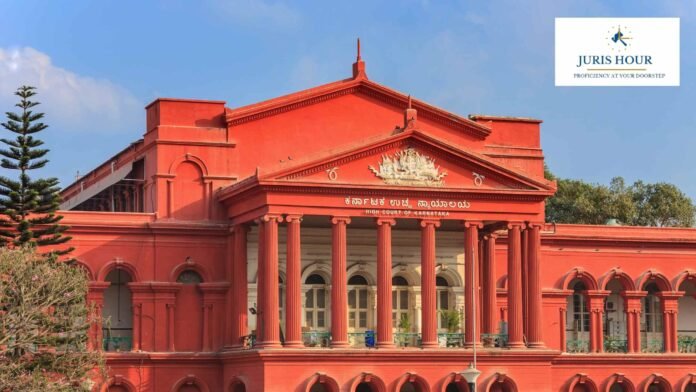
The Karnataka High Court has granted anticipatory bail to a husband and wife accused of availing Input Tax Credit (ITC) on the basis of allegedly fraudulent invoices, holding that the subsequent cancellation of a supplier’s GST registration or closure of the supplier entity, by itself, does not establish that the purchaser fraudulently availed ITC.
The bench of Justice S. Vishwajith Shetty has observed that petitioners herein do not have any criminal antecedents. They have undertaken to appear before the respondent – authorities and produce necessary documents to prove receipt of goods and services from the supplier and they have also undertaken to abide by any condition that may be imposed on them by this Court.
The petitioners is a GST-registered business engaged in recycling used lead-acid batteries and manufacturing remelted lead ingots. The wife was the sole proprietrix of the firm, while the husband was alleged to be managing its affairs.
Buy Now: Recovery Of Tax Dues And Penalty Against Legal Heirs Of A Deceased Assessee : Case Compilation
The GST authorities had issued summons dated April 10, 2026, in connection with an investigation concerning the firm. Apprehending arrest, the petitioners first approached the jurisdictional Sessions Court seeking anticipatory bail. Their application was dismissed on June 16, 2026, following which they approached the High Court.
The petitioners contended that they possessed valid GST registration, had purchased goods from various suppliers, made payments for the purchases through banking channels and regularly filed their GST returns. They further claimed that the invoice value along with applicable tax had been paid to the suppliers through bank transactions.
According to the petitioners, they possessed documents demonstrating actual receipt of goods from the suppliers and had already appeared before the investigating authorities and cooperated with the investigation.
The Central GST department opposed the anticipatory bail application, alleging that the suppliers from whom the petitioners had purportedly purchased goods were fictitious entities and were no longer in existence.
The Department alleged that the petitioners had claimed ITC on the basis of bogus invoices without actual supply of goods. It was further alleged that although money had been transferred into the bank accounts of the purported suppliers, the amounts were subsequently withdrawn and shared between the suppliers and the petitioners.
The Department therefore argued that custodial interrogation was necessary and claimed that the husband was the mastermind behind the alleged transactions.
The Court observed that cancellation of a supplier’s GST registration or subsequent closure of the supplier entity does not, by itself, disentitle a purchaser from claiming ITC, unless the Department is able to establish collusion between the supplier and purchaser.
The Court relied upon the Supreme Court’s decision in State of Maharashtra through the Secretary v. Suresh Trading Company, reported in (1997) 11 SCC 378, as well as the Calcutta High Court decision in Gargo Traders v. Joint Commissioner, Commercial Taxes (State Tax) & Others, 2023 SCC OnLine Cal 1441.
The High Court also examined the prosecution’s reliance on Section 132(1)(c) of the CGST Act.
The Court noted that, according to the prosecution, the petitioners were liable under Section 132(1)(c). However, clauses (a) and (b) of Section 132(1) concern the supplier, and the prosecution must first prima facie establish violation of those provisions before Section 132(1)(c) can be attracted in the circumstances alleged.
The Court found that, at that stage, there was no material prima facie demonstrating violation of clauses (a) or (b) by the suppliers. The mere fact that the suppliers were no longer in existence or that their GST registrations had subsequently been cancelled was held insufficient to establish that the petitioners had availed ITC using fraudulent invoices or bills contemplated under Section 132(1)(b).
The Court noted that the petitioners had earlier appeared before the respondent authorities and that this assertion had not been seriously disputed by the Department.
The petitioners also undertook to appear before the authorities and produce documents concerning the receipt of goods and services from their suppliers. They had no criminal antecedents and agreed to comply with any conditions imposed by the Court.
The High Court referred to the Supreme Court’s decision in Siddharam Satlingappa Mhetre v. State of Maharashtra & Others, (2011) 1 SCC 694, concerning the exercise of discretion in anticipatory bail matters.
The Supreme Court had emphasized that where an accused has joined the investigation, is cooperating with the investigating agency and is not likely to abscond, custodial interrogation should ordinarily be avoided when the circumstances do not otherwise justify it.
The High Court also considered its earlier decision in Akram Pasha v. Senior Intelligence Officer, DGGI, 2025 SCC OnLine Kar 30886. In that case, the Court had observed that although offences under the CGST Act are economic offences, the punishment prescribed under the statute remains relevant while assessing the gravity of the alleged offence and determining whether custody is indispensable.
The High Court recorded that the Special Leave Petition challenging the Akram Pasha decision had been dismissed by the Supreme Court on March 25, 2026.
The Court also referred to the Delhi High Court’s decision in Tarun Jain v. Directorate General of GST Intelligence, Bail Application No. 3771/2021, decided on November 26, 2021.
The decision dealt with allegations of wrongful utilisation of ITC and emphasized the need to balance two competing considerations in anticipatory bail proceedings: protection of personal liberty and ensuring that the investigation is not obstructed.
The Delhi High Court had observed that the investigating authorities may obtain the necessary information through cooperation of the accused, making arrest unnecessary in appropriate cases. It also emphasized the constitutional protection of personal liberty under Article 21 and the principle that bail is ordinarily preferred over incarceration.
After considering the allegations and the material placed before it, the Karnataka High Court concluded that the petitioners were entitled to anticipatory bail.
The Court accordingly allowed the criminal petition and directed that the petitioners be released in the event of their arrest pursuant to the summons issued under Section 70 of the CGST Act.
However, the relief was made subject to stringent conditions.
The petitioners were directed to appear before the respondent authorities at 10:30 a.m. on August 20, 2026. The authorities were permitted to take them into custody on that date if necessary for interrogation.
The Court, however, directed that following interrogation, the petitioners should be released on the same day, on or before 6:00 p.m., subject to execution of a personal bond of ₹5 lakh each along with two sureties for the like amount.
They were further directed to cooperate with the Department and appear whenever summoned. They were prohibited from directly or indirectly inducing, threatening or promising any person acquainted with the facts of the case.
The petitioners were also required to keep their mobile phone numbers operational and provide those numbers to the authorities. The Court additionally directed them to drop a PIN on Google Maps so that their location would remain available to the respondent authority for any appropriate application concerning cancellation of bail.
The petitioners were required to surrender their passports and were prohibited from leaving India without prior permission of the respondent authority. Those who did not possess passports were directed to file an affidavit to that effect.
Membership Required to Access Case Details & Order Copy
To view the complete Case Details and Download Order Copy, you must have an active membership. Please subscribe to continue.
Read More: Fake GST ITC | 14 Months’ Custody Can’t Alone Override S. 45 PMLA Twin Conditions: Jharkhand HC

