
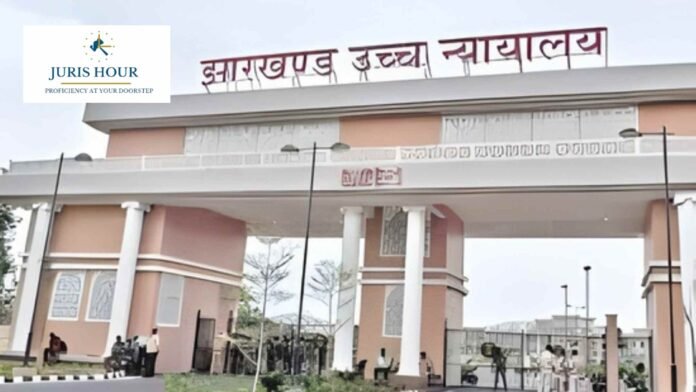
The Jharkhand High Court has dismissed a successive bail application in a money-laundering case arising out of an alleged large-scale fake GST invoice and Input Tax Credit (ITC) syndicate and held that the stringent twin conditions under Section 45 of the Prevention of Money Laundering Act, 2002 (PMLA) remained unsatisfied and that no fresh ground or supervening circumstance had been demonstrated to justify departure from the earlier rejection of bail.
The bench of Justice Sujit Narayan Prasad has observed that a person need not necessarily be shown as an accused in the scheduled offence if proceeds of crime derived from such offence exist and the person has knowingly participated in, assisted or facilitated a process or activity connected with those proceeds.
The case originated from three complaints filed by the Directorate General of GST Intelligence (DGGI), Jamshedpur, against persons allegedly involved in a network of fictitious companies and firms. According to the prosecution case, the syndicate operated across Jharkhand, West Bengal, Delhi and other States and allegedly generated fake GST invoices without actual supply of goods or services to facilitate ineligible ITC.
Buy Now: Recovery Of Tax Dues And Penalty Against Legal Heirs Of A Deceased Assessee : Case Compilation
The High Court noted the prosecution allegation that approximately 135 shell companies were created and used for availing and passing on fraudulent ITC of around ₹750 crore. The alleged proceeds were subsequently transferred through multiple layers and into other States, including Tamil Nadu, Telangana, Andhra Pradesh, Maharashtra and Odisha.
The prosecution further alleged that identities and documents of innocent persons were misused to create dummy companies. According to the case placed before the Court, persons were allegedly recruited on the pretext of employment and their identity documents, OTPs and other credentials were subsequently used for establishing and operating shell entities.
The prosecution alleged that Agarwal was an active member of the syndicate and was associated with several entities allegedly involved in fraudulent ITC transactions. He was stated to be a director or proprietor of entities that allegedly claimed ineligible ITC on the strength of bogus invoices without corresponding supply of goods or services.
The Court referred to the prosecution’s allegation that transactions involving entities connected with the alleged syndicate were found in Agarwal’s bank accounts. An HDFC Bank account allegedly recorded credits totalling ₹16.64 crore between October 28, 2016 and February 2, 2025, including substantial transactions involving Greentech Steel Enterprises, Greentech Minerals Pvt. Ltd. and Bizzare Commercial Pvt. Ltd.
The prosecution alleged that the accounts of entities that were not genuinely conducting business were used for layering proceeds generated from fraudulent ITC claims. It alleged that the activities caused a loss of approximately ₹15.95 crore to the government exchequer attributable to the petitioner’s alleged activities.
The investigation also led to a search at the petitioner’s premises on May 8, 2025 under Section 17 of the PMLA. The Court recorded that ₹3,48,500 in cash and three electronic devices, including two mobile phones and a laptop, were seized. The petitioner was subsequently arrested after his statement was recorded under Section 50 of the PMLA.
The High Court placed considerable emphasis on the fact that Agarwal’s earlier regular bail application, B.A. No. 6030 of 2025, had already been dismissed on merits on October 8, 2025.
Following that order, the petitioner approached the Supreme Court in SLP (Criminal) No. 16591 of 2025. On January 5, 2026, the Supreme Court directed the ED to complete further investigation within four months and granted liberty to the petitioner to seek fresh bail in the event of a breach of the stipulated timeline. The Supreme Court, however, did not record any finding directing his release on bail.
The petitioner subsequently moved another bail application before the Special Judge, PMLA, Ranchi, but the application was dismissed on May 25, 2026. The present proceedings before the High Court therefore constituted a successive bail application.
The petitioner’s principal arguments were that he had not been named in the predicate offence, had remained in custody since May 8, 2025, and that the trial was likely to take considerable time because 29 prosecution witnesses were proposed to be examined.
Reliance was also placed on the bail granted by the Supreme Court to co-accused Mohit Deora on July 17, 2026. The petitioner argued that the principle of parity, coupled with prolonged incarceration and the expected duration of the trial, justified his release on bail.
The ED opposed the application, arguing that there was no fresh ground or material change in circumstances. It contended that the petitioner was a key operative and beneficiary of the alleged syndicate, had links with multiple shell entities and was connected with fraudulent ITC transactions.
The ED also pointed out that charges had already been framed on July 7, 2026 and that one of the 29 witnesses had partly been examined. It further raised concerns regarding the possibility of interference with witnesses and repetition of similar activities if the petitioner were released.
One of the significant legal issues considered by the Court was the petitioner’s contention that he had not been named as an accused in the predicate offence.
The High Court rejected this argument, relying on the established legal position that the offence of money laundering under Section 3 of the PMLA is an independent offence.
The Court referred to the Supreme Court’s decisions in Pavana Dibbur v. Directorate of Enforcement and Vijay Madanlal Choudhary v. Union of India while considering this aspect.
The High Court therefore held that the absence of the petitioner’s name from the predicate offence did not, by itself, eliminate the possibility of liability under the PMLA.
The Court extensively considered Section 45 of the PMLA, which imposes stringent conditions for grant of bail in money-laundering cases.
The Court explained that where the prosecution opposes bail, the Court must be satisfied that there are reasonable grounds for believing that the accused is not guilty of the offence and that the accused is not likely to commit any offence while on bail.
According to the High Court, the expression “reasonable grounds for believing” requires the Court to undertake a prima facie assessment of the material collected during investigation. The Court must therefore be satisfied, on the basis of that material, that the accused is not guilty and is unlikely to commit an offence while on bail.
The Court observed that Section 45 effectively places additional restrictions on the ordinary bail principle. In the present case, the Court concluded that the material already considered in the earlier proceedings continued to disclose a prima facie case against the petitioner and that the statutory twin conditions were not satisfied.
The Court also considered the petitioner’s reliance on the bail granted to co-accused Mohit Deora.
It noted that the bail applications of other co-accused, including Shiva Kumar Deora and Amit Gupta, had been rejected and that no relief had been granted to them by the Supreme Court. The Court therefore held that the petitioner could not claim bail merely because one co-accused had subsequently obtained bail.
The High Court further observed that the Supreme Court’s January 5, 2026 order did not constitute a finding in the petitioner’s favour. The liberty granted to approach the Court afresh did not amount to a direction that bail should be granted.
The petitioner had remained in custody for approximately 14 months and argued that the prolonged incarceration, combined with the likely duration of the trial, warranted bail.
The High Court, however, held that the period of custody could not be treated as an independent ground for bail in the facts of the case. It noted that the prosecution complaint had been filed within the statutory period, charges had already been framed and the trial had entered the evidence stage.
The Court stressed that in an economic offence of the magnitude alleged in the case, the length of incarceration alone could not override the statutory restrictions under Section 45 of the PMLA. While considering bail, the Court was required to consider the nature of the accusations, the evidence, the severity of the potential punishment, the character and circumstances of the accused, the possibility of securing his presence, the risk of witness tampering and the broader public interest.
The High Court ultimately found that the earlier bail application had been rejected after consideration of the factual and legal aspects of the case. The present application did not disclose any major change in circumstances capable of warranting reconsideration.
The Court specifically concluded that the alleged role of the petitioner in the money-laundering operation remained significant and that the twin conditions under Section 45 continued to remain unsatisfied. It also found a continuing risk of evidence tampering, influencing vulnerable witnesses and repetition of the alleged offence if bail were granted.
The Jharkhand High Court held that the petitioner had failed to establish any ground warranting exercise of discretionary jurisdiction in his favour. The Court found no exceptional circumstance justifying departure from its earlier order rejecting bail.
The Court dismissed the bail application. At the same time, it expressly clarified that its observations and findings were confined to consideration of bail and would not prejudice or influence the merits of the prosecution case at the stage of trial.
Membership Required to Access Case Details & Order Copy
To view the complete Case Details and Download Order Copy, you must have an active membership. Please subscribe to continue.
Read More: Share Application Money Can’t Be Treated as Unexplained Cash Credit: ITAT

