
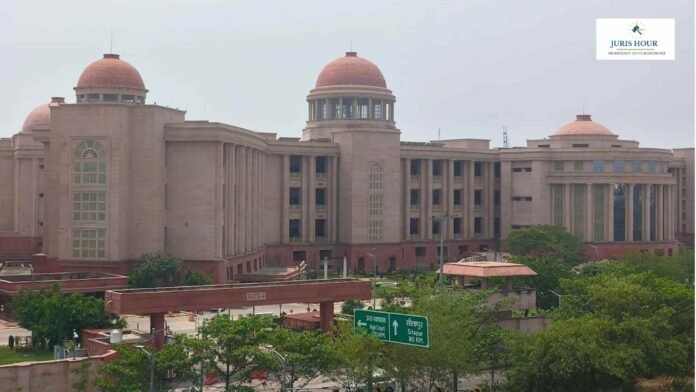
The Allahabad High Court has granted interim protection to a taxpayer by staying coercive recovery proceedings in a case challenging the imposition of penalty under Section 122(1A) of the Central Goods and Services Tax (CGST) Act, 2017, observing that the challenge raises a prima facie issue regarding the retrospective application of a penal provision that came into force only on January 1, 2021.
The bench of Justice Saurabh Lavania has directed that no coercive action shall be taken for recovery of the disputed amount, provided the petitioner furnishes an indemnity bond to the satisfaction of the competent authority within ten days. The matter has been directed to be listed along with Writ Tax No. 935 of 2026 after completion of pleadings.
The dispute pertains to a penalty order dated November 19, 2024, passed by the Additional Commissioner, Central GST, in relation to the Assessment Year 2018–19. The order was subsequently upheld by the Commissioner (Appeals) through an order dated December 18, 2025.
Buy Now: 80+ Income Tax Judgments | E-Magazine July 2026
Before the High Court, the petitioner argued that the penalty had been imposed under Section 122(1A) of the CGST Act, a provision inserted by the Finance Act, 2020 and brought into force only from January 1, 2021. Since the alleged transactions related to FY 2018–19, the petitioner contended that the provision could not be invoked retrospectively to penalise conduct that occurred before its enactment.
The petitioner further asserted that the authority exercising powers under Section 122(1A) was appointed only through a circular issued on October 27, 2025, reinforcing its argument that the impugned proceedings suffered from a jurisdictional defect.
To support its case, the petitioner relied upon the Bombay High Court’s decision in Amit Manilal Haria & Ors. v. Joint Commissioner, CGST & Central Excise, decided on February 25, 2026.
The Allahabad High Court reproduced significant portions of the Bombay High Court’s ruling, wherein it was held that Section 122(1A) cannot be applied retrospectively to periods prior to its enforcement on January 1, 2021.
The Bombay High Court had observed that imposing a penalty under a provision that was not in force when the alleged acts occurred would violate Article 20(1) of the Constitution of India, which prohibits retrospective penal consequences. It further held that a person cannot be subjected to a penalty under a law that was not in existence at the relevant time and consequently declared such proceedings to be without jurisdiction.
Opposing the writ petition, counsel appearing for the revenue argued that the petition was not maintainable because the petitioner had an effective statutory appellate remedy available under the GST law.
The petitioner countered that the writ petition was nevertheless maintainable because the challenge was based on lack of jurisdiction, contending that the authority had exercised powers under a penal provision that did not exist during the relevant assessment period.
After considering the rival submissions, the Allahabad High Court held that the writ petition was prima facie maintainable, noting that the petitioner had raised a jurisdictional challenge warranting examination. The Court entertained the petition and directed the respondents to file a counter affidavit within four weeks, granting the petitioner two additional weeks thereafter to file a rejoinder.
Membership Required to Access Case Details & Order Copy
To view the complete Case Details and Download Order Copy, you must have an active membership. Please subscribe to continue.

