
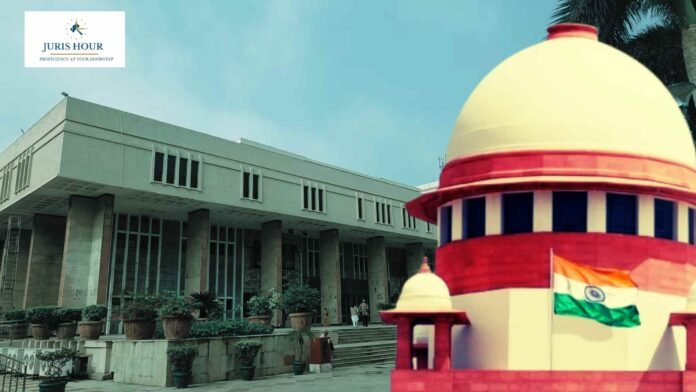
The Supreme Court has refused to interfere with the Delhi High Court’s judgment holding that separate GST proceedings initiated for different financial years and based on distinct allegations are not barred by Section 6(2)(b) of the CGST Act.
The bench of Justice J.B. Pardiwala and Justice K. Vinod Chandran dismissed the Special Leave Petition (SLP) observing that after hearing the petitioner and examining the material on record, it found no good ground to interfere with the impugned judgment of the Delhi High Court. Consequently, the SLP was dismissed, thereby affirming the legal position adopted by the High Court.
The controversy arose after the petitioner, a GST-registered partnership firm engaged in the supply of scientific products, was subjected to two separate GST proceedings.
Buy Now: 130 GST Judgments – E-Magazine July 2026
The first proceeding commenced with a show cause notice dated 22 May 2024 under Section 73 of the State GST Act relating to Financial Year 2019–20. The department alleged incorrect declaration of tax liability and excess availment of Input Tax Credit (ITC), culminating in a confirmed demand of approximately ₹15.72 lakh.
Thereafter, on 27 June 2025, the department issued another show cause notice under Section 74 of the CGST Act concerning Financial Year 2018–19. This proceeding was founded on an altogether different allegation—that the petitioner had fraudulently availed ITC on the strength of goods-less invoices issued by a non-existent supplier, leading to a tax demand of around ₹12.11 lakh.
Challenging the second notice and the consequential proceedings, the petitioner approached the Delhi High Court contending that the subsequent action was barred under Section 6(2)(b) of the CGST Act, which prohibits parallel proceedings on the same subject matter.
The principal issue before the Court was whether the initiation of proceedings under Section 74 for a different financial year, but involving ITC-related allegations, amounted to impermissible parallel proceedings prohibited by Section 6(2)(b).
The petitioner argued that since both proceedings concerned Input Tax Credit, the second proceeding ought to be treated as barred.
The bench rejected the contention and undertook a detailed interpretation of Section 6(2)(b).
The Court held that the statutory prohibition against parallel proceedings is attracted only where the proceedings concern the same subject matter; arise from the same set of facts; and relate to the same assessment period and alleged contravention.
According to the Bench, these essential ingredients were absent in the present case.
The Court observed that the two proceedings related to different financial years—FY 2018–19 and FY 2019–20, involved different factual foundations, and were initiated under different statutory provisions addressing distinct types of violations.
The High Court emphasized that Section 73 and Section 74 operate in different legal spheres.
Proceedings under Section 73 concern tax short payment or wrongful ITC without allegations of fraud or suppression, whereas Section 74 specifically applies where fraud, wilful misstatement or suppression of facts is alleged.
In the present case, the earlier proceedings under Section 73 were based on return discrepancies and excess ITC, while the subsequent proceedings under Section 74 alleged fraudulent availment of ITC through fake invoices issued by a non-existent entity.
The Court held that these were entirely separate contraventions and could not be treated as the “same subject matter” merely because both involved ITC.
The petitioner also argued that the adjudicating authority had failed to grant a proper opportunity of hearing in violation of Section 75(4) of the CGST Act.
Rejecting this argument, the High Court found that the adjudicating authority had duly considered the petitioner’s reply before passing the order. It concluded that there was no breach of the principles of natural justice warranting interference under Article 226 of the Constitution.
The Court further reiterated the settled principle that writ jurisdiction should ordinarily not be invoked where an effective statutory appellate remedy exists.
It noted that the petitioner had the remedy of filing an appeal under Section 107 of the CGST Act. However, to ensure that the petitioner was not prejudiced, the Court directed that the period spent pursuing the writ petition before the High Court would be excluded while computing limitation for filing the statutory appeal.
The petitioner challenged the Delhi High Court’s judgment before the Supreme Court through a Special Leave Petition.
After hearing counsel and examining the record, the Supreme Court succinctly held that no good ground existed to interfere with the impugned judgment passed by the Delhi High Court and dismissed the Special Leave Petition. The Court also disposed of all pending applications.
Although brief, the Supreme Court’s order effectively lends finality to the Delhi High Court’s interpretation of Section 6(2)(b).
Membership Required to Access Case Details & Order Copy
To view the complete Case Details and Download Order Copy, you must have an active membership. Please subscribe to continue.

