
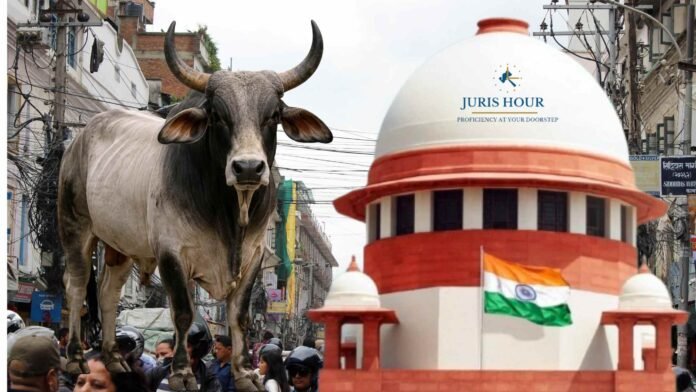
The Supreme Court has restored compensation awarded to the widow of a man who died after being attacked by a stray bull, holding that courts cannot deny substantive justice merely on technical grounds after prolonged litigation.
The bench of Justice Sanjay Karol and Justice Nongmeikapam Kotiswar Singh observed that forcing a claimant to initiate fresh civil proceedings nearly two decades after the incident would render the victim’s family “remediless” and defeat the ends of justice.
The appeal arose from the case of Nisha, widow of Vijay Kumar, who suffered severe head injuries after being attacked by a stray bull while walking on a road in Sangrur, Punjab, on 21 September 2007. The incident was promptly reported to the police, and a Daily Diary Report (DDR) was registered. During his lifetime, Vijay Kumar sought compensation from the authorities, but no relief was granted.
Buy Now: Supreme Court Judgments E-Magazine – 5 Month Combo (2026) (1st February – 30th June 2026)
Following his death, his widow approached the Punjab and Haryana High Court through a writ petition seeking compensation from the Municipal Council and other authorities. The Single Judge awarded ₹29.32 lakh as compensation with 6% annual interest from 1 September 2012, applying principles analogous to compensation under the Motor Vehicles Act.
However, the Division Bench later set aside the award, holding that disputed questions of fact could not be adjudicated in writ proceedings and directing the claimant to approach the civil court instead. Aggrieved by this decision, the widow approached the Supreme Court.
The Supreme Court found that the High Court’s Division Bench had adopted an overly technical approach. It noted that the writ petition had been pending since 2010 and the Division Bench’s decision came only in 2025. Directing the claimant to begin fresh civil litigation after such an extraordinary delay would effectively deprive her of any meaningful remedy.
The Court held that although the reasoning regarding maintainability might appear attractive at first glance, the realities of the case demanded a different approach. Since nearly two decades had passed since the incident, the interests of justice required adjudication on merits instead of relegating the claimant to another round of litigation.
The Supreme Court observed that the factual foundation of the claim was largely undisputed. The deceased had submitted a compensation application to the Deputy Commissioner in March 2010 claiming ₹1 crore. The authorities did not reject the claim because the incident had not occurred; instead, they stated that no funds were available for payment of compensation.
The Court also noted that an FIR had been lodged, legal notices had been issued, and the occurrence of the incident was never denied by the authorities. In these circumstances, the Court held that the matter did not involve such disputed facts as to justify dismissal of the writ petition.
Moving beyond the individual dispute, the Supreme Court expressed serious concern over the growing menace of stray cattle and bovine-related accidents across India. The Bench remarked that such incidents are no longer isolated events but have become commonplace, frequently resulting in injuries and fatalities involving both pedestrians and motorists.
The Court observed that stray animals cannot become “natural speed breakers” on roads and highways and stressed that governments must evolve effective mechanisms to prevent animals from roaming freely on public roads. It also questioned how families of victims and owners of animals killed in such incidents are presently compensated.
The judgment extensively discussed the constitutional framework governing animal welfare. Referring to Article 48, the Court noted that the State has a constitutional obligation to organise agriculture and animal husbandry while protecting cattle. Simultaneously, Article 51A(g) imposes a fundamental duty upon every citizen to show compassion for all living beings.
The Bench emphasised that protecting animals does not conflict with protecting human life. Rather, effective management of stray cattle is essential for safeguarding both animal welfare and public safety.
The Supreme Court observed that owners should ensure their cattle return to designated shelters, while abandoned or stray animals should be housed in adequately staffed and funded shelters. It referred to the Animal Birth Control Rules, 2023, which define animal shelters as facilities for abandoned and stray animals requiring treatment, rehabilitation or adoption.
The Court stressed that properly functioning shelters, regular patrolling, identification of cattle owners, and effective impounding mechanisms are essential to prevent avoidable accidents involving stray animals.
The Supreme Court examined legislation across numerous States and Union Territories governing cattle preservation, gaushalas, cattle shelters, municipal responsibilities and impounding procedures. The judgment reviewed statutory frameworks in Punjab, Haryana, Delhi, Karnataka, Maharashtra, Rajasthan, Uttar Pradesh, Himachal Pradesh, Uttarakhand, Assam and several other States.
The Court observed that while legislative mechanisms exist across much of the country, their implementation remains inadequate, resulting in increasing incidents involving stray cattle on public roads. The judgment also highlighted the continuing relevance of the Cattle Trespass Act, 1871, alongside modern State enactments dealing with cattle welfare and management.
Allowing the appeal, the Supreme Court set aside the Division Bench’s judgment and restored the relief granted to the claimant. The Court held that technical objections regarding maintainability cannot override substantive justice where prolonged litigation has already consumed years and the material facts are substantially undisputed.
Membership Required to Access Case Details & Order Copy
To view the complete Case Details and Download Order Copy, you must have an active membership. Please subscribe to continue.

