
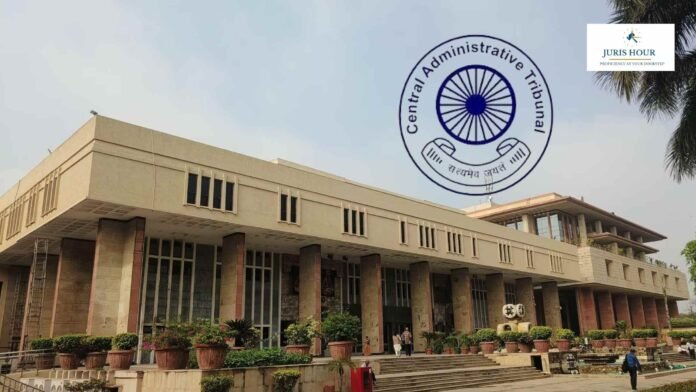
The Central Administrative Tribunal (CAT), Principal Bench, New Delhi, has delivered a significant judgment quashing a disciplinary charge sheet issued against an Indian Revenue Service (IRS) officer, Manmeet Singh Ahluwalia holding that personal neighbourhood disputes and alleged misconduct by family members cannot ordinarily be converted into disciplinary misconduct under the Central Civil Services (Conduct) Rules, 1964.
The Tribunal also found the disciplinary proceedings to be tainted by arbitrariness, unexplained delay and apparent mala fides, while imposing costs of ₹50,000 on the Central Board of Indirect Taxes and Customs (CBIC).
Subsequently, when the Union of India challenged the matter before the Delhi High Court, the Court expressed displeasure over repeated adjournments sought by the respondents and imposed an additional cost of ₹25,000, permitting the Department to recover the amount from the officer responsible for the delay.
Buy Now: Service Tax Judgement E-Compilation : June 2026
The applicant, an IRS (Customs & GST) officer of the 2012 batch, had served in several prestigious assignments, including the National Committee on Trade Facilitation (NCTF) Secretariat and the Directorate General of Export Promotion. He had also represented India before multiple international forums, including the World Customs Organization (WCO), European Union, Asian Development Bank, and customs administrations of several countries, besides playing an important role in drafting India’s National Trade Facilitation Action Plan in line with the WTO Trade Facilitation Agreement.
While serving as Deputy Commissioner in CBIC and residing in government accommodation at Vatika Apartments, New Delhi, disputes allegedly arose between his family and neighbouring residents beginning in 2019. Several complaints were lodged alleging abusive behaviour, threats and physical altercations. The complaints eventually led to registration of criminal cases, constitution of an internal inquiry committee and later disciplinary proceedings by CBIC.
Parallel complaints were also received from the CGST Audit Commissionerate, Jodhpur alleging unauthorised absence, indiscipline and rude behaviour with taxpayers, leading to his suspension in May 2021. Although the suspension was revoked in August 2022, CBIC issued a charge memorandum dated 18 August 2022 alleging misconduct relating to residential disputes and unauthorised absence.
The officer approached the Tribunal contending that the disciplinary proceedings were the culmination of a sustained campaign by certain senior officers who allegedly acted with personal bias and in close coordination with neighbouring residents.
He argued that the complaints were retaliatory in nature, that important defence documents and recorded statements were withheld, that requests for change of inquiry officer and video recording of proceedings were rejected, and that the disciplinary action had ignored material evidence favourable to him. He further submitted that much of the alleged unauthorised absence occurred during the COVID-19 pandemic when lockdowns, medical emergencies and work-from-home arrangements prevailed.
The Tribunal framed several important legal issues, including whether personal neighbourhood disputes involving family members could amount to misconduct under Rule 3(1) of the CCS (Conduct) Rules, whether disciplinary proceedings were vitiated by mala fides, whether delay and denial of relied-upon documents violated principles of natural justice, and whether the Tribunal could interfere with a charge sheet at the pre-enquiry stage.
While acknowledging the settled principle that courts ordinarily do not interfere with charge sheets at the threshold, the Bench observed that judicial interference remains permissible where disciplinary powers are exercised for collateral purposes or where the proceedings are tainted by mala fides, arbitrariness or abuse of power. Relying upon several Supreme Court precedents, including Union of India v. Kunisetty Satyanarayana, Union of India v. Upendra Singh, Secretary, Ministry of Defence v. Prabhash Chandra Mirdha and State of Punjab v. V.K. Khanna, the Tribunal held that exceptional cases warrant judicial intervention even before completion of disciplinary proceedings.
One of the Tribunal’s most significant findings related to the first article of charge, which was founded upon quarrels occurring within the residential government colony.
The Bench observed that the allegations substantially related to neighbourhood or domestic disputes and much of the alleged behaviour had been attributed to family members rather than the officer himself. It held that such disputes arising in a private sphere do not automatically constitute misconduct under Rule 3 unless they cross the threshold of moral turpitude, misuse of official authority or conduct directly affecting public service.
The Tribunal emphasised that government servants do not surrender their civil rights merely because they occupy official accommodation, and converting ordinary domestic disagreements into service misconduct would amount to impermissible moral policing beyond the scope of the Conduct Rules.
The Tribunal was equally critical of the second article of charge alleging unauthorised absence.
It noted that the periods relied upon by the Department substantially fell during the extraordinary COVID-19 pandemic, when the Supreme Court itself had taken judicial notice of unprecedented disruption and repeatedly extended periods of limitation for judicial proceedings.
The Tribunal observed that absence during lockdowns, medical emergencies and pandemic restrictions cannot automatically be characterised as misconduct. It found that the Department itself had not taken any decision on the officer’s leave applications while simultaneously initiating disciplinary proceedings years later.
According to the Bench, initiation of proceedings in August 2022 regarding alleged absences occurring during 2020 and early 2021 reflected unexplained and inordinate delay that undermined fairness and violated principles of natural justice.
Although recognising that allegations of mala fides are difficult to conclusively establish at the threshold, the Tribunal held that surrounding circumstances disclosed sufficient prima facie material warranting judicial scrutiny.
Among the factors noted were: initiation of proceedings immediately after complaints arising from residential disputes; prolonged suspension without timely verification; revival of stale allegations after considerable delay; refusal to consider the officer’s explanations and defence material; and earlier judicial observations by the District Court regarding personal vendetta in connected proceedings.
The Tribunal observed that where surrounding facts indicate disciplinary machinery is being used punitively rather than for bona fide administrative regulation, judicial intervention becomes necessary to prevent abuse of power.
The Bench further held that the statement of imputations accompanying the charge memorandum ran into dozens of paragraphs and extensively narrated background events rather than clearly specifying the precise acts constituting misconduct.
Referring to Supreme Court jurisprudence on disciplinary proceedings, the Tribunal reiterated that charges must be definite, specific and capable of fair adjudication. Vague allegations and broad narratives cannot substitute properly framed articles of charge.
Concluding that the disciplinary proceedings reflected administrative victimisation rather than bona fide disciplinary regulation, the Tribunal quashed the charge memorandum dated 18 August 2022.
The Bench strongly criticised the role of the competent authority, observing that effective administrative supervision had failed and that the charge sheet appeared to have been issued without proper application of mind. It imposed costs of ₹50,000 on Respondent No. 2 (CBIC) payable to the Prime Minister’s Relief Fund within four weeks, remarking that such costs were necessary for permitting, facilitating and sustaining harassment inflicted upon the applicant.
The litigation did not conclude with the Tribunal’s decision.
In the connected writ proceedings before the Delhi High Court, the matter came up repeatedly over approximately one and a half months. The Division Bench comprising Justice Anil Kshetrapal and Justice Amit Mahajan noted that on every hearing the respondents sought adjournments.
Finding no justification for repeated delays, the High Court granted a final opportunity subject to payment of ₹25,000 as costs to the petitioner. The Court also granted liberty to the Department to recover the amount from the officer responsible for causing the delay and listed the matter for further hearing on 25 March 2026.
The CAT’s judgment is an important precedent on the limits of disciplinary jurisdiction over civil servants. It reinforces that private family or neighbourhood disputes cannot ordinarily be converted into official misconduct unless they directly affect public service or involve misuse of official position; disciplinary authorities must act promptly and fairly rather than revive stale allegations after unexplained delays; absence during the exceptional COVID-19 period requires careful factual examination before being branded as misconduct; vague and omnibus charge sheets violate principles governing departmental proceedings; and courts and tribunals may intervene at the charge-sheet stage where disciplinary proceedings appear to be driven by mala fides, arbitrariness or abuse of administrative power.
Membership Required to Access Case Details & Order Copy
To view the complete Case Details and Download Order Copy, you must have an active membership. Please subscribe to continue.

