
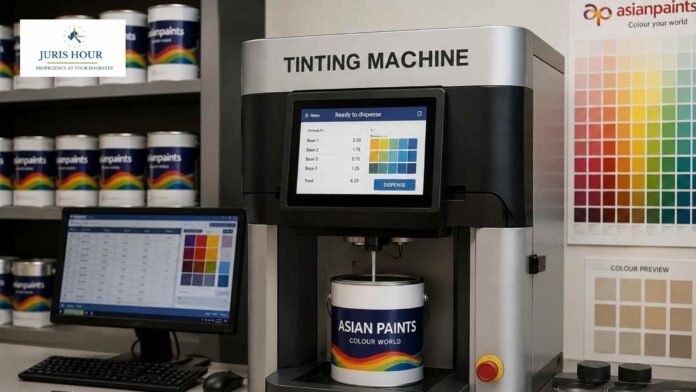
The Mumbai Bench of the Customs, Excise and Service Tax Appellate Tribunal (CESTAT) has held that the leasing of tinting machines by a paint manufacturer to its dealers constitutes a “deemed sale” involving transfer of the right to use goods and is therefore not liable to service tax under the Finance Act, 1994.
Setting aside the order of the Commissioner (Appeals), the bench of M.M. Parthiban (Technical Member) allowed the appeal filed by Asian Paints Limited and quashed the service tax demand, interest, and penalties for the post-negative list period.
The dispute arose from an EA-2000 audit conducted by the Service Tax Department during April and May 2008. During the audit, the department observed that Asian Paints was collecting lease rental charges from its dealers and distributors for providing computerized tinting machines used for mixing base paints with colourants according to customers’ requirements.
Buy Now: Service Tax Judgement E-Compilation : June 2026
The department viewed the arrangement as a taxable service. For the period before 1 July 2012, it treated the activity as “leasing services including equipment leasing” falling under the category of Banking and Other Financial Services. After the introduction of the negative list regime, the department classified the transaction as a declared service involving the transfer of goods by way of hiring or leasing without transfer of the right to use, making it liable to service tax under Section 66E of the Finance Act, 1994. Accordingly, multiple show cause notices were issued covering the period from April 2005 to March 2015.
The adjudicating authority confirmed the entire demand along with interest and penalties. On appeal, the Commissioner (Appeals) dropped the demand for the period prior to 1 July 2012 but sustained the demand for the post-negative list period from 1 July 2012 to 31 March 2015. Aggrieved by this decision, Asian Paints approached the CESTAT.
Asian Paints argued that the lease agreements executed with its dealers satisfied all the legal requirements laid down by the Supreme Court in Bharat Sanchar Nigam Ltd. v. Union of India (BSNL) for determining whether a transaction amounts to a transfer of the right to use goods.
The company submitted that the tinting machines were specifically identified, physically delivered to dealers, remained under the dealers’ exclusive possession and control during the lease period, and could not simultaneously be transferred to any other person. It also pointed out that VAT had been paid on the lease rentals, recognizing the transactions as deemed sales under the State VAT laws. The company further contended that there was no suppression of facts since all relevant details had been disclosed in statutory records and returns.
The principal question before the Tribunal was whether leasing tinting machines to dealers amounted to a taxable service under the category of Supply of Tangible Goods for Use (STGU) or declared service under Section 66E of the Finance Act, 1994; or a deemed sale involving transfer of the right to use goods, which falls outside the service tax net and is instead liable to VAT.
The court examined the detailed lease agreement entered into between Asian Paints and its dealers. The Tribunal noted that the agreement identified the leased equipment, required delivery to the dealer, granted exclusive possession and operational control during the lease period, restricted relocation without consent, required return of the equipment upon expiry of the lease, and provided that the equipment could not simultaneously be leased to another party.
The Tribunal held that these contractual terms satisfied all five tests laid down by the Supreme Court in BSNL for determining whether there has been a transfer of the right to use goods.
The Tribunal also relied upon the Tax Research Unit (TRU) clarification issued while introducing the levy on Supply of Tangible Goods for Use in 2008. The clarification explains that service tax is attracted only where possession and effective control remain with the supplier. Conversely, where both possession and effective control are transferred, the transaction becomes a deemed sale liable to VAT rather than service tax.
Further reliance was placed on CBIC Circular No. 198/08/2016-ST dated 17 August 2016, which reiterates that authorities must examine lease agreements against the five-fold BSNL test before concluding that service tax is payable. The Tribunal observed that the circular itself recognizes that transfer of the right to use goods constitutes a deemed sale outside the ambit of service tax.
An important factor considered by the Tribunal was that Asian Paints had consistently discharged VAT on the lease rentals. The Tribunal noted that invoices issued for lease rentals reflected payment of VAT at the applicable rate and that the transactions had been assessed by State VAT authorities.
This, coupled with the contractual transfer of possession and control, reinforced the conclusion that the arrangement constituted a deemed sale rather than a taxable service.
The Tribunal also referred to its earlier decision in Arval India Pvt. Ltd. v. Principal Commissioner of Service Tax, where lease rentals under a similar operating lease arrangement had been held to constitute deemed sales not liable to service tax.
The Bench observed that once the entire lease rental is taxable as a deemed sale under the constitutional framework, no part of that consideration can simultaneously be subjected to service tax under the Finance Act, 1994.
The Tribunal concluded that the lease agreements clearly transferred the right to use the tinting machines to dealers and satisfied all five criteria prescribed by the Supreme Court in BSNL. Consequently, the transactions qualified as deemed sales under Article 366(29A)(d) of the Constitution of India.
The Tribunal held that the service tax demand confirmed by the Commissioner (Appeals) lacked legal basis and could not be sustained. Since the demand itself failed on merits, the associated interest and penalties also automatically became unsustainable.
The Mumbai Bench of the CESTAT set aside the impugned appellate order dated 13 July 2022 to the extent it confirmed the service tax demand for the post-negative list period. The Tribunal held that the leasing of tinting machines amounted to a deemed sale involving transfer of the right to use goods and therefore fell outside the scope of service tax under the Finance Act, 1994.
Membership Required to Access Case Details & Order Copy
To view the complete Case Details and Download Order Copy, you must have an active membership. Please subscribe to continue.
Read More: Dept. Can’t Deny Refund for Missing Challan in Its Own Records: CESTAT

