
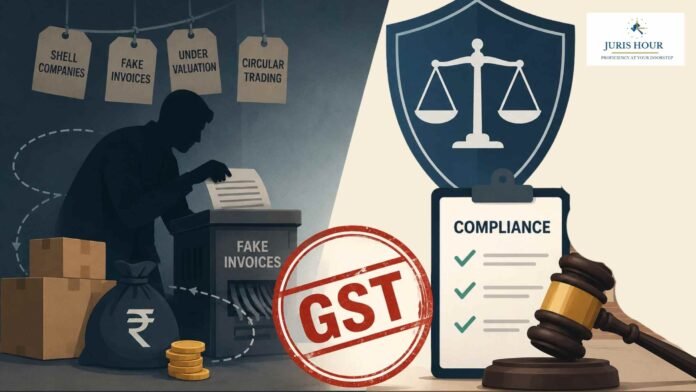
The Goods and Services Tax (GST), introduced on July 1, 2017, was envisioned as India’s most significant indirect tax reform, replacing multiple central and state taxes with a unified tax regime. While GST has substantially improved tax compliance through digitization, e-invoicing, e-way bills, and return matching, tax evasion remains one of the biggest challenges before the tax administration.
Industry experts estimate that GST evasion has evolved from traditional cash-based tax suppression into sophisticated technology-driven frauds involving shell companies, fake invoices, circular trading, undervaluation, and misuse of Input Tax Credit (ITC). Enforcement agencies, particularly the Directorate General of GST Intelligence (DGGI), have detected thousands of such cases running into tens of thousands of crores over the past few years.
This report examines how GST evasion is carried out, why certain loopholes continue to exist, and how businesses attempt to manipulate the law while remaining ostensibly compliant.
GST Works on Trust
GST is fundamentally a self-assessment tax system.
Businesses calculate their own tax liability, claim eligible ITC, and file returns without prior approval from tax authorities. The Government verifies compliance later using technology and risk-based audits.
This trust-based model reduces compliance costs but simultaneously creates opportunities for fraud where taxpayers intentionally exploit weaknesses in documentation and transaction verification.
Unlike the earlier VAT or Excise regime where physical inspections were more common, GST relies heavily on electronic records, making documentation the centrepiece of compliance.
Fake Invoice Rackets: The Biggest GST Fraud
The most common method of GST evasion today is the issuance of fake invoices without any actual supply of goods or services.
How it works
A fake company obtains GST registration.
Instead of conducting genuine business, it merely issues invoices showing sales worth several crores.
The purchasing company claims Input Tax Credit based on these invoices.
Although no goods ever move, the recipient reduces its GST liability using fraudulent ITC.
The fake supplier often disappears before paying the tax collected.
This allows the beneficiary to unlawfully reduce tax payable while the Government loses revenue.
Such rackets typically involve multiple shell companies, dummy directors, forged identity documents, and fabricated bank transactions.
BUY NOW: E-Magazine: Top 100 GST ITC Judgements (2024–25)
Circular Trading
Circular trading is among the most sophisticated GST frauds.
Unlike fake invoicing between two companies, circular trading involves an entire network of entities repeatedly buying and selling the same goods on paper.
For example,
Company A invoices Company B.
Company B invoices Company C.
Company C invoices Company D.
Company D invoices Company A.
The cycle continues repeatedly.
The goods either never move or move only once while invoices continue circulating.
Every participant claims Input Tax Credit, inflates turnover, or becomes eligible for refunds without corresponding economic activity. Authorities increasingly use graph analytics and transaction-network analysis to detect these schemes.
Shell Companies
Many GST frauds depend upon shell entities.
These companies exist only on paper.
Often,
- no office exists,
- no employees exist,
- no manufacturing facility exists,
- no inventory exists.
Yet these firms report turnovers worth hundreds of crores.
Dummy directors, daily wage workers, or persons unaware of the registration are frequently shown as promoters.
Once fake invoices are issued, the company disappears or becomes non-functional before investigation begins.
Under-Valuation of Goods
Another common practice involves deliberately undervaluing taxable supplies.
For instance,
Goods actually sold for ₹10 lakh may be invoiced for ₹7 lakh.
The remaining amount may be collected in cash or through undisclosed channels.
Consequently,
- GST is paid only on the reduced invoice value,
- income tax liability also decreases,
- accounting books show artificially lower turnover.
Such practices are more difficult to detect in industries where market prices fluctuate significantly.
Suppression of Sales
Cash-intensive sectors remain particularly vulnerable.
Restaurants,
retail traders,
construction,
real estate,
jewellery,
small manufacturers,
and certain service providers sometimes fail to report all sales.
Customers paying cash often receive no invoice.
The sale remains outside GST returns.
Recent data-driven investigations have also shown instances where businesses allegedly deleted recorded sales from billing software before filing returns, creating a mismatch between operational data and tax declarations.
Wrong Classification of Goods
GST rates differ significantly across products.
Businesses sometimes intentionally classify products under lower-tax categories.
Examples include
- luxury goods classified as essential goods,
- branded products shown as unbranded,
- processed food declared as agricultural produce.
Classification disputes frequently become major litigation before High Courts and the Supreme Court.
Splitting Business to Escape Compliance
Certain businesses split operations among multiple firms.
Instead of operating through one entity,
they create
- separate proprietorships,
- family-owned firms,
- partnership entities.
Each remains below statutory thresholds or avoids mandatory compliance obligations that would otherwise apply to a larger consolidated business.
Where the arrangement is artificial and lacks commercial substance, authorities may invoke anti-evasion provisions.
Misuse of Export Benefits
Exports are generally zero-rated under GST.
Exporters can claim refunds of accumulated ITC.
Some fraudulent operators exploit this mechanism by:
- creating fake exports,
- inflating export values,
- generating fake purchase invoices,
- claiming refunds without corresponding genuine business activity.
Because refunds involve direct payments from the Government, these cases receive high enforcement priority.
Bogus Job Work Transactions
Some manufacturers misuse GST provisions relating to job work.
Goods are shown as sent to job workers but are actually sold elsewhere without payment of tax.
Since GST permits movement of goods for job work subject to conditions, false documentation may be used to conceal taxable supplies.
Misuse of Exemptions
GST law grants exemptions to specific sectors.
Businesses sometimes manipulate documentation to portray taxable supplies as exempt supplies.
Examples include
- claiming educational exemption for commercial training,
- treating taxable healthcare services as exempt,
- misusing charitable exemptions.
Many disputes arise over whether the exemption genuinely applies to the nature of the supply.
Bogus Input Tax Credit Chains
One of the most sophisticated fraud models involves long ITC chains.
Instead of one fake supplier,
fraudsters create
- multiple wholesalers,
- distributors,
- traders,
- transport entities.
Each appears legitimate.
Eventually,
a genuine manufacturer purchases from the final entity and claims ITC.
Tracing the fraud requires analysing the entire supply chain rather than only the immediate supplier.
Playing Within the Law—or Against Its Spirit?
Many tax avoidance arrangements rely not on outright fabrication but on exploiting ambiguities in the law. Businesses may structure transactions to technically comply with statutory wording while defeating the underlying purpose of GST. This distinction is important:
- Tax planning involves arranging affairs within the law to minimise tax.
- Tax evasion involves concealment, false statements, fabricated transactions, or deliberate non-compliance.
- Aggressive tax avoidance lies in a grey area where legal form may not reflect commercial reality, inviting scrutiny under anti-abuse principles.
Courts increasingly look beyond documentation to examine whether there was a genuine supply, real movement of goods, actual consideration, and commercial substance.
How the Government Detects GST Evasion
The Government now employs advanced digital surveillance tools to identify suspicious patterns.
Authorities analyse:
- GSTR-1, GSTR-3B, and GSTR-2B return mismatches,
- e-way bill data,
- e-invoices,
- income-tax filings,
- banking transactions,
- customs records,
- transport documentation,
- electricity consumption,
- geolocation and business registration details.
Artificial intelligence, network analytics, and forensic accounting techniques are increasingly used to identify fake invoice networks and circular trading patterns that are difficult to detect through manual audits.
Legal Consequences
The CGST Act provides a comprehensive enforcement framework.
Authorities may:
- recover unpaid tax,
- deny wrongly availed ITC,
- levy interest,
- impose monetary penalties,
- provisionally attach property,
- arrest persons in serious cases,
- prosecute offenders for specified offences involving fraudulent ITC, fake invoices, or tax evasion.
The precise consequences depend on the nature, value, and intent behind the violation, and enforcement actions are subject to judicial review.
The Way Forward
GST compliance is steadily becoming more technology-driven. The expansion of e-invoicing, real-time data sharing, AI-assisted risk profiling, and tighter integration between GST, customs, and income-tax databases has narrowed many of the avenues once used for evasion. Yet fraudsters continue to adapt, often using complex corporate structures, digital records, and intermediary entities to disguise illegitimate transactions.
For legitimate businesses, the challenge is no longer limited to maintaining their own compliance. They must also conduct due diligence on suppliers, verify the authenticity of invoices, and ensure that transactions have genuine commercial substance. A failure to do so can expose even bona fide taxpayers to disputes over Input Tax Credit.
As the GST ecosystem matures, enforcement is likely to rely less on routine inspections and more on data analytics, forensic accounting, and coordinated investigations. The long-term success of the GST regime will depend on balancing robust enforcement against deliberate fraud while avoiding unnecessary hardship for compliant businesses that make genuine errors.

