
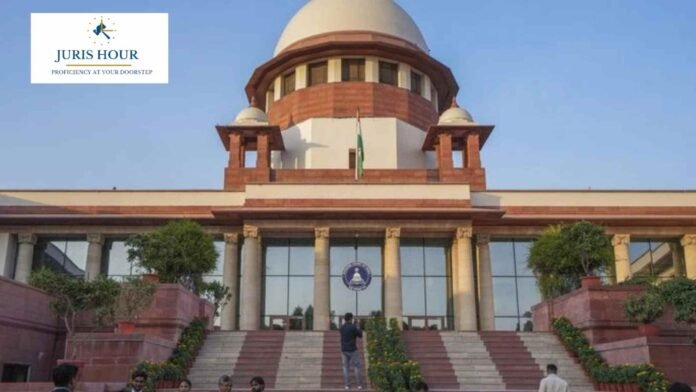
The Supreme Court has declined to decide, at this stage, the contentious issue of whether Goods and Services Tax (GST) is leviable on affiliation fees collected by universities.
Instead, the bench of Justice J.B. Pardiwala and Justice K. Vinod Chandran has closed the Special Leave Petitions (SLPs) filed by Bharathidasan University while granting liberty to challenge the issue again after the Madras High Court disposes of the remaining issues pending before a Single Judge.
The case arose from GST show cause notices issued under Section 74(5) of the Tamil Nadu Goods and Services Tax Act, 2017. The tax authorities sought to recover GST, along with interest and penalties, on affiliation fees collected by Bharathidasan University from its affiliated colleges for the financial years 2019-20 to 2022-23.
Buy Now: GST Judgements E-Compilation – June 2026
The University argued that affiliation fees are exempt from GST under Notification No. 12/2017-Central Tax (Rate), contending that such fees are statutory and regulatory in nature and do not constitute a commercial “supply” or “consideration” under the GST law.
The controversy gained complexity after two Single Benches of the Madras High Court expressed conflicting views on the taxability of university affiliation fees. Owing to the conflicting judicial opinions, the matter was referred to a Division Bench.
The Division Bench ultimately held that the activity of granting affiliation is an independent statutory function and does not fall within the limited exemption available for services relating to admissions or conduct of examinations by educational institutions. However, after answering the legal reference, the Division Bench remanded the matter to the Single Judge to adjudicate the remaining issues in the writ petitions.
Appearing for Bharathidasan University, Senior Advocate S. Nagamuthu argued that divergent judicial opinions exist across various High Courts on the taxability of affiliation fees.
The University also relied upon a Karnataka High Court judgment which had granted exemption to affiliation fees. It was pointed out that the Supreme Court had earlier dismissed the Revenue’s Special Leave Petition against that Karnataka decision, suggesting that the issue deserves authoritative determination because universities across the country are facing substantial GST demands.
The Supreme Court, however, observed that the dismissal of the earlier SLP against the Karnataka High Court judgment did not amount to affirmation of that decision on merits. Referring to the landmark ruling in Kunhayammed v. State of Kerala, the Bench reiterated that dismissal of an SLP without a reasoned judgment does not result in merger of the High Court judgment with the Supreme Court’s order.
Since the Madras High Court had already remanded the matter to the Single Judge for consideration of the remaining issues, the Supreme Court held that it would be appropriate for those proceedings to conclude first.
Accordingly, the Court closed the Special Leave Petitions while granting the University liberty to challenge any adverse order, along with the Division Bench’s reference decision, before the Supreme Court at a later stage.
The Bench observed that if, in the meantime, the Supreme Court delivers a judgment in another case holding that affiliation fees are exempt from GST, Bharathidasan University would be entitled to place that judgment before the Single Judge.
The Court specifically noted that such a Supreme Court decision would override the Division Bench’s view and could be relied upon while deciding the pending writ petitions.
Membership Required to Access Case Details & Order Copy
To view the complete Case Details and Download Order Copy, you must have an active membership. Please subscribe to continue.

