
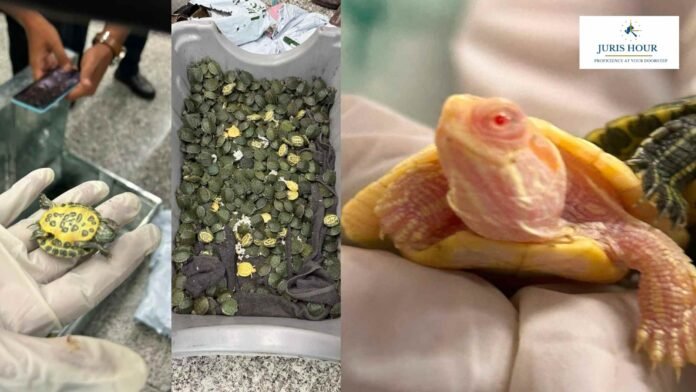
In a major crackdown on illegal wildlife trafficking, the Air Intelligence Unit (AIU) of Kolkata Customs has seized 707 live Red-eared Slider turtles (Trachemys scripta elegans) from the checked-in baggage of an international passenger at Netaji Subhas Chandra Bose International (NSCBI) Airport.
The seizure, made on July 22, 2026, is among the largest interceptions of invasive exotic reptiles at the airport in recent times and has triggered a detailed investigation into a possible international wildlife smuggling network.
According to Customs authorities, the turtles were concealed inside the passenger’s checked-in baggage without any valid import licence or statutory permissions. The passenger was intercepted after crossing the Green Channel, following which officers carried out a detailed examination of the baggage and discovered the live reptiles.
Seizure Made Under Multiple Wildlife Laws
The Customs department stated that all 707 live Red-eared Slider turtles have been seized under the provisions of the Customs Act, 1962, the Wild Life (Protection) Act, 1972, and the Convention on International Trade in Endangered Species of Wild Fauna and Flora (CITES). Officials confirmed that further investigation is underway to ascertain the origin, intended destination, and the individuals or syndicates involved in the illegal import.
Authorities are examining whether the consignment was part of an organised international wildlife trafficking network, as Thailand has emerged as a significant transit point in several recent cases involving the smuggling of exotic wildlife into India.
Why Red-Eared Sliders Are a Concern
The Red-eared Slider (Trachemys scripta elegans) is a semi-aquatic freshwater turtle native to the southern United States and northern Mexico. Although commonly sold in the international pet trade, it is recognised globally as one of the world’s most invasive alien species due to its ability to establish breeding populations outside its native range.
These turtles compete aggressively with native turtle species for food, basking sites, and nesting areas. Their introduction into natural ecosystems can significantly disrupt local biodiversity, prompting many countries to regulate or prohibit their import and trade.
Growing Trend of Exotic Wildlife Smuggling
The latest seizure highlights a continuing pattern of attempts to smuggle exotic animals into India through international airports. Customs authorities have intercepted several consignments of exotic reptiles, birds, mammals, and other wildlife over the past two years, particularly on flights originating from Southeast Asian countries.
Previous interceptions at Indian airports have also involved thousands of Red-eared Slider turtles concealed in passenger baggage, underscoring the lucrative nature of the illegal exotic pet trade and the challenges faced by enforcement agencies.
Investigation Continues
Customs officials have reiterated their zero-tolerance approach towards wildlife trafficking and stated that efforts are underway to identify the complete supply chain behind the attempted smuggling. Investigators are expected to examine the passenger’s travel history, possible accomplices, and links with international trafficking syndicates.
The seizure once again underscores the critical role played by airport Customs authorities in preventing illegal cross-border movement of protected and invasive wildlife species, while reinforcing India’s commitment to enforcing domestic wildlife laws and its obligations under CITES.

