
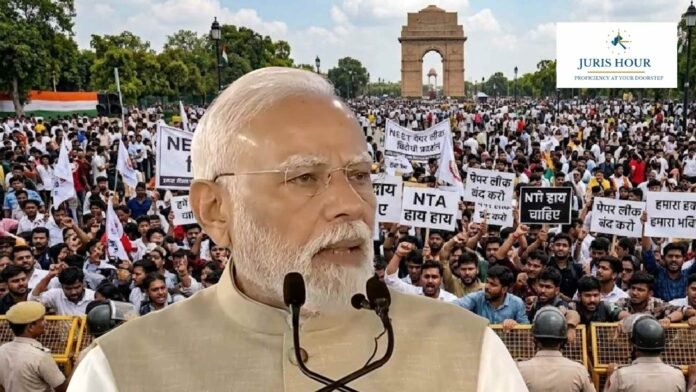
Prime Minister Narendra Modi on Thursday announced that the Union Government will establish fast-track courts to ensure the speedy trial of criminal cases involving examination paper leaks, as protests over the alleged NEET-UG 2026 paper leak continue across the country.
The move is aimed at ensuring swift punishment for those involved in compromising the integrity of public examinations and restoring confidence in the examination system.
The announcement comes at a time when students, youth organisations, and opposition parties have intensified their demands for accountability following allegations that the NEET-UG 2026 question paper was leaked before the examination. Demonstrations have taken place in several parts of the country, with protesters calling for strict action against those responsible and reforms to prevent future examination malpractices.
Buy Now: Service Tax Judgement E-Compilation : June 2026
Government Pledges Swift Justice
In a post on social media platform X, Prime Minister Modi described the future of the country’s youth as the government’s foremost priority and asserted that those involved in examination paper leak rackets would face stringent legal consequences.
Emphasising the seriousness of the issue, the Prime Minister said that nothing was more important than safeguarding the future of students and assured that the government remained committed to ensuring strict punishment for those who undermine the fairness of public examinations. He further stated that dedicated fast-track courts would help ensure that such cases are decided expeditiously.
The Prime Minister also reiterated the Centre’s commitment to making the country’s examination system more secure, transparent, and resistant to organised malpractice.
Fast-Track Courts to Deal with Paper Leak Cases
The proposed fast-track courts are expected to exclusively handle criminal proceedings arising from examination paper leaks and related offences. By providing an expedited judicial mechanism, the government intends to reduce delays in prosecution and ensure timely convictions where offences are established.
The initiative forms part of the Centre’s broader strategy to adopt a zero-tolerance approach towards examination-related fraud and organised paper leak syndicates. It is also expected to work alongside ongoing investigations into recent examination leak incidents.
Government officials have indicated that the establishment of dedicated courts is intended not only to punish offenders swiftly but also to serve as a deterrent against future attempts to compromise competitive examinations.
NEET-UG 2026 Controversy Triggers Nationwide Protests
The announcement follows widespread public outrage over allegations surrounding the NEET-UG 2026 examination. Students across the country have questioned the credibility of the examination process, alleging that the question paper was leaked before the test.
The controversy has sparked demonstrations demanding greater transparency in the conduct of national-level competitive examinations, stricter accountability of officials, and stronger mechanisms to prevent paper leaks.
Opposition parties have also criticised the government’s handling of the issue and sought comprehensive reforms to restore public confidence in the examination system.
Chalo Sansad March and Police Action
Public anger intensified after the ‘Chalo Sansad’ march organised on July 20 by thousands of students and youth activists. The protesters marched from Jantar Mantar towards Parliament to demand action over the alleged paper leak.
The march was stopped by Delhi Police, leading to clashes between protesters and security personnel. Police used tear gas and carried out a lathi-charge to disperse the crowd after demonstrators attempted to move towards Parliament.
The police action generated widespread criticism, with several political leaders, lawyers, and civil society groups alleging excessive use of force against peaceful demonstrators.
Judicial Inquiry Sought into Police Crackdown
The controversy over the police action has also reached the legal fraternity. Supreme Court Bar Association President and Senior Advocate Vikas Singh has written to Prime Minister Narendra Modi and Union Home Minister Amit Shah seeking the constitution of a judicial inquiry into the alleged police excesses during the protest.
In his representation, Singh contended that the crackdown on peaceful demonstrators violated the constitutional guarantees under Articles 14, 19, and 21, which protect equality before law, freedom of speech and peaceful assembly, and the right to life and personal liberty.
Calls for an independent investigation into the police response continue even as the government focuses on strengthening the legal framework to tackle examination fraud.
Strengthening the Integrity of Public Examinations
The Prime Minister’s latest announcement builds upon earlier assurances that the government would not spare those responsible for examination paper leaks. The Centre has consistently maintained that organised examination fraud undermines merit, erodes public trust, and jeopardises the future of millions of students.
With the proposed establishment of fast-track courts, the government aims to ensure that offenders are prosecuted without undue delay while reinforcing the credibility and transparency of India‘s public examination system.

