
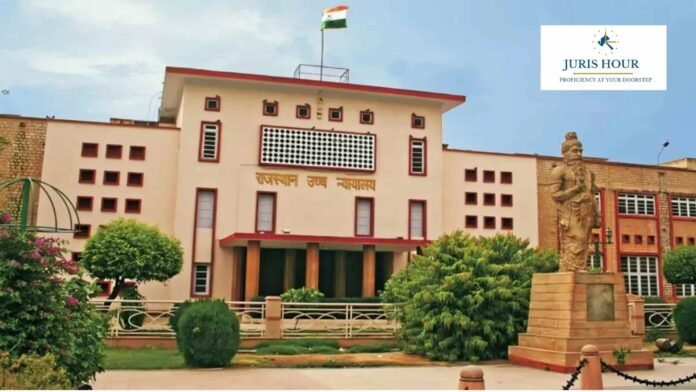
The Rajasthan High Court has set aside a GST demand of ₹2.15 lakh against a registered trader after holding that the tax department failed to issue the mandatory notice in Form GST ASMT-10 before initiating adjudication proceedings.
The bench of Justice Arun Monga and Justice Maneesh Sharma has observed that compliance with Section 61 of the Rajasthan GST Act, 2017 read with Rule 99 of the Rajasthan GST Rules is a statutory prerequisite, and failure to follow this procedure vitiates the entire proceedings.
The petitioner, a sole proprietorship engaged in the business of trading edible oil and registered under the Rajasthan GST Act, challenged an adjudication order dated 22 February 2025, through which the department confirmed a GST demand of ₹2,15,468 on allegations of excess or incorrect availment of input tax credit (ITC) and non-payment of tax liability. The demand comprised GST of ₹1,02,878, interest of ₹92,590, and penalty of ₹20,000.
Buy Now: GST Judgements E-Compilation – June 2026
According to the petitioner, it became aware of the proceedings only after receiving an SMS from its bank informing it that ₹1,56,177 had been debited from its account pursuant to recovery proceedings initiated by the GST Department. When the petitioner accessed the GST portal, no proceedings were visible under the regular “Notices and Orders” tab. Only after checking the “Additional Notices and Orders” tab, on the advice of its GST consultant, did it discover the show cause notice and adjudication order.
The petitioner asserted that it had never received any email or SMS alert regarding either the issuance of the show cause notice or the adjudication order and, therefore, had been deprived of any opportunity to contest the allegations before the demand was confirmed.
The department alleged that there was a discrepancy between the turnover reflected in the petitioner’s audited financial statements and that reported in GSTR-9C for FY 2020-21. It also proposed reversal of input tax credit under Section 17(5) of the CGST Act, 2017.
The adjudication order further recorded that scrutiny proceedings under Section 61 had been undertaken and that the petitioner had been granted an opportunity of hearing before the order was passed. However, the petitioner disputed these findings, contending that no notice in Form GST ASMT-10 had ever been issued and no opportunity of hearing was provided.
The petitioner argued that the entire proceedings violated the principles of natural justice and the statutory scheme under the GST law.
It contended that neither the show cause notice nor the adjudication order had been validly served in accordance with Section 169 of the GST Act. Although the documents were uploaded in the “Additional Notices and Orders” section of the GST portal, no email or SMS notification was sent despite the GST system’s prescribed standard operating procedures.
The petitioner further argued that the adjudication order was a non-speaking order passed in violation of Section 75(6)and that Section 75(4) mandates grant of an opportunity of hearing whenever an adverse decision is contemplated. It also challenged the recovery proceedings under Section 78, contending that recovery could not be initiated before valid communication of the adjudication order.
The State opposed the writ petition by arguing that the petitioner had an alternative statutory remedy by way of appeal. It also maintained that an opportunity of hearing had been provided before passing the adjudication order and therefore no interference was warranted.
The High Court examined Section 61 of the Rajasthan GST Act along with Rule 99 of the Rajasthan GST Rules, which prescribe the procedure for scrutiny of returns.
The Bench observed that where discrepancies are noticed during scrutiny of returns, the proper officer is required to issue a notice in Form GST ASMT-10, informing the registered person of the discrepancies and seeking an explanation. The Court held that the legislative intent behind this statutory requirement is twofold: to avoid unnecessary litigation; and to provide the taxpayer with an opportunity to explain the discrepancies before coercive proceedings are initiated.
The Court emphasized that if the taxpayer’s explanation is found satisfactory, no further proceedings are required, making issuance of ASMT-10 a crucial safeguard within the statutory framework.
A significant factor influencing the Court’s decision was the department’s own reply to the writ petition.
The Bench noted that while responding to the petitioner’s categorical assertion that no notice in Form GST ASMT-10 had ever been issued, the department failed to specifically deny the allegation. Instead, its reply amounted to an admission that the mandatory notice had not been issued.
The Court held that this admission left no room for sustaining the adjudication order.
Holding that the mandatory statutory procedure had not been followed, the Rajasthan High Court quashed the adjudication order dated 22 February 2025.
The Court observed that since no notice in Form GST ASMT-10, as required under Section 61 read with Rule 99, had been issued before proceeding further, the entire adjudication could not survive.
The writ petition was allowed, while granting liberty to the GST authorities to initiate fresh proceedings in accordance with law after complying with the statutory requirements.
Membership Required to Access Case Details & Order Copy
To view the complete Case Details and Download Order Copy, you must have an active membership. Please subscribe to continue.

