
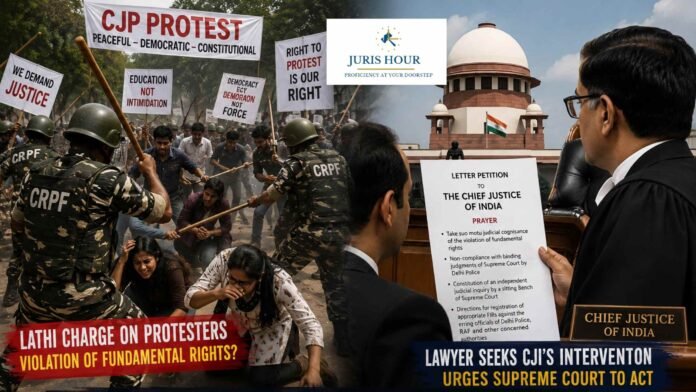
A lawyer has approached the Chief Justice of India (CJI) through a letter petition seeking the Supreme Court’s immediate intervention over the alleged police action against protesters participating in the CJP march in Delhi. The petitioner has urged the apex court to take suo motu judicial cognisance of the alleged violation of fundamental rights and the purported non-compliance with binding Supreme Court judgments governing the handling of peaceful public protests.
According to the letter petition, advocate Narendra Mishra has requested the Chief Justice to initiate proceedings in view of what he describes as an infringement of constitutional guarantees by the Delhi Police during a peaceful demonstration. The petition alleges that the actions of law enforcement authorities were contrary to established constitutional principles and previous directions issued by the Supreme Court regarding the management of public protests.
Letter Petition Alleges Violation of Fundamental Rights
The letter petition contends that the police response to the CJP protest resulted in violations of the protesters’ fundamental rights guaranteed under the Constitution, including the right to peacefully assemble and express dissent.
The petitioner has asserted that the Delhi Police failed to adhere to binding judicial precedents laid down by the Supreme Court concerning the regulation of peaceful demonstrations. It is argued that the use of force and restrictions imposed on protesters require judicial scrutiny to determine whether constitutional safeguards were breached.
Prayer Before the Chief Justice of India
In the letter petition, Advocate Narendra Mishra has sought multiple directions from the Supreme Court.
The principal prayers include:
- The Supreme Court should take suo motu judicial cognisance of the alleged violation of fundamental rights during the peaceful public protest.
- The Court should examine the alleged non-compliance with binding Supreme Court judgments by the Delhi Police while dealing with the demonstration.
- An independent judicial inquiry should be constituted under the supervision of a sitting Bench of the Supreme Court to investigate the incident.
- Appropriate directions should be issued for the registration of FIRs against officials of the Delhi Police, the Rapid Action Force (RAF) and other authorities found responsible for the alleged violations.
Demand for Independent Judicial Inquiry
The petitioner has specifically sought the constitution of an independent judicial inquiry headed by a sitting Bench of the Supreme Court, arguing that an impartial investigation is necessary to ascertain the facts surrounding the police action.
According to the petition, such an inquiry would examine whether the authorities acted in accordance with constitutional requirements and judicially prescribed safeguards while dealing with the protesters.
Alleged Non-Compliance with Supreme Court Precedents
The petition also raises concerns regarding the alleged disregard of binding Supreme Court judgments that require authorities to balance law and order with citizens’ constitutional rights to peaceful assembly and free expression.
It has been submitted that any departure from these constitutional standards warrants judicial intervention, particularly where allegations involve infringement of fundamental rights by State authorities.
Supreme Court Yet to Consider the Request
As of now, the Supreme Court has not taken up the letter petition, and no notice has been issued on the matter. Whether the Chief Justice treats the communication as a public interest matter or directs its registration as a writ petition remains to be seen.
The developments assume significance amid heightened public attention on the police response to the CJP protest and the continuing debate over the balance between maintaining public order and safeguarding the constitutional right to peaceful protest.
The matter is expected to be watched closely as it may raise important constitutional questions concerning the limits of police powers, accountability of law enforcement agencies, and the protection of civil liberties during public demonstrations.
Read More: Safdarjung Doctors Flag Patient Rights and Hospital Independence in Sonam Wangchuk Case

