
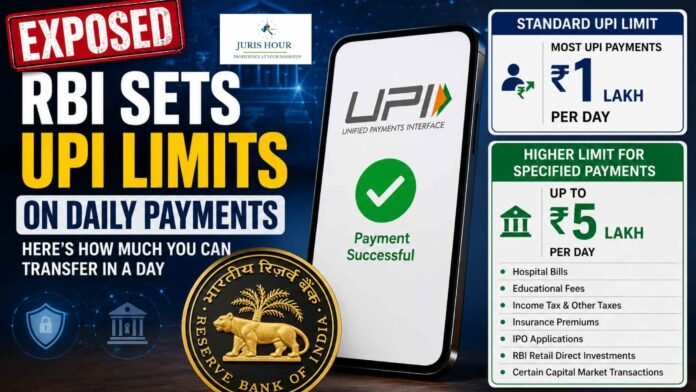
If you’re wondering how much you can pay through UPI in a day, the answer is ₹1 lakh for most regular UPI transactions.
However, for certain specified categories such as hospital bills, educational fees, tax payments, insurance premiums, IPO applications, RBI Retail Direct investments, and select capital market transactions, the limit can go up to ₹5 lakh, subject to RBI, NPCI, and participating bank guidelines. While these are the broad limits, individual banks may prescribe lower transaction or daily limits based on their internal risk management policies.
UPI has revolutionised digital payments in India by enabling instant money transfers round the clock. As the number and value of digital transactions continue to rise, the Reserve Bank of India (RBI), in consultation with the National Payments Corporation of India (NPCI), has prescribed transaction limits to ensure the payment ecosystem remains secure while protecting users from fraud.
Buy Now: Think Before You Pay Cash: 50+ Landmark Rulings on Section 40A(3) Of The Income Tax Act, 1961
Standard UPI Daily Limit
For most person-to-person (P2P) transfers and ordinary merchant payments, the daily UPI transaction limit is ₹1 lakh. Once this limit is reached, users generally cannot make additional UPI payments until the limit resets, unless their transaction falls within a higher-limit category.
Apart from the monetary cap, many banks also impose limits on the number of UPI transactions that can be carried out in a day. New users may initially face lower limits until their accounts establish a transaction history.
Transactions Eligible for ₹5 Lakh Limit
Recognising that several genuine payments exceed ₹1 lakh, RBI has allowed higher UPI limits of up to ₹5 lakh for specific categories. These include:
- Hospital and healthcare payments
- Educational institution fees
- Income tax and other tax payments
- Insurance premium payments
- IPO subscriptions
- RBI Retail Direct investments
- Certain capital market transactions
The enhanced limit is available only for eligible transactions processed through participating banks and payment platforms.
Why RBI Has Fixed These Limits
The transaction limits are intended to strike a balance between convenience and security. They help minimise losses arising from cyber fraud, prevent unauthorised high-value transfers, strengthen banking risk management, and enhance confidence in India’s rapidly expanding digital payment ecosystem.
With billions of UPI transactions taking place every month, even a small percentage of fraudulent transactions can result in significant financial losses. Transaction limits therefore act as an important layer of protection.
Banks May Have Different Limits
Although RBI and NPCI prescribe the overall framework, banks are free to impose stricter operational limits based on customer profiles, fraud monitoring systems, and internal risk assessments. Consequently, users of different banks—or even different customers of the same bank—may have varying UPI limits.
RBI Considering Higher Merchant Limits
The RBI has also indicated that it is exploring greater flexibility for person-to-merchant (P2M) payments, especially for businesses where high-value digital payments are becoming increasingly common. However, the ₹1 lakh limit for regular person-to-person transfers continues to remain unchanged.
What Users Should Remember
Before making a large UPI payment, users should check their bank’s applicable transaction limits, especially if they are paying school fees, taxes, hospital bills, or insurance premiums. If a payment exceeds the permitted limit, alternative banking channels such as NEFT, RTGS, or Internet Banking may be required.
As UPI continues to dominate India‘s digital payment landscape, RBI’s transaction limits are designed to ensure that the system remains both convenient for users and resilient against financial fraud.
Read More: JURISHOUR | TAX LAW DAILY BULLETIN : 20 JULY, 2026

