
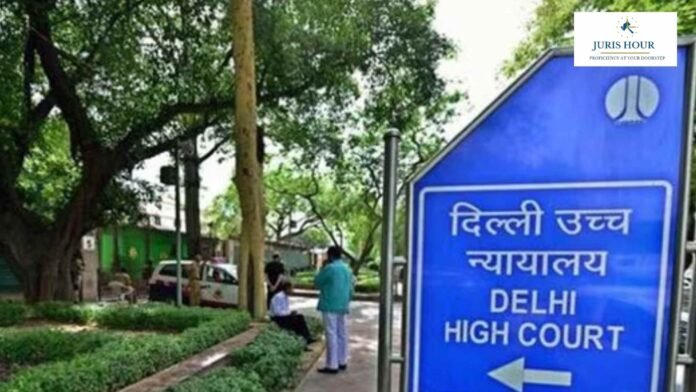
The Delhi High Court has quashed the Rs. 21 Crore Tax Addition and held that block assessment can’t be based on post-search investigation.
The bench of Justice Dinesh Mehta and Justice Rajneesh Kumar Gupta has observed that an assessment under Chapter XIV-B cannot be sustained in the absence of incriminating material found during a search. The issuance of a notice under Section 143(2) is mandatory before completing a block assessment under Section 158BC.
The dispute traces back to Assessment Year 1995-96. The appellant/assessee is a wholly owned subsidiary of Sun Air Hotels Ltd., received ₹21 crore when development rights relating to a hotel project at Bangla Sahib Road in New Delhi were transferred back to its holding company. The assessee claimed exemption from capital gains under Section 47(v) of the Income Tax Act, which exempts certain transfers between a holding company and its wholly owned subsidiary.
Buy Now: Supreme court Judgements E-Compilation – JUNE 2026
The Assessing Officer had accepted this claim in the regular scrutiny assessment under Section 143(3) on 9 February 1998 after examining the transaction.
Subsequently, a search was conducted at the company’s premises on 21 November 2000. Based on the search proceedings and subsequent investigations, the Revenue concluded that Sun Aero was not, in fact, a wholly owned subsidiary of Sun Air Hotels Ltd. It consequently initiated block assessment proceedings under Section 158BC and added ₹21 crore as taxable capital gains.
The Commissioner of Income Tax (Appeals) allowed the assessee’s appeal, holding that the capital gains issue had already been examined in the original assessment and that the transaction had been fully disclosed in the regular books of account. The CIT(A) concluded that the addition fell outside the scope of Chapter XIV-B, which is intended only for undisclosed income unearthed during search operations.
Although the ITAT initially upheld the deletion, the matter was remanded by the High Court in an earlier round of litigation. Upon remand, the Tribunal ruled in favour of the Revenue, refusing to entertain the assessee’s jurisdictional objections on the ground that no cross-appeal had been filed. This prompted the present appeal before the High Court.
The Bench held that the Tribunal committed an error in refusing to consider the assessee’s jurisdictional objections merely because no cross-appeal had been filed.
The Court observed that where the Revenue alone files an appeal, the assessee is entitled to support the order passed by the lower appellate authority on any permissible legal ground. Filing a separate appeal or cross-objection is unnecessary for raising purely legal issues that go to the root of the assessment.
According to the Court, jurisdictional defects can be raised at any stage of the proceedings, including before the High Court, particularly where no additional evidence is required.
A central issue before the Court was whether the block assessment could survive when the alleged material relied upon by the Revenue was discovered only during post-search investigations.
The Court carefully examined the assessment order and noted that although the Assessing Officer referred to certain material allegedly indicating that Sun Aero was not a wholly owned subsidiary, the assessment itself revealed that this conclusion emerged from investigations conducted after completion of the search.
The Bench held that Chapter XIV-B is confined strictly to undisclosed income detected as a result of the search itself. Material gathered subsequently during assessment proceedings cannot be treated as “search material” capable of sustaining a block assessment.
Since the disputed addition rested on post-search investigation rather than evidence unearthed during the search, the Court concluded that the jurisdictional requirement for invoking Chapter XIV-B had not been satisfied.
The High Court relied extensively on the Supreme Court’s landmark decision in Assistant Commissioner of Income Tax v. Hotel Blue Moon, which clarified that Chapter XIV-B assessments are intended exclusively for undisclosed income discovered during search operations and are not substitutes for regular assessments.
The Court observed that where a transaction has already been disclosed and examined in a regular assessment under Section 143(3), it cannot ordinarily be revisited through block assessment unless fresh incriminating material is found during the search itself.
The Court also considered whether the Assessing Officer had issued a notice under Section 143(2) while completing the block assessment under Section 158BC.
Relying on Hotel Blue Moon as well as the Delhi High Court’s earlier decision in Principal Commissioner of Income Tax v. Silver Line, the Bench reiterated that issuance of notice under Section 143(2) is a mandatory jurisdictional requirement and cannot be treated as a curable procedural defect.
During the hearing, even the Revenue was unable to produce any evidence demonstrating that such notice had ever been issued. After examining the assessment records, the Court concluded that no notice under Section 143(2) had been served upon the assessee during the block assessment proceedings.
Accordingly, the Court held that the assessment itself was invalid for want of mandatory statutory notice.
Having answered both jurisdictional questions in favour of the assessee, the Delhi High Court quashed the assessment order dated 29 November 2002 and the ITAT’s order dated 20 September 2016.
Since the assessment itself was annulled on jurisdictional grounds, the Court found it unnecessary to examine the substantive issue regarding the ₹21 crore exemption under Section 47(v), leaving that question open.
Membership Required to Access Case Details & Order Copy
To view the complete Case Details and Download Order Copy, you must have an active membership. Please subscribe to continue.

