
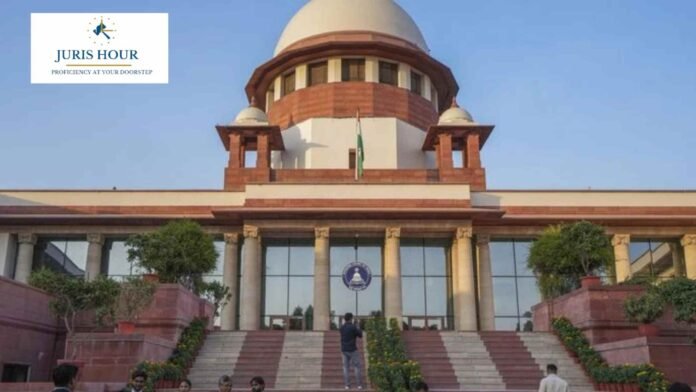
The Supreme Court has held that an insurance company cannot deny liability for a motor accident occurring in Nepal merely because the insured did not pay an additional premium for extending geographical coverage, where the vehicle was operating under a valid permit issued under the Motor Vehicles Act, 1988.
The bench of Justice Sanjay Karol dismissed the appeal filed by Oriental Insurance Co. Ltd. and upheld the liability of the insurer to compensate the victims’ family.
The dispute arose from a tragic road accident involving a bus owned by Durg Roadways Private Limited that was undertaking a religious tour from Durg (Chhattisgarh) to Nepal. During the journey, the bus collided with a hill, resulting in the deaths of three persons, including driver Riaz Khan and passenger Harish Yadav.
Buy Now: Supreme court Judgements E-Compilation – JUNE 2026
The legal heirs of Harish Yadav approached the Motor Accident Claims Tribunal (MACT), seeking compensation of approximately ₹48.99 lakh. The Tribunal awarded compensation of ₹32.67 lakh with 6% annual interest but held the vehicle owner liable instead of the insurance company.
On appeal, the Chhattisgarh High Court reversed the Tribunal’s finding on liability and directed Oriental Insurance Co. Ltd. to satisfy the award. Challenging this decision, the insurer approached the Supreme Court.
The Supreme Court examined two principal legal questions: Whether a motor insurance policy issued in India covers an accident occurring in Nepal when no additional premium was paid under General Regulation 4 (GR.4) of the India Motor Tariff, 2002. Whether the driver’s Indian driving licence authorized him to drive the vehicle in Nepal at the time of the accident.
The Bench noted that before commencing the journey, the vehicle owner had obtained a special permit from the Additional Regional Transport Authority, Durg under Section 88(8) of the Motor Vehicles Act, expressly authorizing the bus to travel through Nepal.
The Court observed that the insurance policy contained two relevant clauses “Geographical Area: India” and “Limitation as to Use”, which covered the vehicle when used under a permit issued under the Motor Vehicles Act.
According to the Court, the insurer attempted to rely solely on the geographical limitation while ignoring the broader “Limitation as to Use” clause.
The Bench held that once the vehicle was operating under a valid statutory permit authorizing travel to Nepal, the insurance policy extended to such use. It ruled that the clause relating to use under a permit was general in nature and did not impose any territorial restriction.
The Court emphasized that insurance contracts must be read as a whole rather than by isolating individual clauses.
It observed that if insurers intend to exclude accidents occurring outside India even where the vehicle possesses a valid permit, such exclusions must be drafted clearly and expressly.
The Bench remarked that insurance companies are free to define the extent of coverage, but they must communicate exclusions in unambiguous terms. Where ambiguity exists, the interpretation favouring the insured should prevail, particularly in light of the beneficial object of the Motor Vehicles Act.
Applying the doctrine of contra proferentem, the Court held that any uncertainty in policy wording must operate against the insurer that drafted the contract.
Oriental Insurance argued that General Regulation 4 of the India Motor Tariff required payment of an additional premium to extend coverage to Nepal.
The Supreme Court rejected this contention.
It held that Section 147(5) of the Motor Vehicles Act contains a non-obstante clause requiring insurers to indemnify liabilities which the policy purports to cover, notwithstanding anything contained in any other law.
The Court ruled that this statutory obligation overrides the regulatory requirements contained in the India Motor Tariff, including the requirement of payment of additional premium under GR.4, in circumstances where the vehicle was otherwise operating lawfully under a valid permit.
The Bench further observed that Parliament consciously enacted provisions enabling Indian vehicles to travel outside the country.
Referring to Sections 139 and 149 of the Motor Vehicles Act and Article 245 of the Constitution, the Court held that the statute contemplates extra-territorial operation and recognizes situations involving cross-border transportation.
Accordingly, the Court concluded that the Act applies even where an accident occurs in Nepal, provided statutory requirements are satisfied.
The insurer also argued that the driver lacked authorization to drive in Nepal.
Rejecting this submission, the Court noted that the driver possessed a valid Indian driving licence; Nepalese authorities verified his licence and vehicle documents before permitting entry into Nepal; the Bhansar Pragna Patra and Indian Tourist Passenger Checking Card specifically recorded the driver’s licence particulars; and no evidence was produced showing that the licence was invalid in Nepal.
The Court also referred to Article 7 of the 1950 Treaty of Peace and Friendship between India and Nepal, observing that it facilitates movement and recognition of authorizations between the two countries.
Although the accident occurred in 2010, the Court took note of two important developments: The Insurance Regulatory and Development Authority of India (IRDAI) de-notified the India Motor Tariff with effect from 1 April 2024. The Inter-Country Transport Vehicles Rules, 2021 now provide a structured legal framework for Indian vehicles travelling to neighbouring countries under valid inter-country permits.
The Court observed that despite these developments, uncertainty continues regarding cross-border motor insurance coverage because there is no comprehensive statutory or regulatory framework expressly addressing extension of domestic motor insurance policies to foreign jurisdictions.
Recognising recurring disputes in this area, the Court made three important recommendations: Insurance policies should clearly specify whether extra-territorial coverage is available. If cross-border coverage is excluded, insurers must expressly inform policyholders that a separate endorsement is necessary before international travel. IRDAI should consider issuing a master circular standardising cross-border coverage clauses across all motor insurance policies.
Before concluding, the Supreme Court expressed concern over the quality of reasoning adopted by Motor Accident Claims Tribunals.
The Bench observed that while tribunals often record evidence in detail, their findings sometimes fail to adequately correlate the evidence with the conclusions reached. Since accident claim cases directly concern compensation for victims and their families, reasoned orders are essential for ensuring justice and reducing unnecessary appeals.
The Supreme Court dismissed Oriental Insurance Company’s appeal and affirmed the Chhattisgarh High Court’s judgment.
The court held that Oriental Insurance Co. Ltd. is liable to pay the compensation awarded by the Motor Accident Claims Tribunal, together with interest.
The Court directed that the amount be deposited within four weeks if not already paid and also directed that a copy of the judgment be forwarded to IRDAI for consideration of the recommendations relating to cross-border motor insurance coverage.
Membership Required to Access Case Details & Order Copy
To view the complete Case Details and Download Order Copy, you must have an active membership. Please subscribe to continue.
Read More: Territorial Jurisdiction Not Ground to Reject President-Transferred ITAT Appeals: Delhi High Court

