
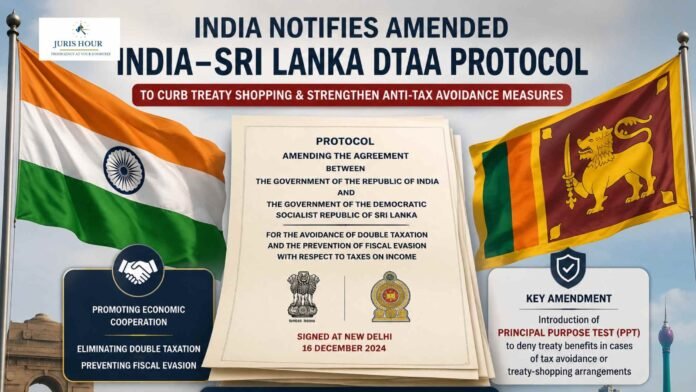
The Central Government has officially notified the Protocol amending the Agreement between the Government of the Republic of India and the Government of the Democratic Socialist Republic of Sri Lanka for the Avoidance of Double Taxation and the Prevention of Fiscal Evasion with respect to Taxes on Income, bringing into force significant anti-tax avoidance measures aligned with global international tax standards.
According to the notification, the amending Protocol was signed in New Delhi on 16 December 2024 and entered into force on 19 June 2026, following the completion of domestic legal procedures by both India and Sri Lanka.
In India, its provisions will apply to income derived in fiscal years beginning on or after 1 April following the calendar year in which the Protocol entered into force, effectively making it applicable from the relevant assessment period thereafter.
Buy Now: June 2026 Ultimate Legal & Taxation Combo
Protocol Modernises the Existing Tax Treaty
The Protocol amends the India–Sri Lanka Double Taxation Avoidance Agreement (DTAA) originally signed on 22 January 2013. Its principal objective is to update the treaty in line with internationally accepted standards developed under the OECD/G20 Base Erosion and Profit Shifting (BEPS) Project, particularly measures designed to prevent the misuse of tax treaties for unintended tax benefits.
The amendments are aimed at ensuring that the tax treaty facilitates genuine cross-border trade and investment while preventing its exploitation through aggressive tax planning structures.
New Preamble Targets Treaty Abuse
One of the most significant amendments is the complete replacement of the treaty’s preamble.
The revised preamble makes it clear that while the treaty seeks to eliminate double taxation and promote economic cooperation between India and Sri Lanka, it is not intended to create opportunities for non-taxation or reduced taxation through tax evasion, tax avoidance or treaty-shopping arrangements. It specifically recognises that treaty benefits should not be used indirectly by residents of third countries through artificial structures.
This language reflects India’s broader policy of incorporating anti-abuse provisions into its tax treaties in accordance with international best practices.
Principal Purpose Test Introduced
Perhaps the most impactful amendment is the replacement of paragraph 6 of Article 28 with a Principal Purpose Test (PPT).
Under the new provision, a treaty benefit will be denied if, considering all relevant facts and circumstances, it is reasonable to conclude that obtaining the treaty benefit was one of the principal purposes of an arrangement or transaction.
However, the benefit may still be granted if the taxpayer establishes that allowing the benefit would be consistent with the object and purpose of the relevant provisions of the treaty.
The PPT has become one of the key anti-abuse standards adopted internationally under the BEPS framework and has already been incorporated into several of India’s tax treaties.
Entry into Force and Applicability
The Protocol provides that each Contracting State must notify the other through diplomatic channels after completing the procedures required under its domestic laws.
It entered into force on the 30th day after the later notification, which was determined to be 19 June 2026.
The Protocol further provides that:
- In India, it applies to income derived in fiscal years beginning on or after the first day of April following the calendar year in which it entered into force.
- In Sri Lanka, it similarly applies to taxable years beginning on or after the corresponding date.
Government Gives Legal Effect to the Protocol
Exercising powers under Section 159(1) of the Income-tax Act, 2025, the Central Government has directed that all provisions of the Protocol shall have effect in India.
The notification formally incorporates the amended treaty provisions into India’s domestic legal framework, enabling tax authorities to apply the revised anti-abuse standards while administering cross-border taxation between India and Sri Lanka.
Membership Required to Access Notification Details & Copy
To view the complete Notification Details and Download Copy, you must have an active membership. Please subscribe to continue.

