
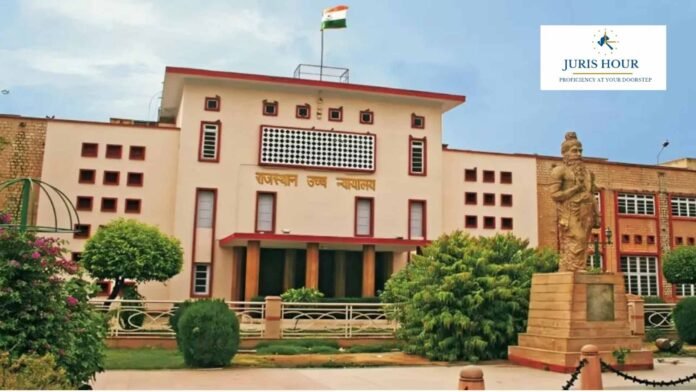
The Rajasthan High Court has dismissed an appeal holding that once an assessee expressly concedes the demand of CENVAT credit before the Customs, Excise and Service Tax Appellate Tribunal (CESTAT), it cannot subsequently seek adjudication on the issue of the extended period of limitation.
The Bench of Justice Arun Monga and Justice Sandeep Taneja upheld the CESTAT’s refusal to entertain a rectification application, observing that there was no “mistake apparent on the record” warranting interference.
The appellant, a manufacturer of M.S. Billets, was issued a show cause notice dated August 20, 2010, demanding CENVAT credit of ₹7.73 lakh, along with interest and penalty. The demand pertained to CENVAT credit availed on iron and steel items and cement used in the supporting structure of an overhead crane during the period April 2008 to January 2009. The department invoked the extended period of limitation while raising the demand.
Buy Now: Service Tax Judgement E-Compilation : June 2026
The adjudicating authority confirmed the demand, interest and equivalent penalty. Though the assessee deposited the dues under protest, its appeal before the Commissioner (Appeals) was rejected.
Before the CESTAT, the assessee argued that divergent judicial opinions existed on the admissibility of CENVAT credit on such goods and, therefore, there was no suppression, fraud or wilful misstatement to justify imposition of penalty or invocation of the extended limitation period.
However, during the hearing, the assessee’s counsel expressly stated that the company was not contesting the demand of CENVAT credit or interest, but was only seeking deletion of the penalty. Accepting this submission, the Tribunal set aside the penalty on the ground that the issue was highly debatable during the relevant period and no mala fide intention could be attributed to the assessee. The Tribunal, however, did not separately discuss the limitation issue.
Subsequently, the assessee filed a rectification application contending that the Tribunal had failed to adjudicate its plea regarding the extended period of limitation. The application was rejected, leading to the present appeal before the High Court.
The High Court held that the Tribunal committed no error in declining to decide the limitation issue because the assessee had consciously abandoned its challenge to the demand itself.
The Bench observed that once the appellant conceded the demand of CENVAT credit with interest, the question of limitation automatically became academic, as limitation is intrinsically linked to the sustainability of the demand.
According to the Court the concession before the Tribunal was clear and unequivocal. The only surviving issue before the Tribunal was whether the penalty should be sustained. Since the Tribunal granted the relief sought by deleting the penalty, there was no occasion to adjudicate the limitation plea. Consequently, omission to discuss limitation did not constitute a “mistake apparent on the record” capable of rectification.
The Court also noted an independent legal impediment. During the pendency of the proceedings, the appellant-company had been directed to be wound up. The Bench observed that after winding up, the company ceases to exist as a juristic entity and proceedings cannot ordinarily continue on the strength of a power of attorney executed by its erstwhile directors. Accordingly, the Court expressed doubts regarding the locus standi of the appellant to pursue the appeal.
Finding no legal infirmity either in the CESTAT’s original order or in its rejection of the rectification application, the Rajasthan High Court dismissed the appeal and disposed of all pending applications.
Membership Required to Access Case Details & Order Copy
To view the complete Case Details and Download Order Copy, you must have an active membership. Please subscribe to continue.

