
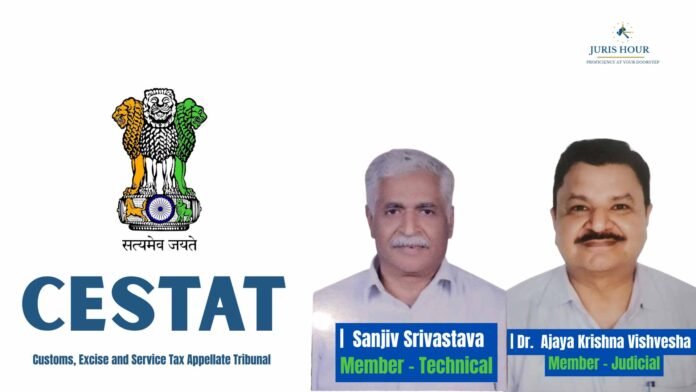
The Ahmedabad Bench of the Customs, Excise and Service Tax Appellate Tribunal (CESTAT) has dismissed an appeal filed by the Commissioner of CGST & Central Excise, Gandhinagar, thereby upholding an adjudication order that dropped a service tax demand of over ₹2.65 crore, along with interest and penalties, against contractor.
The bench of Dr. Ajaya Krishna Vishvesha (Judicial Member) and Sanjiv Srivastava (Technical Member) has ruled that construction of residential quarters for government employees and various public infrastructure projects executed for government bodies did not attract service tax under the provisions invoked by the department.
The appeal arose from an Order-in-Origina through which the Commissioner had dropped the demand raised under a Show Cause Notice issued in October 2013. The Revenue challenged that order before the Tribunal, contending that the assessee had wrongly claimed exemption from service tax on works contract services rendered between the financial years 2008-09 and 2011-12.
Buy Now: Service Tax Judgement E-Compilation : June 2026
The respondent/assessee is a proprietary concern, was engaged in executing construction contracts for various government and semi-government organizations, including the Gujarat State Police Housing Corporation Ltd. (GSPHCL), Roads & Buildings Department, Agriculture Produce Market Committees (APMCs), GETCO and other public authorities. During investigation, the department alleged that the contractor had neither obtained service tax registration nor discharged service tax liability on the services provided.
Following scrutiny of records, the department concluded that the assessee had received more than ₹24.08 crore towards construction services and was liable to pay approximately ₹2.60 crore as service tax under the category of “Works Contract Service.” An additional demand of ₹5.28 lakh was raised under the reverse charge mechanism in respect of Goods Transport Agency (GTA) services, besides interest and penalties.
The department argued that the adjudicating authority had incorrectly dropped the proceedings without appreciating the legal position governing works contract services during the relevant period. The benefit of exemption notifications and CBEC circulars relied upon by the assessee was unavailable because the contracts were classified as “Works Contract Service.” Only specified infrastructure such as roads, airports, bridges, tunnels and dams qualified for exemption, whereas the remaining construction activities should have been subjected to service tax. Several judicial precedents relied upon in the adjudication order had not attained finality.
The respondent contended that the contracts primarily related to construction of government staff quarters, hostels, educational institutions, libraries, public buildings, roads and other civic infrastructure. These structures were intended for public purposes or for residential use by government employees and therefore fell outside the taxable category under the Finance Act, 1994.
It was further argued that even if certain activities were classified as works contracts, they were not undertaken for commerce or industry, which was an essential requirement for taxability in many of the contracts executed. The assessee also claimed entitlement to the benefit of the Works Contract (Composition Scheme for Payment of Service Tax) Rules, 2007.
The Bench observed that the adjudicating authority had meticulously examined each contract executed by the assessee and correctly analysed its nature before dropping the demand.
The Tribunal noted that the projects included construction of Government staff quarters; Police housing; Hostels; Government schools; Libraries; Roads; Public office buildings; Archaeological restoration works; and Other civic infrastructure.
It found that these structures were either intended for the personal residential use of government employees or constituted public infrastructure that was not primarily meant for commerce or industry. Consequently, they did not satisfy the conditions necessary for levy of service tax under the relevant provisions of the Finance Act.
The Tribunal extensively relied upon earlier decisions holding that construction of residential quarters for government departments, public sector organizations and even private employers for housing their employees falls within the exclusion relating to “personal use.”
The Tribunal observed that these authorities consistently recognized that residential complexes constructed for allotment to employees are outside the taxable scope of “Construction of Complex Service” and that civic infrastructure built for public purposes cannot be regarded as construction primarily meant for commerce or industry.
Membership Required to Access Case Details & Order Copy
To view the complete Case Details and Download Order Copy, you must have an active membership. Please subscribe to continue.
Read More: Service Tax Payable On Spoken English Training Institute: CESTAT

