
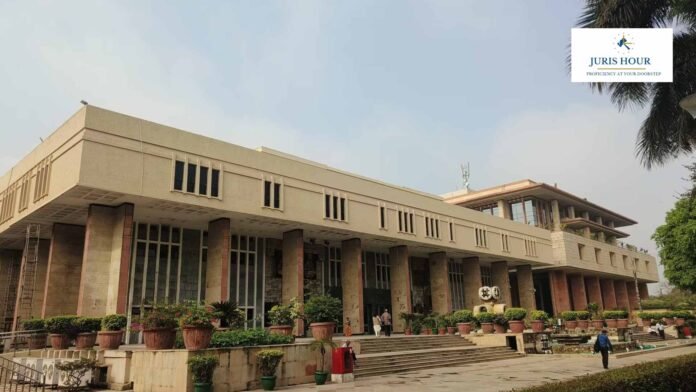
The Delhi High Court has dismissed a writ petition filed by a Delhi-based agro-chemical trader challenging a GST demand of over ₹5.51 crore, holding that disputes involving appreciation of evidence, adequacy of adjudication, and procedural issues should ordinarily be decided by the statutory appellate authority rather than in writ jurisdiction under Article 226 of the Constitution.
The Bench of Justice Anil Kshetrapal and Justice Shail Jain has relied upon the Allahabad High Court’s decision in Patanjali Ayurved Ltd. v. Union of India, holding that the proper officer adjudicating proceedings under Sections 73 or 74 is competent to impose consequential penalties under Section 122 as part of the same adjudication proceedings.
The petitioner, proprietor of M/s Shree Chem India, is engaged in the trading of agro-chemical products, including pesticides and insecticides. The Directorate General of GST Intelligence (DGGI), Delhi Zonal Unit, had issued a show cause notice on June 17, 2025, alleging mis-declaration, undervaluation, and clandestine clearance of taxable goods during the financial years 2018-19 to 2022-23.
Buy Now: 50+ Judgements on Customs Valuation
Following adjudication under Section 74 of the Central Goods and Services Tax (CGST) Act, 2017, the Principal Commissioner confirmed:
- GST demand of ₹5,51,34,232
- Applicable interest
- Penalty equal to the tax amount under Section 74
- Additional penalties under Sections 122(1)(ii) and 122(3)(e) of the CGST Act.
Instead of filing a statutory appeal under Section 107 of the CGST Act, the taxpayer approached the Delhi High Court directly through a writ petition.
The petitioner challenged the adjudication order on multiple grounds, primarily alleging violation of natural justice and jurisdictional errors.
Among the principal arguments were:
- The adjudicating authority failed to properly consider the detailed reply submitted to the show cause notice, violating Section 74(9) of the CGST Act.
- Mandatory personal hearing under Section 75(4) was allegedly denied as notices fixing hearing dates were never served.
- Statements recorded under Section 70 of the CGST Act were claimed to have been obtained under coercion and therefore could not be relied upon.
- Requests for cross-examination of third-party witnesses relied upon in the show cause notice were allegedly ignored.
- The Principal Commissioner allegedly lacked jurisdiction to impose penalties under Sections 122(1)(ii) and 122(3)(e).
The Division Bench reiterated the settled principle that where the CGST Act provides a complete appellate mechanism, High Courts ordinarily refrain from entertaining writ petitions against adjudication orders.
The Court noted that although exceptions exist—such as violation of natural justice, lack of jurisdiction, or breach of fundamental rights—the petitioner failed to establish any exceptional circumstance warranting interference under Article 226.
Rejecting the allegation that the adjudicating authority failed to consider the taxpayer’s reply, the Court observed that questions relating to adequacy of reasoning or correctness of findings fall within the scope of appellate scrutiny.
According to the Court, merely because every submission was not discussed elaborately in the order does not automatically establish non-compliance with Section 74(9). Such issues concern the merits of adjudication and are better examined by the appellate authority.
On the allegation that notices of personal hearing were never served, the Court observed that the issue involved disputed questions of fact.
While the petitioner denied receiving hearing notices, the adjudication order recorded that three opportunities of personal hearing had been granted. Determining whether notices were actually issued and served in accordance with Section 169of the CGST Act would require examination of departmental records, making the issue unsuitable for adjudication in writ proceedings.
The Court also declined to examine allegations that statements under Section 70 had been obtained under coercion or that cross-examination had been wrongly denied.
It held that questions regarding voluntariness of statements, evidentiary value, retraction, and the necessity of cross-examination involve appreciation of evidence and therefore fall squarely within the jurisdiction of the appellate authority.
The petitioner also argued that while adjudicating proceedings under Section 74, the Principal Commissioner could not impose penalties under Section 122.
Finding no patent jurisdictional defect or manifest violation of natural justice, the Delhi High Court dismissed the writ petition and directed the taxpayer to pursue the statutory appellate remedy under Section 107 of the CGST Act.
The Court granted protection regarding limitation by clarifying that if an appeal is filed, the period during which the writ petition remained pending before the High Court shall be excluded while computing the limitation period. The appellate authority has been directed to decide the appeal independently and uninfluenced by any observations made in the High Court’s judgment.
Membership Required to Access Case Details & Order Copy
To view the complete Case Details and Download Order Copy, you must have an active membership. Please subscribe to continue.
Read More: Bank SMS Alert Charges Must Be Based on Usage: RBI

