
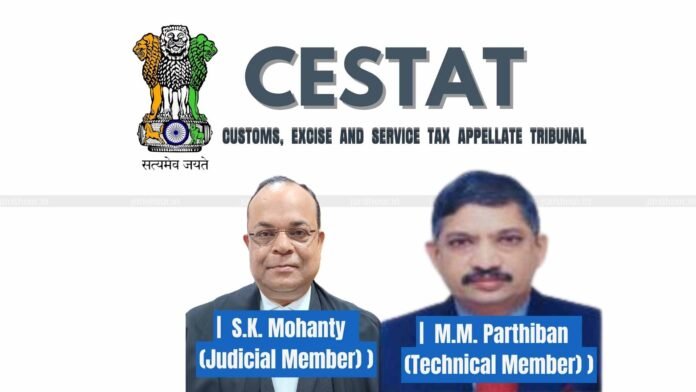
The Mumbai Bench of the Customs, Excise and Service Tax Appellate Tribunal (CESTAT) has held that prototype commercial vehicles cleared for testing purposes to another unit of the same manufacturer cannot be valued under Rule 8 of the Central Excise Valuation Rules, 2000 at 110% of the cost of production. Instead, the valuation must be based on the price of comparable goods under Rule 4 of the Valuation Rules.
The bench of S.K. Mohanty (Judicial Member) and M.M. Parthiban (Technical Member) has observed that Rule 8 applies only when excisable goods are consumed by the manufacturer or on its behalf in the manufacture of other articles. In the present case, the prototype vehicles were not used as inputs for manufacturing another product. Instead, they were developed and transferred solely for testing and certification purposes.
The appellant/assessee, Mahindra & Mahindra manufactures prototype commercial vehicles falling under Chapter Heading 8704 of the Central Excise Tariff. During the relevant period, the company transferred such prototype trucks to its other manufacturing units for testing and evaluation purposes. While clearing these vehicles, the company discharged central excise duty by determining their value under Section 4(1)(b) of the Central Excise Act, 1944 read with Rule 4 of the Central Excise Valuation Rules, 2000, using the value of comparable goods.
Buy Now: GST Judgements E-Compilation – June 2026
The Department disputed this method and argued that because the vehicles were transferred to another unit of the same company, the valuation should be determined under Rule 8 of the Valuation Rules. Under Rule 8, goods consumed captively are valued at 110% of the cost of production. Based on this interpretation, show-cause notices were issued alleging short-payment of duty.
The adjudicating authority had originally dropped the demands, holding that the company’s valuation method was correct. However, on appeal by the Revenue, the Commissioner (Appeals) reversed those findings and ruled in favour of the Department, prompting Mahindra & Mahindra to approach the Tribunal.
The key question before the Tribunal was whether prototype vehicles transferred for testing purposes could be treated as goods consumed captively in further manufacturing activities, thereby attracting Rule 8 valuation, or whether they should be valued on the basis of comparable goods under Rule 4.
The answer to this issue had significant financial implications because valuation under Rule 8 based on cost of production would substantially increase the assessable value and corresponding excise duty liability.
The Bench highlighted that under Rule 126 of the Central Motor Vehicles Rules, 1989, prototype vehicles are required to undergo testing by designated agencies before commercial production and marketing can commence. Such prototypes serve as test models and cannot be equated with goods consumed in the manufacture of other vehicles.
Accordingly, the Tribunal held that the precondition for invoking Rule 8 was absent.
The Tribunal extensively relied upon previous decisions rendered in Mahindra & Mahindra’s own cases. Earlier benches had already concluded that prototype vehicles are distinct from commercially manufactured vehicles and cannot be regarded as products consumed in further manufacture. Consequently, valuation based on cost construction under Rule 8 was found to be inappropriate.
The earlier rulings had also observed that applying Rule 8 would lead to unrealistic assessable values that bear no resemblance to the value of comparable commercial vehicles. The Tribunal further noted that the Department had accepted earlier orders dropping similar demands and therefore could not insist upon a contrary interpretation in identical circumstances.
The Tribunal concluded that the value adopted by Mahindra & Mahindra under Rule 4 of the Central Excise Valuation Rules, based on comparable goods, was legally correct. It held that Rule 8 had no application to prototype vehicles cleared for testing purposes.
Finding no merit in the appellate order that had confirmed the duty demands, the Tribunal set aside the impugned order and allowed both appeals filed by the manufacturer.
Membership Required to Access Case Details & Order Copy
To view the complete Case Details and Download Order Copy, you must have an active membership. Please subscribe to continue.
Read More: Can GST Demands Orders Be Quashed If Issued by an Officer Lacking Monetary Jurisdiction?

