
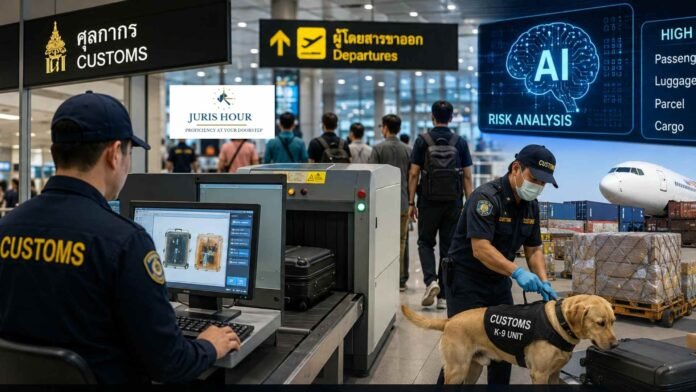
Thailand Customs has launched a major overhaul of its outbound customs and security screening framework, introducing artificial intelligence (AI), advanced X-ray technology, K-9 detection units and intelligence-based risk assessment systems to combat the growing threat of transnational drug trafficking through the country’s transportation and logistics networks.
The initiative comes amid increasing concerns that international criminal organizations are exploiting Thailand’s extensive aviation, cargo and logistics infrastructure as a transit hub for moving narcotics and other illicit goods across borders.
Buy Now: Customs Duty Judgements E-Compilation – June 2026
Government Orders Stronger Outbound Monitoring
Speaking on the intensified enforcement drive, Customs Department Director-General Phantong Loykulnanta stated that the government has adopted a clear policy aimed at ensuring Thailand is no longer used as a transit route for international drug-trafficking syndicates.
While Thailand is not regarded as a major producer of narcotics, authorities acknowledge that the country’s highly developed airports, seaports and logistics facilities have become attractive targets for criminal networks seeking efficient routes for smuggling operations.
Historically, customs inspections have concentrated largely on inbound passengers and imports. However, officials are now significantly expanding scrutiny of outbound travelers, baggage, parcels and commercial cargo in response to emerging trafficking patterns.
AI and Risk-Based Screening at the Core of New Strategy
A key component of the new enforcement framework is the adoption of artificial intelligence and sophisticated risk-management systems capable of analyzing vast amounts of travel and shipment data.
Authorities say these systems will help identify passengers, cargo consignments and parcels that present elevated risk profiles, enabling customs officers to focus resources on suspicious activities rather than relying solely on random inspections.
According to officials, the scale of Thailand’s transport operations makes comprehensive physical inspections impractical. The country handles approximately 85 million passenger movements and more than 13 million cargo containers annually, creating significant challenges for traditional enforcement methods.
By leveraging AI-driven intelligence, customs officials aim to enhance detection capabilities while minimizing disruptions to legitimate travel and trade.
Airports to Expand Outbound X-Ray Screening
The government has instructed Airports of Thailand (AOT) to support the installation and expansion of outbound baggage-screening systems across major airports.
Enhanced screening measures include additional X-ray inspections for checked baggage before loading onto aircraft and increased deployment of K-9 units trained to detect narcotics and other prohibited substances.
Initial coordination has already begun with Bangkok’s Suvarnabhumi Airport to implement upgraded screening infrastructure in both passenger and cargo terminals.
Authorities have also directed customs, police and airport operators to strengthen collaboration through improved information-sharing mechanisms and integrated security databases.
Airline Crew Under Increased Scrutiny
The latest policy push follows heightened concern over several international drug-smuggling incidents involving routes originating from Thailand.
Particular attention has been drawn to a recent case in Australia, where a 26-year-old Thai airline employee was arrested after Australian authorities allegedly discovered more than one kilogram of heroin during baggage inspections at Melbourne Airport.
The incident sparked concerns among Thai authorities because it involved an airline crew member—a category considered vulnerable to recruitment by trafficking organizations due to their frequent international travel and access to airport facilities.
Following the case, Prime Minister Anutin Charnvirakul directed relevant agencies to strengthen airport security and improve intelligence-sharing arrangements. Airlines have also been instructed to enforce stricter policies prohibiting crew members from carrying items on behalf of other individuals, with severe disciplinary consequences for violations.
More Than One Tonne of Narcotics Seized
Customs enforcement statistics underscore the scale of the challenge facing authorities.
Between October 1 and June 30, customs officers seized more than one tonne of illegal narcotics with an estimated market value ranging between 700 million and 800 million baht.
When seizures of other prohibited and smuggled goods are included, the total value of intercepted contraband during the same period reaches approximately 5 billion baht.
Officials say these figures highlight the persistent efforts of organized criminal groups to exploit Thailand’s transport infrastructure and reinforce the need for enhanced enforcement measures.
Cannabis Smuggling Emerges as Growing Concern
In addition to hard drugs, customs authorities are also targeting the illegal export of cannabis.
Officials note that substantial price differences between Thailand and certain foreign markets have created incentives for traffickers attempting to transport cannabis overseas for profit.
To strengthen deterrence, authorities have increased penalties for cannabis-smuggling offences, imposing fines of up to 30,000 baht per kilogram. Individuals unable to pay the fines may face imprisonment and immediate cancellation of their travel arrangements.
Customs officials are also working with international partners to address the issue. Representatives from the British diplomatic mission in Thailand and the UK Border Force are expected to meet with Thai authorities and participate in a joint awareness campaign aimed at discouraging foreign nationals from engaging in cannabis-smuggling activities.
Shift Towards Intelligence-Led Border Enforcement
The latest measures represent a significant shift in Thailand’s border-security strategy, moving away from a predominantly checkpoint-based approach toward intelligence-led enforcement supported by technology and data analytics.
Authorities believe the combination of AI-driven risk assessment, expanded X-ray screening, enhanced interagency cooperation and targeted inspections will make it increasingly difficult for traffickers to use Thailand as a transit corridor for narcotics and other illegal goods.
The government maintains that strengthening outbound controls is essential not only for combating organized crime but also for safeguarding Thailand’s international reputation as a global aviation, trade and logistics hub.

