
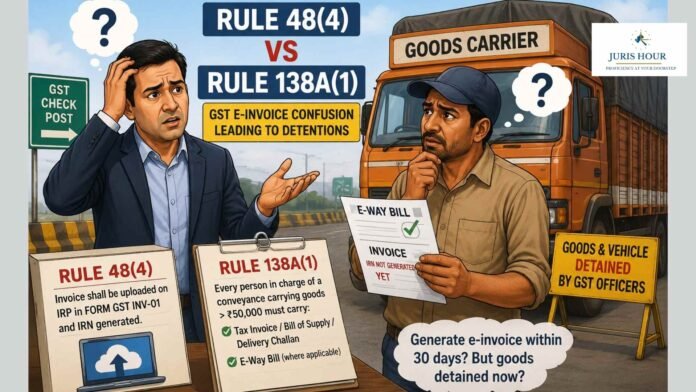
A growing number of GST-registered businesses are facing detention of goods and vehicles during transit because of a widespread misunderstanding regarding the interplay between Rule 48(4) and Rule 138A(1) of the Central Goods and Services Tax (CGST) Rules, 2017.
While many taxpayers believe they can generate an e-invoice within the permitted time limit after issuing the invoice, GST authorities are increasingly taking action where goods are transported without a valid Invoice Reference Number (IRN) at the time of movement. Tax professionals are now calling for an official clarification from the government to prevent unnecessary disputes and business disruptions.
Buy Now: GST Judgements E-Compilation – June 2026
The Legal Position
Rule 138A(1): Documents Required During Transportation
Rule 138A(1) of the CGST Rules mandates that every person in charge of a conveyance carrying goods valued above ₹50,000 must carry the following documents during transportation:
- Tax Invoice, Bill of Supply, or Delivery Challan, as applicable.
- E-Way Bill, wherever required under GST law.
These documents are essential for verification by GST officers during inspections conducted while goods are in transit.
What Rule 48(4) Says About E-Invoicing
Rule 48(4) governs taxpayers who are covered under the mandatory e-invoicing provisions.
The rule provides that the invoice must be uploaded on the Invoice Registration Portal (IRP) in FORM GST INV-01, after which an Invoice Reference Number (IRN) is generated. Only after successful registration does the invoice qualify as a valid e-invoice under the GST framework.
For businesses falling under mandatory e-invoicing, the IRN is therefore not merely an additional compliance requirement but an integral part of a legally valid invoice.
Where the Confusion Begins
Many businesses have interpreted the e-invoicing provisions to mean that, since the GST system allows reporting within the prescribed time limit (such as the currently applicable reporting window for eligible taxpayers), they may:
- Issue a tax invoice,
- Generate the e-way bill,
- Dispatch the goods immediately, and
- Upload the invoice to the IRP later within the permissible period.
This interpretation often proves costly.
During road inspections, GST officers verify whether the invoice accompanying the goods is a valid e-invoice wherever e-invoicing is mandatory. If the invoice has not yet been registered on the IRP and does not contain a valid IRN and QR code, authorities may treat the invoice as non-compliant.
As a result, goods and even the transporting vehicle may be detained, leading to delays, litigation, additional costs, and disruption of supply chains.
Practical Impact on Businesses
Industry professionals report that such cases are becoming increasingly common, particularly among businesses that:
- Dispatch goods immediately after preparing the invoice.
- Generate the IRN later within the allowed reporting period.
- Assume that compliance with the reporting timeline automatically validates transportation.
However, transportation requirements under Rule 138A operate independently from the reporting timeline, resulting in practical compliance challenges.
Why Businesses Are Concerned
The issue has significant commercial consequences:
- Detention of goods during transit.
- Delay in deliveries to customers.
- Blocking of working capital.
- Payment of penalties and detention charges in disputed cases.
- Increased compliance burden and uncertainty.
For businesses operating high-volume logistics, even a few hours of detention can result in substantial financial losses.
Demand for Government Clarification
Tax experts believe that an official clarification from the GST authorities would help eliminate ambiguity surrounding the interaction between Rule 48(4) and Rule 138A(1).
A clarification could specifically address whether goods covered under mandatory e-invoicing can legally be transported before the invoice is registered on the IRP, even if the reporting window has not expired.
Such guidance would reduce unnecessary litigation, ensure uniform enforcement across jurisdictions, and provide certainty to taxpayers.
Best Practice for Taxpayers
Until an official clarification is issued, businesses covered under mandatory e-invoicing should adopt a conservative compliance approach by ensuring that:
- The invoice is uploaded to the IRP before dispatch.
- A valid IRN and QR code are generated prior to movement of goods.
- The e-way bill is generated using the authenticated invoice details.
- The transporter carries all prescribed documents throughout the journey.
Conclusion
The apparent conflict between the practical application of Rule 48(4) and the transport documentation requirements under Rule 138A(1) has become a significant compliance concern under GST. While businesses rely on the permissible reporting timeline for e-invoices, field-level enforcement often focuses on the availability of a valid e-invoice at the time of transportation.
Until the GST Council or the Central Board of Indirect Taxes and Customs (CBIC) issues a clear clarification, taxpayers would be well advised to complete e-invoice generation before dispatching goods to avoid detention, penalties, and unnecessary litigation.

