
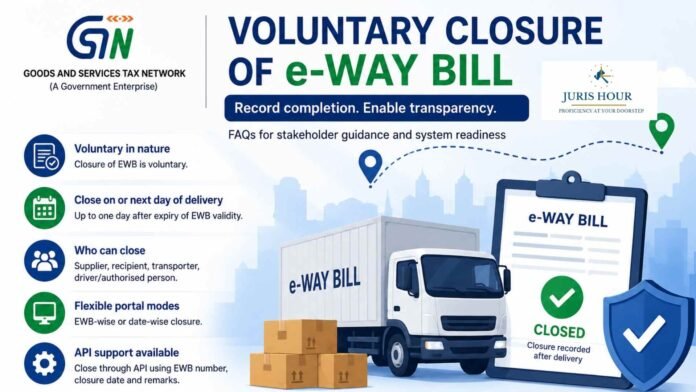
The Goods and Service Tax Network (GSTN) has issued Frequently Asked Question (FAQs) on voluntary closure of e-way bill: business scenarios, API Impact and Portal Behaviour.
1. Scope and Implementation
Q1. What is the Voluntary e-Way Bill Closure facility?
The Voluntary e-Way Bill Closure facility enables closure of an e-Way Bill after delivery of goods has been completed. It is intended to record completion of movement in the system.
Q2. Is closure of EWB mandatory?
No. Closure of EWB is voluntary in nature.
Q3. What is the revised implementation date?
The revised date of implementation is 1st August, 2026.
Q4. When can an EWB be closed?
An E-Way Bill may be closed after completion of delivery of goods. It is advised that such closure should be carried out on the date of delivery or on the immediately succeeding day.
However, the closure functionality shall remain available up to one day after the expiry of validity of the E-Way Bill. The date of closure, i.e. the date of receipt/delivery of goods, should fall between the date of generation and the date of expiry of the E-Way Bill.
Buy Now: GST Judgements E-Compilation – June 2026
For example, where an E-Way Bill is generated on 20.06.2026 and its validity expires on 30.06.2026, the date of closure may be any date between 20.06.2026 and 30.06.2026, depending upon the actual date of receipt of goods. If the goods are received on 25.06.2026, the E-Way Bill may be closed from 25.06.2026 up to 01.07.2026, i.e. one day after the expiry of validity.
Q5. Who can close an EWB?
An EWB may be closed by the supplier, recipient, transporter involved in the transaction, or driver/authorised person whose mobile number has been provided for closure.
2. Portal-based Closure
Q6. Where is the closure option available for supplier, recipient and transporter?
For suppliers, recipients and transporters, the closure option is available after login under the e-Way Bill section of the portal.
Q7. What are the portal modes for closure?
Closure can be performed EWB-wise or date-wise for logged-in users.
Q8. What is EWB-wise closure?
EWB-wise closure means that a specific e-Way Bill number is selected and closed after delivery is completed.
Q9. What is date-wise closure?
Date-wise closure allows the logged-in user to view EWBs for a particular date and close eligible EWBs after delivery.
Q10. Can multiple EWBs be closed through date-wise closure on the portal?
Yes, the option is available.
Q11. Can a driver or authorised person close an EWB?
Yes. A driver or authorised person can close an EWB through the portal-based mobile number closure facility, where the mobile number has been provided for closure purposes.
Q12. How does mobile number-based closure work?
All active EWBs linked to the concerned mobile number are displayed under the Search option on the EWB Common Portal, enabling closure by the authorised person after delivery.
Q13. Is mobile number entry mandatory?
No. Providing the mobile number is optional. However, if closure by driver or authorised person is intended, the relevant mobile number should be provided.
Q14. When can the mobile number be provided or updated?
The mobile number may be provided at the time of EWB generation. If required, it can also be updated during vehicle updation, consolidated EWB operations or extension of validity, wherever applicable in the system.
3. EWB API Impact
Q15. Is an API available for EWB closure?
Yes. An API has been provided for system integrators and API users for closure of EWBs.
Q16. What details are required for closure through API?
For closure through API, the EWB number, closure date and remarks are required to be transmitted.
Q17. Does the closure API support date-wise bulk closure?
No, the current API does not support date-wise bulk closure.
Q18. Is there any API to retrieve EWBs marked as closed, including date-wise retrieval?
No. Currently, no separate API has been introduced to retrieve EWBs that have been marked as closed, including date-wise retrieval of closed EWBs. Such functionality may be considered in future after the closure module is stabilised and based on operational requirements emerging from field usage.
Q19. Will Get EWB Details API show a separate Closed status or closed date?
At present, no separate provision has been introduced in the Get EWB Details API to return a Closed status or Closed Date. For the initial stabilisation period, the existing status framework is being continued. A separate status of “Closed” is proposed to be introduced in due course.
Q20. Can APIs capture the mobile number for closure by driver or authorised person?
No. At present, there is no provision in the APIs to capture or specify the mobile number for closure by driver or authorised person.
Q21. Can a driver or authorised person close EWB through API?
No. As per the current implementation, closure by driver or authorised person through mobile number-based access can be carried out only through the portal.
Q22. What is the character limit for closure remarks?
Closure remarks may be entered up to a maximum of 100 characters.
Q23. Does any API response indicate who closed the EWB?
As of now, the API response does not contain any field indicating the person who closed the e-Way Bill(EWB).
4. Status and Post-Closure Behaviour
Q24. Will a separate status of “Closed” be introduced?
Yes. A separate status of “Closed” is proposed to be introduced in due course for EWBs that have been marked as closed after completion of delivery.
Q25. What is the current EWB status framework?
Currently, the EWB status is reflected as Active, Cancelled or Discarded. For the initial stabilisation period, this existing status framework is being continued so that trade and system users are not adversely impacted during the transition phase.
Q26. If an EWB is marked as closed, will it immediately show as “Closed”?
During the initial stabilisation period, a separate “Closed” status may not be reflected in the existing status framework. However, closure details will be captured in the system.
Q27. Can user actions be performed after an EWB is marked as closed?
Yes. As of now, user actions such as Update Transporter, Extend Validity, Vehicle Updation and other permitted modifications will continue to remain available even after the EWB has been marked as closed.
Q28. Why are post-closure actions allowed initially?
This relaxation is being provided for the benefit of users during the initial stabilisation period.
Q29. Will post-closure actions be restricted later?
Yes. Once the system is stabilised, necessary restrictions will be introduced and post-closure actions will be suitably curtailed.
Q30. Can transporter details be updated after closure?
Yes. During the initial stabilisation period, updating transporter details will continue to be available even after the EWB has been marked as closed. Suitable restrictions may be introduced after stabilisation.
6. Business Scenarios
Scenario 1: Supplier closes EWB after delivery
A supplier generates an EWB for goods dispatched from Chennai to Bengaluru. After goods are delivered, the supplier logs in and closes the EWB on the same day of delivery or on the immediately succeeding day.
Scenario 2: Recipient closes EWB after receipt
A recipient receives goods against an EWB generated by the supplier. After receipt, the recipient closes the EWB to record completion of movement.
Scenario 3: Transporter closes EWB after delivery
A transporter carries goods from Pune to Hyderabad. After delivery, the transporter closes the EWB through portal login.
Scenario 4: Driver closes EWB using mobile number
The driver’s mobile number is provided for closure. After delivery, the driver accesses the portal-based mobile number closure facility, views the active EWBs linked to the mobile number, and closes the relevant EWB.
Scenario 5: Mobile number updated during vehicle updation
An incorrect or missing mobile number is corrected during vehicle updation. The driver or authorised person may then close the EWB through the portal-based mobile number closure facility.
Scenario 6: Closure through API by ERP-integrated taxpayer
An ERP-integrated taxpayer closes EWBs through API after delivery by transmitting the EWB number, closure date and remarks.
Scenario 7: Date-wise closure by transporter
A transporter handles multiple EWBs generated on a single date. After delivery of goods, the transporter uses date-wise closure on the portal to identify and close eligible EWBs.
Scenario 8: EWB marked as closed but vehicle update attempted
During the initial stabilisation period, vehicle updation and other permitted actions will continue to remain available even after closure. After stabilisation, such post-closure actions may be suitably restricted.
Scenario 9: API user wants date-wise list of closed EWBs
At present, no separate API has been introduced for date-wise retrieval of closed EWBs. Such functionality may be considered in future after stabilisation and based on field requirements.
Membership Required to Access FAQ & Copy
To view the complete FAQS and Download Copy, you must have an active membership. Please subscribe to continue.

