
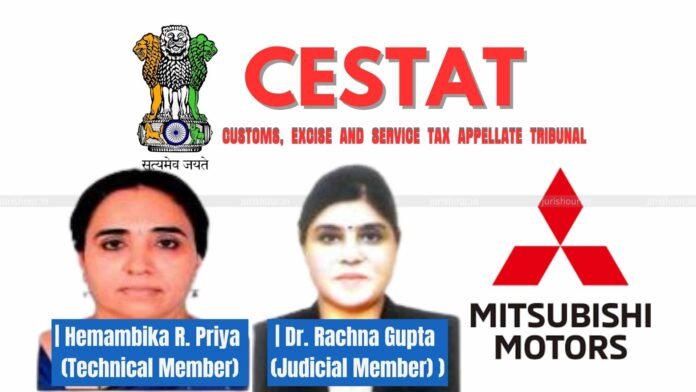
The Principal Bench of the Customs, Excise and Service Tax Appellate Tribunal (CESTAT), New Delhi, has upheld the classification of Electronic Power Steering Electronic Control Units (EPS-ECU) imported by Mitsubishi Electric Automotive India Pvt. Ltd. under Customs Tariff Heading (CTH) 8708 94 00, rejecting the company’s contention that the products should instead be classified under headings applicable to electrical or automatic regulating equipment.
The bench of Dr. Rachna Gupta, Officiating President, and Ms. Hemambika R. Priya, Member (Technical) dismissed 17 customs appeals, reaffirming its earlier decisions on the identical issue. The EPS-ECU is not designed for the distribution or control of electricity. It is not an electrical machine performing an independent function. Its sole purpose is to operate as a component within an automobile’s electric power steering assembly.
Buy Now: Customs Duty Judgements E-Compilation – June 2026
The dispute arose from imports made by Mitsubishi Electric Automotive India Pvt. Ltd. during April to July 2025, involving Electronic Control Units (ECUs) used in Electric Power Steering (EPS) systems and their components.
The importer initially declared the goods under alternative tariff headings but challenged the Customs Department’s decision to classify them under CTH 8708 94 00, which covers steering wheels, steering columns, steering boxes and parts thereof. Differential customs duty was paid under protest, and the company subsequently challenged the assessments before the appellate authorities.
The primary question before the Tribunal was whether the imported EPS-ECU and its components should be classified as automobile steering system parts under CTH 8708 94 00, as claimed by the Revenue; or Electrical control equipment under CTH 8537; Electrical machines having individual functions under CTH 8543; or Automatic regulating or controlling instruments under CTH 9032, as alternatively claimed by the importer.
The Tribunal observed that its Final Order dated 30 March 2026 had examined the very same product and concluded that the EPS-ECU was correctly classifiable under CTH 8708 94 00. Since no stay had been granted by the Supreme Court against that earlier decision, the precedent continued to bind the Tribunal.
The Tribunal held that although the EPS-ECU contains sophisticated electronic circuitry and a microprocessor, its essential character remains that of an integral component of an automobile’s electric power steering system.
According to the Bench, the device merely receives signals from torque and speed sensors, processes those inputs, and regulates the steering assistance provided to the driver. It does not function independently as an automatic regulating instrument or apparatus falling under Chapter 90.
The Tribunal also rejected Mitsubishi’s alternative claim for classification under CTH 8537 and CTH 8543.
Accordingly, it could not be brought under the residual entries of Chapter 85 merely because it incorporates electronic components.
During the hearing, the appellant relied upon subsequent Chennai Bench decisions involving Hyundai Motors Ltd. and Mobis India Ltd., where certain ECUs had been classified under CTH 9032.
However, the Principal Bench distinguished those rulings, noting that ECU is a generic expression covering a wide variety of electronic control units with different functions.
The Tribunal observed that the ECUs involved in Hyundai Motors were materially different from the EPS-ECU imported by Mitsubishi and that each ECU must be classified according to its specific functionality and use. Therefore, the Chennai Bench decisions did not alter the legal position governing Mitsubishi’s imports.
The Tribunal also endorsed the findings of the Commissioner (Appeals), who had concluded that EPS-ECU has no independent commercial or functional use outside the electric power steering system. It is designed exclusively for installation in steering assemblies of automobiles. It satisfies the requirements under Section XVII of the Customs Tariff governing classification of vehicle parts. The specific tariff entry relating to steering columns and their parts takes precedence over more general electrical headings.
Finding no reason to depart from its earlier decisions, the CESTAT held that the imported EPS-ECUs and their components are correctly classifiable under CTH 8708 94 00 as parts of automobile steering systems.
The Tribunal accordingly upheld the order of the Commissioner (Appeals) and dismissed all seventeen appeals filed by Mitsubishi Electric Automotive India Pvt. Ltd.
Membership Required to Access Case Details & Order Copy
To view the complete Case Details and Download Order Copy, you must have an active membership. Please subscribe to continue.
Read More: Job Work Can’t Be Treated as ‘Exempted Service’; No 7% CENVAT Reversal on Job Charges: CESTAT

