
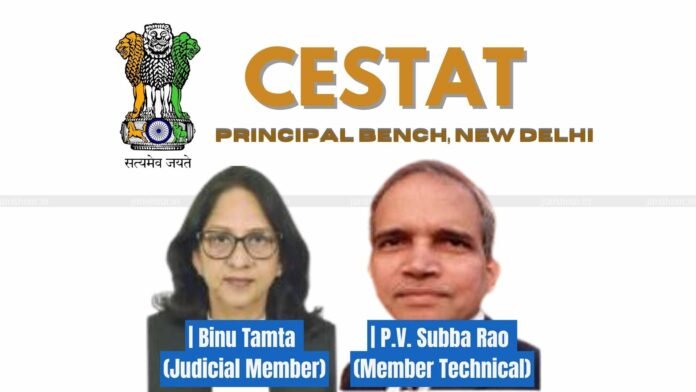
The Customs, Excise and Service Tax Appellate Tribunal (CESTAT), New Delhi, has held that a job-work activity recognized as “manufacture” under the Central Excise law cannot simultaneously be treated as an “exempted service” for demanding reversal under Rule 6(3) of the CENVAT Credit Rules, 2004.
The bench of P.V. Subba Rao (Technical Member) ruled that waste and scrap generated during manufacturing are not “manufactured exempted goods”, thereby setting aside demands requiring payment of 6% of their value.
The appeals involved two principal issues.
Buy Now: Customs Duty Judgements E-Compilation – June 2026
The first related to the department’s demand of 7% of the job-work charges received by the company for manufacturing goods on behalf of its principal manufacturer under Notification No. 214/86-CE. The department alleged that the activity amounted to an exempted service, thereby attracting Rule 6(3)(i) of the CENVAT Credit Rules.
The second issue concerned demands of 6% of the sale value of waste and scrap, including wooden pallets, PVC pipes, iron strips and HDPE sheets, generated during manufacturing. The department treated these clearances as exempted goods requiring payment under Rule 6(3).
The company argued that once the department itself recognized the activity as manufacture and permitted duty-free clearance under Notification No. 214/86-CE, it was legally impermissible to characterize the same activity as an exempted service.
It further submitted that no CENVAT credit had been availed exclusively for job-work production and that proportionate common credit had already been reversed under Rule 6(3A). Consequently, no additional liability under Rule 6(3) could arise.
Regarding waste and scrap, the appellant contended that such materials merely emerge during manufacturing and are not independently manufactured goods. Therefore, they cannot be treated as exempted goods for the purpose of Rule 6.
The department argued that the appellant had rendered a service to the principal manufacturer without paying service tax and had failed to maintain separate records or exercise the prescribed option under Rule 6(3A). Accordingly, it was liable to pay 7% of the value of exempted services.
The department also contended that waste and scrap constituted exempted goods and that, since the appellant had not complied with Rule 6(1), Rule 6(2), or Rule 6(3A), payment of 6% of their value was mandatory.
The Tribunal categorically rejected the department’s approach.
It observed that the same activity had already been treated by the department as manufacture under the Central Excise Act, enabling duty-free clearance through Notification No. 214/86-CE after execution of the prescribed undertaking by the principal manufacturer.
Having accepted the activity as manufacture, the department could not simultaneously classify it as an exempted service merely to invoke Rule 6(3) and demand payment of 7% of the job-work charges. Such an approach, the Tribunal held, was legally unsustainable.
The Tribunal also noted that the appellant had already reversed proportionate CENVAT credit under Rule 6(3A), a fact that was not disputed by the Revenue.
The only objection raised by the department was that the appellant had not formally exercised the option before the jurisdictional Superintendent.
The Bench held that this was merely a procedural or technical requirement. Once the credit had actually been reversed, the department could not demand an additional amount under Rule 6(3) merely because of non-intimation.
On the second issue, the Tribunal made an important distinction between goods intentionally manufactured and waste incidentally generated during production.
The Bench observed that waste and scrap are not manufactured products but arise naturally during the manufacturing process. Drawing an analogy with wastewater generated in a household, the Tribunal stated that no manufacturer intends to manufacture waste or scrap; they merely emerge as an unavoidable consequence of producing the final product.
Although such waste may be saleable and exempt from duty, Rule 6 applies only where exempted goods are themselves manufactured. Since waste and scrap are not manufactured using inputs as final products, Rule 6(1) had no application and the consequential demand under Rule 6(3) also failed.
Allowing all three appeals, the CESTAT set aside the orders passed by the Commissioner (Appeals) and granted consequential relief to Tata Bluescope Steel Pvt. Ltd.
The Tribunal held that Job work recognized as manufacture cannot simultaneously be treated as an exempted service for invoking Rule 6(3). Mere procedural non-intimation under Rule 6(3A) cannot justify a second recovery where proportionate credit has already been reversed. Waste and scrap generated during manufacturing are not manufactured exempted goods, and therefore no 6% payment under Rule 6(3) can be demanded on their clearance.
Membership Required to Access Case Details & Order Copy
To view the complete Case Details and Download Order Copy, you must have an active membership. Please subscribe to continue.

