
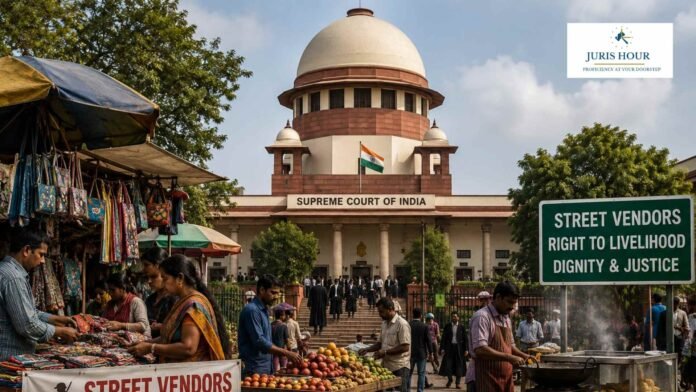
The Supreme Court has quashed the Chandigarh Administration’s 17 July 2020 notification that had expanded the definition of “Essential Service Providers” (ESPs) during the COVID-19 pandemic.
The bench of Justice Sanjay Karol and Justice Nongmeikapam Kotiswar Singh has observed that the notification had outlived the purpose for which it was introduced and directed the authorities to implement a comprehensive and humane street vending policy with adequate rehabilitation measures.
A Bench passed the directions while hearing a matter concerning regulation and rehabilitation of street vendors in Chandigarh.
One of the central issues before the Court was the validity of the Chandigarh Administration’s notification dated 17 July 2020, issued during the COVID-19 pandemic. The notification had substantially widened the category of “Essential Service Providers” by including vendors selling items such as Chhole Bhature, Kulche Chhole, Parantha, fruits and vegetables, among others, and permitted them to operate from 6:00 AM to 10:00 PM.
Buy Now: Supreme court Judgements E-Compilation – JUNE 2026
The Court observed that the notification had been introduced under exceptional circumstances prevailing during the national disaster caused by COVID-19. Since those circumstances no longer existed, the Bench concluded that the notification had served its purpose and could not continue indefinitely.
Accordingly, the Supreme Court quashed the notification and restored the earlier regulatory framework governing essential service providers under the Street Vendors Bye-Laws.
The Court reiterated that while the State possesses the authority to remove illegal encroachments, such action must be accompanied by fairness, responsibility and protection of livelihoods.
It emphasised that identifying new vending zones alone is insufficient unless vendors receive meaningful assistance in shifting to those locations. Relocation often results in loss of established customers and affects the accessibility of essential services to nearby residents. Therefore, rehabilitation measures must ensure minimum disruption to the livelihood of street vendors.
During the proceedings, the Municipal Corporation informed the Court that several measures had already been undertaken.
According to the affidavit Chandigarh has 10,939 registered street vendors, comprising 3,563 Essential Service Providers, 1,139 Mobile Vendors and 6,237 Non-ESP vendors. Around 5,400 challans have been issued during anti-encroachment drives, including nearly 1,150 in the Manimajra area. Details of relocated vendors have been uploaded on the Municipal Corporation’s website through a searchable database. Most vending zones are equipped with drinking water, toilets and paving infrastructure, while additional mobile toilet vans are being procured.
The administration also informed the Court that 6,881 licences had been cancelled for failure to deposit vending fee instalments.
Out of these: 1,346 vendors challenged the cancellations before the appellate authority. 1,177 appeals were allowed subject to payment of outstanding dues. Several appeals and grievance applications remained pending before the appellate forums.
The Court considered submissions made by the Amicus Curiae, who argued that merely issuing challans could not solve the problem of encroachments.
The Amicus pointed out that there was no evidence showing that displaced vendors had actually been rehabilitated in designated vending zones. Large-scale licence cancellations could push vendors into illegal vending due to lack of alternative livelihoods. Pending appeals before the grievance redressal authorities required expeditious disposal. Chandigarh, Mohali and Panchkula should adopt a coordinated strategy because they function as an integrated urban region.
To ensure long-term implementation of the Street Vendors (Protection of Livelihood and Regulation of Street Vending) Act, 2014, the Court issued several directions to the Chandigarh Administration.
The Court directed that recently identified vending zones should be made operational without delay. Daily monitoring must be undertaken to ensure smooth functioning of vending zones. Proper road signage should be installed in commonly used languages directing the public to vending zones. Drinking water, toilets and other civic amenities must be provided and properly maintained. Regular advertisements should be issued through print and electronic media informing citizens about vending zones. Smart identity cards containing geo-coordinates of allotted vending sites should be issued to all licensed vendors, with details shared with the police and district administration. CCTV cameras should be installed in all vending zones within six months, with suitable video storage facilities. Authorities should establish dedicated helplines for vendors and consumers to improve safety and confidence. All pending applications and appeals should be decided within 60 days, while future cases should ordinarily be disposed of within 30 days, subject to the Street Vendors Act and applicable bye-laws.
The Supreme Court directed the Chandigarh Administration to file an affidavit detailing compliance with its directions by 22 July 2026.
The matter has been listed for further hearing on 24 July 2026 to monitor implementation of the Court’s directions.
Membership Required to Access Case Details & Order Copy
To view the complete Case Details and Download Order Copy, you must have an active membership. Please subscribe to continue.
Read More: Lawyers Can’t Surrender Client’s Property Rights Without Express Authority: Supreme Court

