
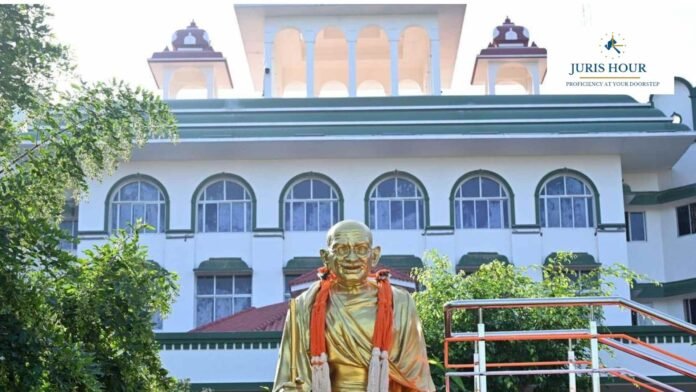
The Madras High Court has ruled that Section 93 of the CGST Act permits initiation of fresh adjudication proceedings even when no notice was issued during the lifetime of the deceased taxable person; liability confined to inherited estate in case of discontinued business.
The bench of Justice D. Bharatha Chakravarthy observed that the GST Department is empowered to initiate fresh proceedings under Sections 73, 74 or 74A against the legal heirs of a deceased taxable person, even if no show cause notice or assessment proceedings had been initiated during the lifetime of the deceased. The Court, however, clarified that where the business has been discontinued, the legal representative’s liability is restricted to the extent of the estate inherited from the deceased.
The case arose after the proprietor of a chemical business passed away in March 2019, following which the business was discontinued and the GST registration was cancelled with effect from December 31, 2019. Several years later, the GST authorities issued communications and notices alleging non-filing of returns in relation to certain e-way bills for the financial year 2018-19.
Buy Now: Must Cite Cases Laws In GST Notices via Common Portal Related Disputes
The legal heir contended that she had never participated in the business and had no knowledge of its transactions after her husband’s demise. Despite her objections, the GST authorities passed an adjudication order determining a tax demand of ₹3.42 lakh along with applicable interest and penalty, leading to the filing of the writ petition.
The principal question before the High Court was: Whether fresh GST assessment proceedings can be initiated against the legal heirs of a deceased taxable person where the business has been discontinued and no proceedings had been initiated during the lifetime of the deceased?
The petitioner argued that Section 93 must be read harmoniously with Section 74 of the CGST Act.
It was submitted that Section 74 mandates issuance of a show cause notice to the “person chargeable with tax.” Since no proceedings were initiated while the original taxable person was alive, fresh proceedings could not subsequently be commenced against the legal heir. The expression “determined after his death” in Section 93 should only cover cases where proceedings had already commenced before death and remained pending. A legal heir who has not continued the business cannot be treated as a “taxable person” merely because of succession. Reliance was placed upon various Supreme Court decisions interpreting taxation statutes as well as judgments under the Income Tax Act dealing with proceedings against deceased assessees.
The GST Department opposed the writ petition, contending that Section 93 itself creates an independent statutory mechanism governing liability after the death of a taxable person.
The Department argued that Section 93 expressly contemplates both situations—where tax liability was determined before death and where it is determined after death. Therefore, the statute itself authorizes initiation as well as determination of tax liability after the death of the taxable person. Since the provision specifically empowers recovery from legal representatives, there was no legal infirmity in initiating proceedings after the taxpayer’s demise.
After examining the statutory framework, the Court rejected the petitioner’s interpretation.
The Court observed that Section 93(1)(b) explicitly states that where the business has been discontinued, the legal representative shall be liable to pay tax, interest and penalty from the estate inherited “whether such tax, interest or penalty has been determined before his death but has remained unpaid or is determined after his death.”
According to the Court, these words have to be given their plain and natural meaning.
The Court held that if the statute expressly permits tax liability to be determined after the death of the taxable person, it necessarily includes the entire adjudicatory process, including issuance of notices, show cause proceedings, consideration of replies, and passing of the final adjudication order.
Any contrary interpretation would defeat the express language employed by Parliament.
The Court also rejected the contention that the expression “person chargeable with tax” under Section 74 refers only to a registered taxable person.
Justice Bharatha Chakravarthy observed that the Legislature deliberately used the broader expression “person chargeable with tax” instead of the narrower term “taxable person.”
The Court held that the expression includes every person upon whom the CGST Act imposes statutory liability, including legal heirs under Section 93, persons liable under reverse charge, e-commerce operators in appropriate cases, and other persons on whom the Act fastens tax liability.
Thus, legal representatives covered under Section 93 fall within the scope of persons against whom proceedings under Section 74 may validly be initiated.
The Court further relied upon the Supreme Court’s decision in Chief Commissioner of CGST v. Safari Retreats Pvt. Ltd., reiterating that taxing statutes must be interpreted strictly according to their language and courts cannot import limitations which the Legislature has consciously omitted.
The judgment noted that while GST is levied upon supplies, the statute may impose liability upon persons other than the supplier in specified circumstances. Therefore, the expression “person chargeable with tax” must be understood in light of the statutory liability created under the Act.
The Madras High Court held that fresh proceedings under Sections 73, 74 or 74A of the CGST Act may be initiated against the legal heirs of a deceased taxable person even if no proceedings had been commenced during the deceased’s lifetime. Such initiation is expressly authorized by Section 93 of the CGST Act. However, where the business has been discontinued, the legal heir’s liability is restricted to the extent of the estate inherited, and cannot exceed the value of such inherited assets.
The Court dismissed the writ petition and upheld the GST adjudication proceedings.
Membership Required to Access Case Details & Order Copy
To view the complete Case Details and Download Order Copy, you must have an active membership. Please subscribe to continue.
Read More: JURISHOUR | TAX LAW DAILY BULLETIN : 30 June, 2026

