
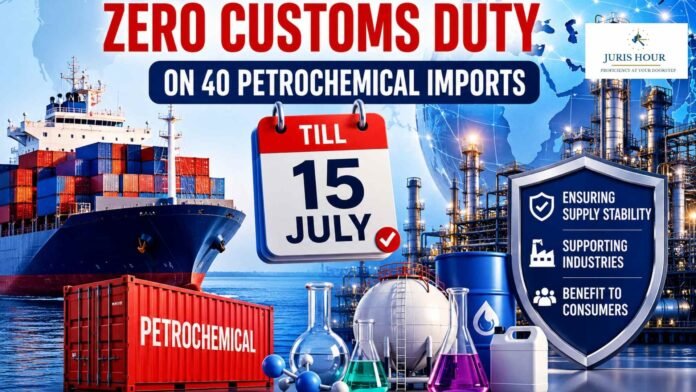
The Central Government has extended the full exemption from customs duty on imports of around 40 critical petrochemical products until July 15, 2026, providing temporary relief to industries facing supply uncertainties arising from geopolitical tensions in West Asia.
The extension was notified by the Ministry of Finance on June 30, 2026, ensuring that the customs duty waiver, which was due to expire on June 30, remains in force for another 15 days. The decision is aimed at maintaining the uninterrupted availability of essential petrochemical feedstock and intermediates for domestic manufacturing industries.
Relief Introduced Amid West Asia Conflict
The customs duty exemption was initially introduced on April 2, 2026, as an emergency measure in response to disruptions in global supply chains caused by the escalating conflict in West Asia. The region plays a crucial role in the global production and transportation of petrochemical products, making supply chains vulnerable to geopolitical instability.
Buy Now: Customs Notifications & Circulars (January – May 2026)
Recognising the potential impact on Indian industries, the government temporarily eliminated customs duty on several key petrochemical imports to prevent shortages and reduce input costs.
With the latest notification, the exemption will continue until July 15, 2026, allowing industries additional time to manage procurement amid ongoing uncertainties.
Objective of the Extension
The extension seeks to ensure:
- Continued availability of essential petrochemical raw materials.
- Stability in domestic manufacturing operations.
- Protection against rising import costs caused by global disruptions.
- Reduced inflationary pressure on downstream industries.
- Uninterrupted production of essential consumer and industrial goods.
The government has stated that the measure is intended to safeguard supply stability while helping industries cope with volatility in international markets.
Industries Expected to Benefit
A wide range of sectors rely heavily on imported petrochemical feedstock and intermediates. The continued duty exemption is expected to provide significant support to industries such as:
- Plastics and polymer manufacturing
- Packaging industry
- Textile and synthetic fibre manufacturers
- Pharmaceutical sector
- Chemical manufacturing
- Automotive components industry
- Paints and coatings
- Adhesives and resins
- Consumer goods manufacturing
These sectors use petrochemical derivatives as essential raw materials, making stable imports critical for uninterrupted production.
Products Covered Under the Exemption
The exemption continues to cover approximately 40 critical petrochemical products, including:
- Methanol
- Anhydrous Ammonia
- Toluene
- Styrene
- Dichloromethane (Methylene Chloride)
- Vinyl Chloride Monomer (VCM)
- Polybutadiene
- Styrene-Butadiene Rubber (SBR)
- Unsaturated Polyester Resins
These products serve as fundamental building blocks for a wide range of industrial and consumer applications.
Supply Chain Concerns Continue
Although global markets have shown signs of stabilisation, shipping disruptions and logistical challenges linked to the West Asia conflict continue to pose risks to international trade.
The region remains a vital corridor for energy supplies and petrochemical exports. Any disruption in maritime routes can significantly affect the availability and pricing of industrial raw materials.
India, being heavily dependent on imports for several petrochemical inputs, remains exposed to such external shocks.
Wider Economic Significance
The customs duty exemption forms part of the government’s broader strategy to minimise the domestic impact of global geopolitical developments.
Besides petrochemical products, concerns persist regarding imports of:
- Crude oil
- Liquefied Natural Gas (LNG)
- Fertilisers
- Industrial chemicals
Given India’s substantial dependence on imported energy resources and fertiliser inputs, ensuring smooth international supply chains remains a key policy priority.
By extending the duty-free window, the government aims to support domestic manufacturers, moderate production costs, and prevent supply shortages that could eventually affect consumers through higher prices.
Short-Term Measure to Maintain Stability
While the exemption currently stands extended only until July 15, 2026, industry stakeholders will closely monitor further government decisions depending on geopolitical developments and global supply chain conditions.
For now, the continued customs duty waiver provides temporary but important relief to manufacturers relying on imported petrochemical feedstock, helping maintain production continuity and supply stability across multiple sectors of the Indian economy.
Read More: 9 Years of GST: Struggles For Rate Rationalisation, ITC Roadblocks Still Continues

