
When the Goods and Services Tax (GST) was launched on 1 July 2017, it was projected as India’s biggest indirect tax reform since Independence. The promise was simple yet ambitious—One Nation, One Tax, One Market. The reform sought to replace multiple Central and State indirect taxes, eliminate cascading taxation, simplify compliance and create a unified national market.
Nine years later, GST has undoubtedly transformed India’s tax ecosystem. Monthly GST collections regularly cross ₹2 lakh crore, the tax base has expanded significantly, e-invoicing and e-way bills have digitised compliance, and interstate trade has become substantially easier. Technology-driven enforcement has also brought millions of businesses into the formal economy.
However, behind these achievements lies another reality.
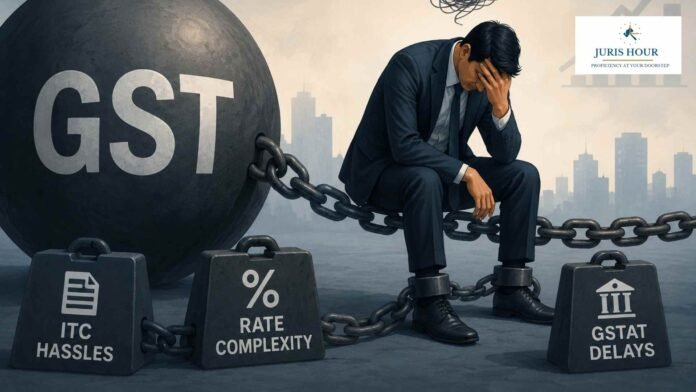
GST continues to struggle with three fundamental challenges:
- Frequent changes in tax rates and incomplete rate rationalisation
- Persistent disputes surrounding Input Tax Credit (ITC)
- An overburdened litigation system despite the operationalisation of GST Appellate Tribunals (GSTAT)
As GST enters its tenth year, the focus is gradually shifting from implementation to perfection.
From a Revolutionary Reform to Continuous Repair
GST replaced nearly 17 Central and State taxes and over 20 cesses with a common tax framework.
The reform achieved several milestones:
- Creation of a common domestic market.
- Digital tax administration through GSTN.
- E-way Bills reducing interstate barriers.
- E-invoicing improving invoice matching.
- Better tax collections through data analytics.
- Reduction of tax cascading.
The compliance ecosystem today is almost entirely digital.
Yet GST has evolved through hundreds of notifications, circulars, amendments and judicial interpretations, indicating that the law remains under constant refinement.
Rate Rationalisation: The Biggest Unfinished Agenda
Perhaps no issue has troubled taxpayers more than GST’s complex rate structure.
The original GST design introduced multiple slabs:
- 0%
- 5%
- 12%
- 18%
- 28%
- Compensation Cess
Although multiple slabs were politically necessary at the time, they also became one of GST’s greatest weaknesses.
Businesses frequently struggled with:
- Classification disputes
- Different rates on similar products
- Constant notifications changing applicable rates
- Litigation over whether a product falls under one entry or another
Thousands of Advance Rulings and High Court decisions emerged merely because identical goods attracted different GST rates.
2025–26 Rate Rationalisation
The long-awaited GST reforms finally resulted in significant rate rationalisation, with the government simplifying several tax slabs and reducing exemptions while attempting to address inverted duty structures and improve compliance. The revised framework aims to reduce classification disputes and simplify taxation for businesses and consumers alike.
While the reform has reduced complexity, experts believe the exercise remains incomplete because:
- petroleum products continue outside GST,
- electricity remains outside GST,
- alcohol for human consumption is excluded,
- stamp duty remains outside GST,
- real estate continues to have multiple tax treatments.
Unless these sectors are integrated, the dream of a truly seamless indirect tax system remains unfinished.
Input Tax Credit: The Most Litigated Area Under GST
If one single issue defines GST litigation, it is Input Tax Credit (ITC).
The philosophy of GST was straightforward:
Tax should be levied only on value addition.
Input Tax Credit was intended to eliminate cascading taxation.
Instead, ITC has become the single largest source of litigation.
Supplier Default vs Recipient Rights
One of the biggest controversies has been whether an honest purchaser should lose ITC because the supplier failed to:
- deposit tax,
- upload invoices,
- file returns,
- remain registered.
Across India, High Courts have repeatedly examined this issue.
Businesses argue:
Once the purchaser has paid the supplier and possesses valid invoices, ITC should not be denied merely because of the supplier’s default.
Tax authorities often contend that Section 16 conditions require actual tax payment to the Government.
This conflict has generated thousands of writ petitions.
GSTR-2B Dependency Changed the Nature of ITC
Originally GST promised automatic invoice matching.
However, the transition to GSTR-2A, followed by GSTR-2B, fundamentally changed compliance.
Today taxpayers must constantly reconcile:
- Purchase Register
- GSTR-2B
- Supplier filings
- Credit reversals
- Reclaimed ITC
Large companies spend enormous resources on reconciliation instead of business expansion.
Even small mismatches frequently trigger notices.
Rule 36(4), Section 16 and Endless Litigation
Over the years, taxpayers have faced disputes relating to:
- Rule 36(4) restrictions
- Blocked credits under Section 17(5)
- Fake invoice allegations
- Non-existent suppliers
- Time limitation for claiming ITC
- Reversal of ITC due to delayed payments
- Credit linked to cancelled registrations
Almost every major High Court has delivered landmark rulings on ITC.
Despite these judgments, complete certainty remains elusive.
Technology Has Improved Compliance—but Also Increased Notices
GST has become one of the world’s most technology-driven tax systems.
Authorities now use:
- AI-driven analytics,
- E-way Bill data,
- E-invoices,
- Banking information,
- Customs imports,
- Income-tax information,
- Data matching algorithms.
This has improved detection of fraud.
However, businesses complain that automated notices are often generated without adequate human verification.
Many notices involve:
- minor mismatches,
- clerical errors,
- timing differences,
- reconciliation issues.
Professionals argue that technology should improve compliance—not multiply litigation.
The GSTAT Journey: A Tribunal That Took Years to Arrive
One of GST’s biggest structural weaknesses was the absence of an effective appellate mechanism.
Although the GST law envisaged the Goods and Services Tax Appellate Tribunal (GSTAT) from the very beginning, taxpayers waited for years before the tribunal became operational.
During this prolonged gap:
- appeals accumulated,
- High Courts became the primary forum,
- taxpayers faced uncertainty,
- recovery proceedings continued despite pending disputes.
The delay significantly increased litigation costs and prolonged tax disputes.
Even After GSTAT, Challenges Continue
While GSTAT has finally begun functioning, several concerns remain.
These include:
- uneven infrastructure across States,
- vacancy of Members,
- heavy backlog,
- transition of old appeals,
- procedural standardisation,
- availability of digital hearings,
- consistency among different benches.
Tax professionals also point out that conflicting decisions between various State Benches could eventually increase litigation before High Courts and the Supreme Court.
The success of GSTAT will ultimately depend not merely on its creation but on the speed and consistency of justice.
Compliance Cost Remains High
GST was expected to simplify business.
Instead, businesses today routinely handle:
- GSTR-1
- GSTR-3B
- Annual Returns
- Reconciliations
- E-way Bills
- E-invoicing
- Refund applications
- Departmental notices
- ITC reconciliations
- Vendor compliance monitoring
For MSMEs, compliance costs remain disproportionately high.
Many small businesses continue to rely entirely on tax professionals simply to remain compliant.
Refund Delays Continue to Hurt Exporters
Although refund processing has improved considerably, exporters still report delays in:
- ITC refunds,
- inverted duty refunds,
- verification processes,
- document scrutiny.
Working capital continues to remain blocked in many cases.
The Government has introduced legislative amendments to accelerate provisional refunds and streamline refund mechanisms, but implementation remains uneven.
GST Litigation Has Shifted from Tax Collection to Interpretation
The nature of GST disputes has also evolved.
Earlier disputes largely involved:
- tax evasion,
- registration,
- transitional credit.
Today litigation increasingly concerns:
- interpretation,
- classification,
- valuation,
- ITC,
- procedural fairness,
- limitation,
- natural justice.
This indicates that GST has matured—but the law still requires greater clarity.
The Road Ahead: GST 3.0?
Experts believe the next phase of GST reforms should focus on structural certainty rather than frequent amendments.
Some widely suggested reforms include:
- Bringing petroleum products under GST.
- Including electricity within the GST chain.
- Rationalising remaining tax slabs.
- Simplifying ITC provisions.
- Reducing compliance burden for MSMEs.
- Faster refunds.
- Strengthening GSTAT with adequate benches and Members.
- Greater certainty through fewer retrospective clarifications.
- Stable law with minimal annual amendments.
Conclusion
Nine years after its launch, GST stands as one of India’s most successful tax reforms in terms of revenue mobilisation, digitisation and market integration. The system has substantially expanded the tax base, improved compliance and made indirect taxation more transparent.
Yet success cannot be measured solely by collections.
The true test of a mature tax regime lies in simplicity, certainty and fairness.
Frequent classification disputes, persistent ITC litigation, evolving compliance requirements and the prolonged struggle to establish an effective appellate framework show that GST remains a work in progress.
The coming decade will determine whether India can transform GST from a technologically advanced tax system into one that is equally predictable, taxpayer-friendly and litigation-free. Only then will the original promise of “One Nation, One Tax” be fully realised.

