
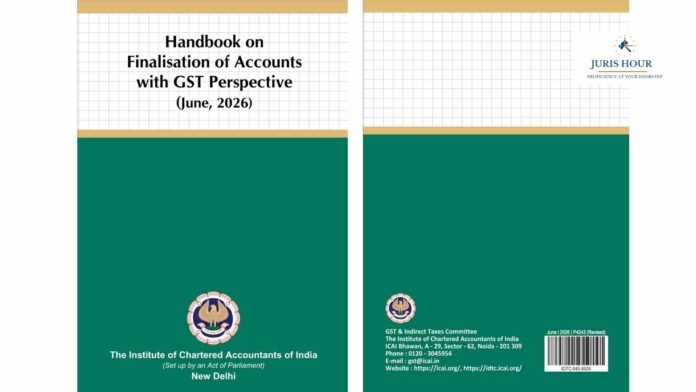
The Institute of Chartered Accountants of India (ICAI) has released the revised edition of the “Handbook on Finalisation of Accounts with GST Perspective (June 2026)”, providing comprehensive guidance to chartered accountants, auditors, tax professionals and businesses on integrating GST compliance with the process of finalisation of financial statements.
The publication has been updated up to 31 May 2026 and reflects the latest legislative amendments, judicial developments, technological changes and compliance requirements under the GST regime.
The handbook, published by the GST & Indirect Taxes Committee of ICAI, emphasizes that GST compliance is no longer confined to filing returns but has become an integral part of financial reporting. It states that errors identified during GST reconciliations can materially affect the “true and fair view” of financial statements if left unaddressed before the audit report is issued.
GST Compliance Must Form Part of Financial Statement Audit
According to the handbook, auditors should not wait until the preparation of the annual GST return and reconciliation statement to verify GST compliance. Instead, GST reconciliations should ideally be performed simultaneously with the statutory audit to identify any discrepancies relating to turnover, input tax credit (ITC), tax liability or disclosures before the accounts are finalized.
The publication notes that although mandatory GST audit under Section 35(5) of the CGST Act has been abolished from August 1, 2021, businesses with aggregate turnover exceeding ₹5 crore continue to file a self-certified Form GSTR-9Calong with the annual return. Since financial statements under the Companies Act and Income-tax law are generally finalized much earlier than GST annual compliances, auditors must proactively verify GST-related adjustments during the audit itself.
Extensive Reconciliation Checklist
The revised handbook recommends that auditors undertake several reconciliations before certifying financial statements, including:
- Electronic Credit Ledger versus ITC in books.
- Electronic Cash Ledger versus GST payments recorded in books.
- GST refunds claimed versus refund receivable balances.
- Turnover reported in books vis-à-vis GSTR-1, GSTR-3B and e-Way Bills.
- ITC reconciliation between books, GSTR-3B and GSTR-2B.
- Reversal of ineligible ITC.
- Outstanding GST notices, demands and contingent liabilities.
- Reverse Charge Mechanism (RCM), TDS and TCS compliance.
- Cross-charge transactions between registrations under the same PAN.
- Vendor reconciliations and treatment of credit/debit notes.
Guidance on Fixed Assets and Blocked Input Tax Credit
The handbook dedicates significant attention to accounting treatment of capital assets from a GST perspective. It reiterates that GST paid on blocked credit items under Section 17(5), including specified motor vehicles, construction of immovable property and certain leasing and insurance services, should form part of the cost of the asset instead of being claimed as input tax credit.
It also advises auditors to verify GST implications arising from:
- Sale or disposal of capital goods.
- Assets sent to job workers.
- Imported services capitalized with fixed assets.
- Right-of-use assets under Ind AS.
- Capital goods written off, lost or destroyed.
Special Focus on Inventory Verification
The ICAI publication provides practical guidance on inventory-related GST issues. It discusses treatment of goods-in-transit, goods sent to job workers, goods supplied on approval basis and stock discrepancies identified during physical verification.
The handbook reminds auditors that ITC on goods written off, lost, destroyed or distributed as free samples may require reversal under the GST law. It also stresses verification of statutory timelines for return of goods sent to job workers to avoid deemed supply implications.
Verification of GST Assets and Liabilities
The handbook advises auditors to reconcile GST input tax credit balances appearing in financial statements with the Electronic Credit Ledger maintained on the GST portal.
Common reconciliation issues highlighted include:
- ITC reflected in books but not available in GSTR-2B.
- Credits availed in different accounting periods.
- Refunds pending, rejected or partially sanctioned.
- ITC reversals not recorded in books.
- Differences arising from delayed supplier filings.
Similarly, GST cash balances should be reconciled with the Electronic Cash Ledger to ensure proper accounting of TDS, TCS, tax payments and outstanding liabilities.
Revenue Recognition Requires GST Review
For the Statement of Profit and Loss, the handbook recommends detailed verification of turnover reported under GST with revenue recorded in books. Particular emphasis has been placed on:
- Multi-state GST registrations.
- Cross-charges between registrations.
- Deemed supplies without consideration.
- HSN classification.
- Taxability of advances.
- Discounts and credit notes.
- Exchange rate differences.
- Non-GST supplies.
- Sales promotion schemes including free samples and “Buy One Get One” offers.
Finance Act, 2026 Amendment on Post-Supply Discounts
One of the notable updates incorporated in the revised handbook is the amendment introduced by the Finance Act, 2026to Section 15(3)(b) of the CGST Act concerning post-supply discounts.
The publication explains that once the amendment becomes operational, post-supply discounts will be deductible from taxable value if a valid credit note under Section 34 is issued and the recipient reverses the corresponding input tax credit. However, it also clarifies that until the amendment is notified, the earlier legal position requiring a pre-existing agreement and invoice linkage will continue to apply.
Practical Resource for Professionals
The handbook contains dedicated chapters on audit approach, balance sheet review, profit and loss verification, CARO 2020, tax audit implications and frequently asked questions. It is intended to serve as a practical reference for chartered accountants, auditors, finance professionals and businesses undertaking year-end financial reporting under the GST regime.
By emphasizing simultaneous GST reconciliation and financial statement audit, ICAI aims to help professionals reduce compliance risks, prevent material misstatements and ensure that audited financial statements present a true and fair view while remaining consistent with GST law and reporting requirements.
Membership Required to Access Handbook & Copy
To view the complete Handbook and Download Copy, you must have an active membership. Please subscribe to continue.

