
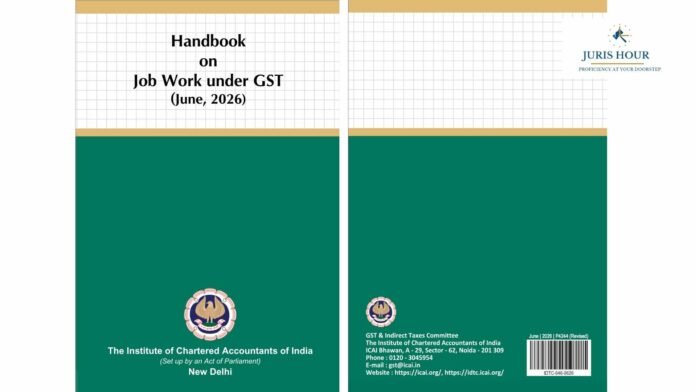
The Institute of Chartered Accountants of India (ICAI), through its GST & Indirect Taxes Committee, has released the Fourth Edition of the “Handbook on Job Work under GST”, comprehensively revised to incorporate legislative amendments, judicial developments, procedural changes, and CBIC clarifications up to May 31, 2026. The publication is intended to serve as a practical guide for chartered accountants, tax professionals, manufacturers, job workers, and businesses dealing with job work transactions under the Goods and Services Tax (GST) regime.
The revised handbook explains the statutory framework governing job work under the Central Goods and Services Tax (CGST) Act, 2017 and the corresponding Rules while simplifying complex compliance requirements through illustrations, procedural guidance, and practical scenarios.
BUY NOW: 500+ CGST Notifications (2017–2025) | Clickable Index E-Magazine | Hyperlinked Original PDFs
Comprehensive Guidance on Job Work Provisions
The handbook explains that under Section 2(68) of the CGST Act, job work refers to any treatment or process undertaken on goods belonging to another registered person. It emphasizes that the principal must be a registered person for the activity to qualify as job work under GST. The publication also clarifies that activities such as packing, repacking, testing, inspection, labelling, and contract manufacturing can qualify as job work, provided ownership of the goods remains with the principal.
Further, it reiterates that job work is treated as a supply of services under Schedule II of the CGST Act and discusses the valuation implications, aggregate turnover considerations, and registration requirements applicable to job workers.
Updated Compliance Procedures
A major focus of the revised handbook is the procedural framework prescribed under Section 143 of the CGST Act and Rule 45 of the CGST Rules.
It explains that principals may send inputs, semi-finished goods, or capital goods to job workers without payment of GST under a delivery challan, while detailing documentation requirements, e-way bill provisions, and movement of goods between multiple job workers. The publication also provides guidance on filing Form GST ITC-04, including the revised filing frequency based on aggregate turnover.
The handbook further clarifies that goods can be supplied directly from suppliers to job workers without first reaching the principal’s premises, while allowing the principal to avail input tax credit subject to prescribed conditions.
Timelines for Return of Goods Explained
The publication reiterates the statutory timelines applicable to goods sent for job work.
Inputs and semi-finished goods are generally required to be returned within one year, while capital goods must be returned within three years. The Commissioner may extend these periods upon sufficient cause being shown. However, moulds, dies, jigs, fixtures, and tools remain exempt from these time limits. Failure to comply results in the transaction being deemed as a supply from the principal to the job worker from the date the goods were originally dispatched, making the principal liable to pay GST along with applicable interest.
Practical Illustrations for Businesses
To simplify compliance, the handbook includes practical flowcharts illustrating common business situations, including:
- Goods sent to a job worker and returned.
- Goods supplied directly by vendors to job workers.
- Direct supply of processed goods from the job worker’s premises to customers.
- Movement of goods between multiple job workers.
These illustrations provide practical guidance on documentation, delivery challans, e-way bills, and invoicing requirements for each scenario.
Registration, Waste & Scrap, and ITC
The ICAI publication also discusses the GST registration requirements applicable to job workers, clarifying that registration depends upon aggregate turnover rather than merely making inter-State supplies of services.
Separate chapters explain the treatment of waste and scrap generated during job work, eligibility of principals to claim input tax credit even where goods are directly dispatched to job workers, and the consequences where prescribed timelines are not adhered to.
The handbook also addresses place of supply provisions, delivery challan requirements, tax invoice contents, transitional provisions from the pre-GST regime, and applicable GST rates for different categories of job work services.
Compilation of Statutory Provisions and Circulars
Apart from explanatory notes, the publication contains the complete statutory text of relevant provisions including Sections 19, 141 and 143 of the CGST Act, Rule 45 and Rule 55 of the CGST Rules, specimen delivery challans, Form GST ITC-04, and a compilation of important CBIC circulars issued from 2017 through 2024 relating to job work under GST.
Strengthening GST Compliance
In the foreword, ICAI President CA. Prasanna Kumar D noted that the GST framework has undergone continuous evolution since its implementation in 2017 and that the revised handbook has been prepared to assist professionals and taxpayers in understanding the latest legal and procedural developments relating to job work. The GST & Indirect Taxes Committee stated that the handbook has been updated up to May 31, 2026, with the objective of providing comprehensive guidance at one place for all stakeholders involved in GST compliance.
Membership Required to Access Case Details & Order Copy
To view the complete Case Details and Download Order Copy, you must have an active membership. Please subscribe to continue.

