
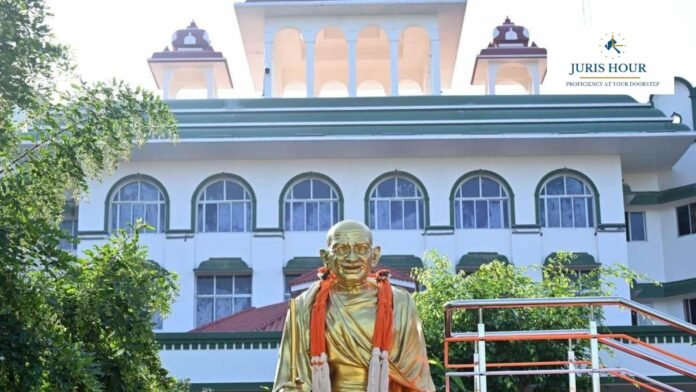
The Madurai Bench of the Madras High Court has held that statutory notifications issued under the Central Goods and Services Tax (CGST) Act cannot travel beyond the recommendations of the GST Council.
The bench of Justice G.R. Swaminathan and Justice R. Kalaimathi has observed that the GST Council cannot subsequently ratify a notification that was issued beyond its original recommendations.
The petitions were filed by several dealers engaged in the sale of pulses such as Moong Dal and Toor Dal. These traders marketed their products under brand names that were not registered under the Trade Marks Act or Copyright Act.
When GST was introduced on 1 July 2017, Notification No. 1/2017-Central Tax (Rate) imposed GST only on pulses sold in unit containers bearing a registered brand name. Likewise, Notification No. 2/2017 exempted pulses that did not satisfy these conditions. Consequently, traders using unregistered brand names remained outside the GST net. However, the Central Government later issued Notifications No. 27/2017 and 28/2017 dated 22 September 2017, expanding GST liability to products bearing a brand name over which an actionable claim or enforceable legal right existed, even if the brand was not formally registered, unless such rights had been voluntarily foregone. Based on these amendments, show cause notices were issued to the petitioners demanding GST.
The petitioners challenged both the notifications and the consequential show cause notices, contending that the amendments exceeded the recommendations made by the GST Council and therefore violated Article 279A of the Constitution.
The Division Bench framed two substantial constitutional issues: Whether notifications issued by the Central Government under Sections 9 and 11 of the CGST Act can go beyond the recommendations of the GST Council. Whether the GST Council possesses the power to subsequently ratify or validate such notifications after they have been issued.
The petitioners relied heavily on the Supreme Court’s landmark judgment in Union of India v. Mohit Minerals Pvt. Ltd. (2022) 10 SCC 700, arguing that although GST Council recommendations may not bind Parliament while enacting legislation, they do bind the executive when exercising delegated legislative powers through notifications and rules.
According to the petitioners, the impugned notifications substantially altered the taxability recommended by the GST Council and therefore exceeded statutory authority.
The Union Government argued that GST Council recommendations should not be interpreted mechanically. It submitted that the notifications merely reflected the true intention behind the GST Council’s recommendations and corrected drafting errors noticed after the Council’s meeting. It also pointed out that the amendments were subsequently placed before the 22nd GST Council Meeting and ratified.
The Court undertook a detailed examination of the constitutional framework governing GST, particularly Articles 246A, 269A and 279A, alongside Sections 9, 11, 164 and 166 of the CGST Act.
Referring extensively to the Supreme Court’s observations in Mohit Minerals, the Bench noted that while GST Council recommendations are not binding upon Parliament in making primary legislation, they are binding upon the Government when it exercises delegated legislative powers through subordinate legislation.
The Court observed that notifications issued under Sections 9 and 11 stand on the same footing as rules framed under Section 164 because both constitute subordinate legislation and are required to be laid before Parliament.
Accordingly, once the Government is bound by GST Council recommendations while framing rules, the same principle necessarily extends to statutory notifications issued under the charging and exemption provisions of the CGST Act.
A central feature of the judgment is the Court’s interpretation of the phrase “on the recommendations of the Council”appearing in Sections 9 and 11.
The Bench held that the statutory language requires the recommendations of the GST Council to precede the issuance of notifications. Therefore, notifications cannot subsequently be validated merely because the Council later approves or ratifies them.
The Court reasoned that permitting post facto ratification would undermine the constitutional role assigned to the GST Council under Article 279A and dilute the framework of cooperative federalism established through the GST constitutional amendment.
The Court emphasized that GST was introduced to create a harmonized national indirect tax system based on consensus between the Union and the States.
It observed that allowing the Central Government to independently alter or expand GST Council recommendations while issuing notifications would defeat the very objective of maintaining national uniformity in GST and weaken the cooperative federal structure embedded in the Constitution.
Holding that the impugned notifications travelled beyond the GST Council’s recommendations and could not be sustained merely because they were later ratified, the Madras High Court declared the challenged portions of the notifications invalid to that extent.
The Court also quashed the show cause notices issued against the petitioners, granting relief to the pulse traders who had challenged the levy.
Membership Required to Access Case Details & Order Copy
To view the complete Case Details and Download Order Copy, you must have an active membership. Please subscribe to continue.

