
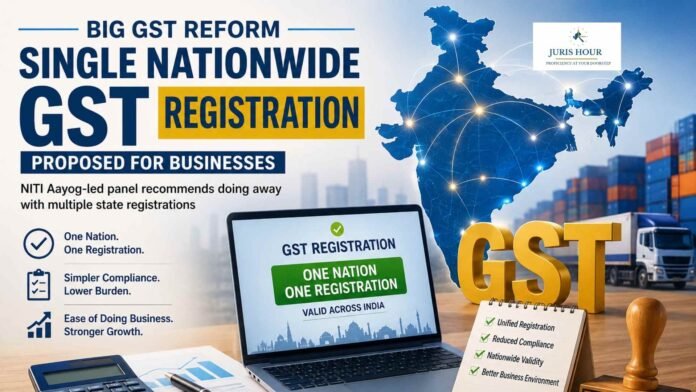
A high-level reform panel headed by Rajiv Gauba has proposed a significant overhaul of India’s Goods and Services Tax (GST) framework by recommending the introduction of a single nationwide GST registration for businesses operating across multiple states.
If implemented, the move could become the most substantial structural reform in the GST regime since its launch in July 2017.
The recommendation forms part of a broader set of regulatory reforms submitted by the High-Level Committee on Regulatory Reforms, which was constituted to identify measures aimed at reducing compliance burdens and improving the ease of doing business in India.
According to government sources, the proposed changes are being considered for implementation during the current fiscal year, although extensive consultations with stakeholders and deliberations within the GST Council will be required before any final decision is taken.
Existing System Requires Multiple State Registrations
Under the current GST framework, businesses operating in more than one state are required to obtain separate GST registrations in each state where they have a place of business. This means companies must comply with multiple registration procedures, maintain separate records, and undertake state-specific compliance obligations.
Industry participants have frequently highlighted the administrative burden created by this structure, particularly for companies with a nationwide footprint. The requirement for multiple registrations often leads to increased compliance costs, duplication of processes, and additional regulatory complexities.
The reform panel has suggested replacing this system with a single PAN-based GST registration valid throughout India, enabling businesses to operate across states without obtaining separate registrations.
Aim Is to Simplify GST Compliance
Government officials familiar with the proposal indicated that simplification of GST compliance remains a key policy objective.
According to sources, the recommendation seeks to reduce procedural complexities that have accumulated over the years through numerous amendments, notifications, circulars, and clarifications issued under the GST framework.
A nationwide registration model could potentially eliminate repetitive compliance requirements and make the tax regime easier for taxpayers to understand and administer.
Businesses with operations across multiple states are expected to benefit significantly through reduced paperwork, streamlined compliance management, and lower administrative costs.
Revenue Sharing Among States Remains a Major Challenge
Despite its potential advantages, the proposal faces a critical implementation challenge—determining how GST revenues would be allocated among states under a single-registration system.
At present, state-wise GST registrations facilitate the identification and distribution of tax revenues to the respective states. A unified registration model would require the development of a robust mechanism to ensure accurate apportionment of tax collections among states where supplies are made.
Officials have acknowledged that this issue involves significant technical and constitutional considerations. The feasibility of the proposal will largely depend on whether a practical and acceptable revenue-sharing mechanism can be devised.
Experts note that any changes affecting the fiscal interests of states are likely to be closely scrutinized during discussions in the GST Council.
Roadmap Prepared, Consultations Expected
Sources indicate that the committee has already prepared a roadmap for the proposed reform. The next stage is expected to involve consultations with industry bodies, tax professionals, state governments, and other stakeholders.
The recommendation comes amid continuing calls from businesses for a simpler GST regime. Since its introduction, GST has undergone several legislative amendments and procedural changes, leading to demands for greater rationalisation and simplification.
Officials believe that reducing compliance complexity can improve taxpayer experience while also supporting business growth and investment.
GST Council Approval Will Be Essential
Any move towards a nationwide GST registration system would require legislative and procedural changes that can only be implemented after deliberations in the GST Council, the apex decision-making body for GST matters.
The Council comprises representatives from both the Centre and the states, making consensus-building crucial for any major structural reform.
While the proposal is still at a preliminary stage, tax experts believe that if successfully implemented, a single GST registration could significantly transform India’s indirect tax compliance landscape and mark the next major evolution of the GST regime nearly a decade after its introduction.
Read More: ED Raids Rajesh Exports

