
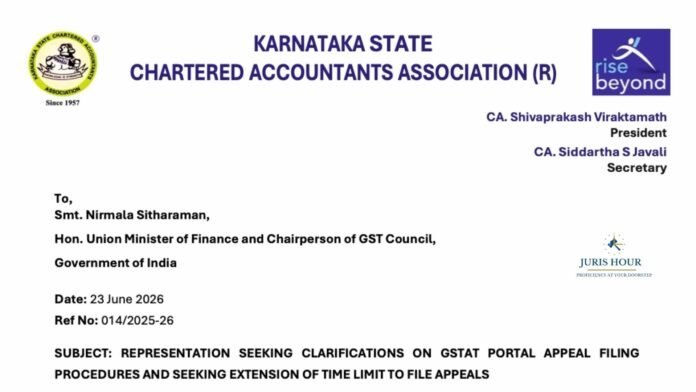
In a significant representation submitted to Union Finance Minister and GST Council Chairperson Nirmala Sitharaman, the Karnataka State Chartered Accountants Association (KSCAA) has sought a three-month extension of the 30 June deadline for filing appeals before the Goods and Services Tax Appellate Tribunal (GSTAT), citing serious procedural, technical, and regulatory concerns surrounding the newly launched GSTAT portal.
The representation, dated June 23, 2026, states that taxpayers and tax professionals across India are facing substantial challenges in understanding and complying with the online filing framework introduced for GSTAT appeals. According to KSCAA, the portal’s recent operationalization, coupled with the absence of comprehensive guidance and evolving procedural rules, has created uncertainty that could adversely affect litigants’ access to justice.
Transition to a New National Appellate System
KSCAA pointed out that appellate practices under GST have evolved differently across States and jurisdictions over the years. With GSTAT now functioning as a unified national appellate forum, taxpayers and professionals are being required to adapt to a standardized electronic filing framework.
The Association emphasized that the portal-based filing process involves multiple mandatory validations, document uploads, and system-generated checks. Since stakeholders are still becoming familiar with the platform, inadvertent filing errors and procedural defects are likely to occur despite genuine compliance efforts. Rectifying such defects, particularly in cases involving voluminous records and complex disputes, can be time-consuming.
KSCAA’s Key Demands
The Association has requested the Government to immediately issue:
Detailed Circular and Filing Instructions
KSCAA has sought comprehensive guidance explaining the information, documents, and supporting records required under each field of the GSTAT appeal application. According to the representation, such guidance would help ensure uniform compliance and significantly reduce avoidable defect notices from the Registry.
Frequently Asked Questions (FAQs)
The Association has also requested a detailed FAQ document addressing common filing issues, portal functionalities, and procedural uncertainties faced by litigants and professionals.
Publication of Common Defects
Another major demand is the publication of common defects identified by the Registry in appeal filings, along with practical guidance to prevent recurrence of such defects. KSCAA believes this would improve filing quality and reduce administrative burden on the Tribunal.
Why KSCAA Wants a Three-Month Extension
1. Recent Launch of GSTAT Portal
The Association highlighted that GSTAT has become operational only recently and taxpayers are still learning the filing process. Additionally, the non-availability of the Tribunal during the initial years of GST has resulted in a large backlog of matters requiring appeals, making preparation of appeal records a significant exercise.
2. Contradictions and Technical Deficiencies in the Portal
One of the strongest criticisms in the representation concerns contradictions within the portal itself.
KSCAA pointed to inconsistencies regarding:
- Whether uploaded documents should be colour-scanned or grayscale.
- Whether physical signatures or digital signatures are required.
- Duplication of effort where Form GST APL-05 and annexures are filled online but are also required to be uploaded separately as PDF files.
- Confusion over whether appeal records must be submitted as a single consolidated paper book or uploaded as multiple files under separate tabs.
The Association argues that these contradictions make compliance uncertain and, in some cases, practically impossible.
Rules Still Undergoing Changes
KSCAA also expressed concern that the GSTAT (Procedure) Rules, 2025 are still evolving.
The representation notes that committee meetings held on May 29 and June 1, 2026, identified various anomalies, unresolved issues, and proposed amendments. Since these changes have not yet been incorporated through a consolidated Gazette notification, stakeholders remain uncertain about the final procedural requirements applicable to appeals.
According to the Association, expecting taxpayers to comply with procedures that are themselves undergoing revision creates avoidable legal and practical difficulties.
Portal Fields Differ from Notified Form APL-05
A major legal concern raised by KSCAA relates to discrepancies between the GSTAT portal and the notified Form GST APL-05.
The Association states that the portal requires additional information not found in the statutory form and contains several fields lacking adequate instructions. These include fields relating to:
- Grounds of Appeal
- Case summaries
- Disputed amounts
- Commencement dates
- Case history particulars
The absence of clear explanations creates a risk of procedural defects even where taxpayers attempt to comply in good faith.
Questions Over Authorised Representatives
The representation also identifies redundancy and inconsistency in the treatment of authorised representatives under Form GST APL-05.
KSCAA noted that similar information regarding the authorised representative is sought in multiple sections of the form, potentially creating confusion regarding whether the representative relates to the appellant or the respondent authority. The Association has suggested consolidation of these fields into a single entry.
Ambiguity on Power of Attorney and Vakalatnama
The Association has further sought clarification regarding:
- Whether a Power of Attorney or Vakalatnama in favour of a Chartered Accountant must be executed on stamp paper.
- Whether portal-based authorization itself is sufficient.
- The procedure for changing or replacing an authorised representative after filing an appeal.
According to KSCAA, the absence of clear instructions on these issues could lead to procedural disputes at a later stage.
Digital Signature Confusion
The representation also highlights uncertainty regarding digital signature requirements.
While the portal requires uploaded documents to be digitally signed, it remains unclear whether:
- A single digital signature on the document is sufficient; or
- Every page must be digitally signed separately.
KSCAA warned that if page-wise signing is required, taxpayers may be forced to purchase additional third-party software, resulting in unnecessary compliance costs.
No Offline Utility Available
Another major grievance concerns the absence of an offline filing utility.
Unlike several other government and judicial portals, GSTAT presently does not provide any downloadable tool for preparing appeals offline. The Association stated that professionals must remain continuously logged into the portal, exposing them to session timeouts, data loss, and repeated data entry. Payment failures and technical glitches often require restarting the filing process from scratch.
KSCAA observed that the GSTAT portal falls short of contemporary standards followed by forums such as the Income Tax Appellate Tribunal and the Supreme Court.
Lack of Clarity on Paper Books and Additional Evidence
The Association has also raised concerns regarding the filing of paper books and supplementary records.
Although GSTAT has indicated that initial filing may be completed using only basic documents such as the Show Cause Notice, Order-in-Original, Order-in-Appeal, and Grounds of Appeal, several important procedural questions remain unanswered.
These include:
- When detailed paper books may be filed.
- Whether separate case law compilations can be submitted later.
- Whether Tribunal permission would be required for additional evidence.
- Timelines for uploading supplementary documents.
- Whether matters will first be listed for admission before directions regarding paper books are issued.
KSCAA contends that these uncertainties are discouraging many professionals from filing appeals before the June 30 deadline.
Final Request to Government
Concluding its representation, KSCAA has urged the Government to:
- Extend the GSTAT appeal filing deadline by three months; and
- Issue detailed circulars, FAQs, instructions, and guidance on common defects to facilitate smooth compliance.
The Association stated that such measures would help ensure that appeals are decided on merits rather than being affected by procedural and technical hurdles arising from the transition to the new electronic filing regime.
Significance of the Representation
With the June 30, 2026 deadline for filing legacy GST appeals rapidly approaching, the representation highlights growing concerns among tax professionals regarding the readiness of the GSTAT ecosystem. If accepted, the requested extension could provide much-needed breathing space for taxpayers while allowing authorities to address procedural ambiguities and strengthen the portal infrastructure before large-scale appellate litigation begins.
Membership Required to Access Representation & Copy
To view the complete Representation and Download Copy, you must have an active membership. Please subscribe to continue.
Read More: Can an Acquired Workforce Be Treated as a Depreciable Asset? ITAT

