
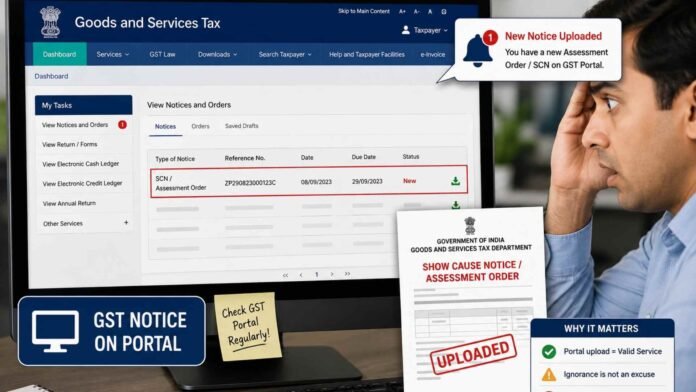
The Supreme Court has dismissed an SLP filed against a Section 74 assessment order, making two critical observations.
First, upload of an assessment order on the electronic portal constitutes valid communication – no convincing reason exists to overlook electronic service, and ignorance of a portal-uploaded order will not be accepted.
Second, and independently, the petitioner’s own admission of having become aware of proceedings in 2024 yet approaching the High Court by writ only in 2025 by which time Section 107 appeal was time-barred was fatal.
The bench of Justice Joymalya Bagchi and Justice Vipul M. Pancholi firmly held that a writ petition cannot serve as a surrogate for an appellate remedy the petitioner chose not to avail
The petitioner argued that the authorities had wrongly invoked Section 74 of the CGST Act, a provision dealing with tax demands involving fraud, wilful misstatement or suppression of facts. The company contended that the essential ingredients necessary for invoking Section 74 were absent in the present case.
According to the petitioner, there was no wilful suppression of material facts. It was further submitted that the Input Tax Credit (ITC) claimed in the GST returns for October 2017 had subsequently been voluntarily reversed in the returns filed for November 2017. The company also attempted to draw support from another matter pending before the Supreme Court involving similar issues relating to Section 74 notices.
The Supreme Court examined the show cause notice dated September 8, 2023 and the assessment order dated November 7, 2023. The Bench noted that the factual matrix forming the basis of the proceedings had been elaborately discussed by the tax authorities in the impugned order.
The Court observed that the CGST Act provides a specific appellate remedy under Section 107 against assessment orders. Instead of availing that statutory remedy within time, the petitioner sought to challenge the proceedings through a writ petition after the limitation period had expired.
A significant aspect of the judgment relates to electronic communication of GST orders. The petitioner argued that it was unaware of the assessment order because it had been uploaded on the GST portal.
Rejecting the contention, the Supreme Court held that no convincing explanation had been provided for overlooking communications available on the electronic portal. The Court further noted that, by the petitioner’s own admission, it had become aware of the proceedings much earlier in 2024 but approached the High Court only in 2025.
The Bench agreed with the Punjab and Haryana High Court’s decision to refuse interference. It observed that the writ petition was being used as a surrogate for appellate proceedings that had not been pursued within the prescribed period.
The Court emphasized that when a statutory remedy exists and the taxpayer has failed to avail it in time, writ jurisdiction ordinarily should not be invoked to revive a time-barred challenge.
The petitioner relied upon another pending Special Leave Petition concerning Section 74 notices. However, the Supreme Court distinguished that matter on facts. The Bench observed that the earlier case involved a challenge to the validity of the show cause notice itself on the ground that primary facts constituting suppression had not been disclosed.
In contrast, the present case involved a challenge after the assessment order had already been passed and after the statutory appeal remedy had become time-barred. Accordingly, the Court found no reason to extend the benefit of the pending proceedings to the petitioner.
Finding no merit in the challenge, the Supreme Court dismissed the Special Leave Petition and disposed of all pending applications. The ruling serves as a reminder to taxpayers that GST orders uploaded on the electronic portal carry legal significance and that failure to challenge such orders within the statutory period may prove fatal to subsequent litigation.
Membership Required to Access Case Details & Order Copy
To view the complete Case Details and Download Order Copy, you must have an active membership. Please subscribe to continue.

