
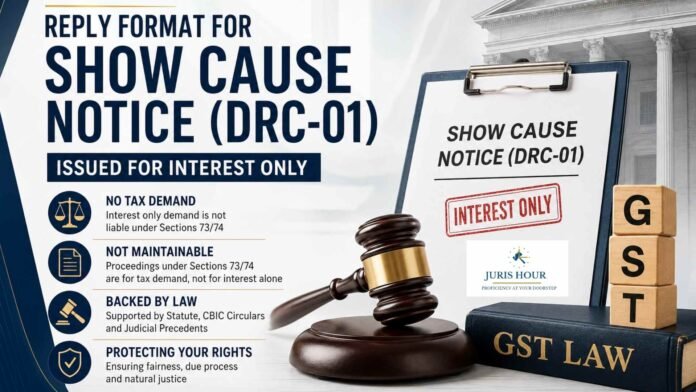
Here’s the reply format for show cause notice issued only for interest demand under FORM DRC-01.
To
The Proper Officer
[Jurisdiction / Division / Commissionerate]
[Address]
Subject: Reply to Show Cause Notice in Form DRC-01 dated ______ proposing recovery of interest for the tax period ______ – Request for dropping of proceedings.
Reference: Show Cause Notice No. ______ dated ______ issued under Section 73/74 of the CGST/SGST Act.
Respected Sir/Madam,
I, [Name of Taxpayer/Authorized Signatory], on behalf of M/s. [Name of Registered Person], GSTIN __________, hereby submit this reply to the aforesaid Show Cause Notice (“SCN”) proposing recovery of interest under the provisions of the GST law.
The allegations and proposals contained in the notice are denied in their entirety except to the extent specifically admitted herein. The impugned notice is contrary to the statutory scheme, judicial precedents, and settled principles of law and therefore deserves to be withdrawn.
I. FACTUAL BACKGROUND
- The registered person has duly discharged its tax liabilities and has regularly furnished returns prescribed under the GST law.
- The impugned SCN does not allege any short payment of tax, wrongful availment of input tax credit, erroneous refund, suppression of facts, or tax evasion.
- The sole proposal contained in the SCN pertains to recovery of interest for the period mentioned therein.
- The notice seeks to invoke proceedings under Sections 73/74 of the Act even though no corresponding tax demand has been proposed.
II. PRELIMINARY OBJECTIONS
A. Proceedings under Sections 73/74 cannot be initiated solely for recovery of interest
- Sections 73 and 74 are adjudicatory provisions intended for determination of tax not paid, short paid, erroneously refunded, or wrongly availed/utilized input tax credit.
- In the present case, there is no proposal for determination of tax liability. The entire proceedings have been initiated exclusively for recovery of interest.
- Since the foundation of proceedings under Sections 73/74 is absent, the impugned notice lacks jurisdiction and is liable to be set aside.
B. Separate statutory mechanism exists for recovery of admitted interest
- The GST law provides a specific mechanism for recovery of self-assessed tax and consequential interest where the liability is undisputed.
- When the legislature has prescribed a particular procedure for recovery, the authorities are required to follow that procedure alone and cannot resort to an alternative route not contemplated by law.
- Invocation of adjudication provisions for recovery of interest alone defeats the legislative framework and renders the proceedings unsustainable.
III. LEGAL SUBMISSIONS
A. Lack of Jurisdiction
- The impugned notice seeks to expand the scope of Sections 73/74 beyond their intended purpose.
- Interest is merely ancillary to tax liability and cannot ordinarily become the sole subject matter of adjudication under provisions meant for determination of tax.
- In the absence of a tax demand, the proceedings initiated under Sections 73/74 are without jurisdiction and deserve to be dropped.
B. Violation of Principles of Natural Justice
- The impugned notice fails to provide adequate reasoning regarding:
- the basis of interest computation;
- the period for which interest is sought;
- the manner in which liability has been determined; and
- whether the alleged liability is disputed or admitted.
- The notice does not furnish sufficient material enabling the taxpayer to effectively rebut the allegations.
- Any action having civil consequences must satisfy the requirements of fairness, transparency, and reasoned decision-making.
C. Statutory Procedure Must Be Strictly Followed
- It is a settled principle that where a statute prescribes a particular manner for doing an act, that act must be done only in that manner and not otherwise.
- Since the GST law contains a specific mechanism for recovery of undisputed liabilities, initiation of proceedings under Sections 73/74 solely for interest recovery is legally untenable.
IV. WITHOUT PREJUDICE SUBMISSIONS
- Without prejudice to the above objections, the computation of interest proposed in the notice is denied.
- The notice neither provides complete workings nor explains the methodology adopted for calculating the alleged interest liability.
- The taxpayer reserves the right to file a detailed rebuttal and additional documents upon receipt of complete calculations and supporting records relied upon by the department.
V. REQUEST FOR PERSONAL HEARING
- In the interest of justice and fair adjudication, an opportunity of personal hearing may kindly be granted before passing any adverse order.
- The taxpayer also reserves the right to file supplementary submissions, documents, and judicial precedents during the course of hearing.
VI. JUDICIAL PRECEDENTS SUPPORTING THE TAXPAYER
Union of India v. LC Infra Projects Pvt. Ltd.
2020 (116 taxmann.com 205) (Karnataka High Court)
- The Hon’ble Karnataka High Court held that where the tax liability is self-assessed and admitted, the proper course available to the department is recovery under the machinery provisions of the Act and not initiation of adjudication proceedings under Sections 73 or 74.
- The Court observed that Sections 73 and 74 are intended for determination of disputed tax liability and cannot be routinely invoked for recovery of admitted dues.
- Accordingly, the impugned notice seeking recovery of interest alone under Section 73/74 is contrary to the ratio laid down by the Hon’ble Karnataka High Court.
2. Mahadeo Construction Co. v. Union of India
2020 (116 taxmann.com 262) (Jharkhand High Court)
- The Hon’ble Jharkhand High Court held that recovery proceedings cannot be initiated in a mechanical manner without following due process prescribed under the statute.
- The Court emphasized that principles of natural justice are required to be observed before fastening any liability upon a taxpayer.
- The impugned notice fails to satisfy these requirements and therefore deserves to be quashed.
3. Assistant Commissioner of CGST & Central Excise v. Daejung Moparts Pvt. Ltd.
2023 (74 GSTL 361) (Supreme Court)
- The Hon’ble Supreme Court held that where liability is disputed, the taxpayer is entitled to adjudication and due process before recovery proceedings can be undertaken.
- The decision reinforces the proposition that statutory safeguards cannot be bypassed while determining liabilities under GST law.
4. J.K. Synthetics Ltd. v. Commercial Taxes Officer
(1994) 94 STC 422 (Supreme Court)
- The Hon’ble Supreme Court held that interest is compensatory in nature and arises only when tax legally payable remains unpaid.
- The existence and extent of liability must therefore be established in accordance with law before interest can be demanded.
- The impugned notice fails to undertake such determination.
5. Pratibha Processors v. Union of India
(1996) 11 SCC 101
- The Hon’ble Supreme Court held that interest is merely accessory to the principal liability and cannot survive independently where the principal liability itself is absent or not established.
- Therefore, in the absence of any proposed tax demand, proceedings solely for recovery of interest are legally unsustainable.
6. Megha Engineering & Infrastructures Ltd. v. Commissioner of Central Tax
2019 (26 GSTL 183) (Telangana High Court)
- Though the Court recognized the liability to pay interest on delayed payment of tax, it did not authorize initiation of proceedings under Sections 73/74 exclusively for recovery of interest.
- The judgment therefore does not support the issuance of the impugned SCN.
7. Nazir Ahmad v. King Emperor
AIR 1936 PC 253
- It is a settled principle of law that when a statute prescribes a particular manner for doing an act, the act must be performed only in that manner and in no other manner.
- Since the GST law provides a specific mechanism for recovery of admitted liabilities, the department cannot invoke an alternative procedure not contemplated by the statute.
8. Maneka Gandhi v. Union of India
AIR 1978 SC 597
- The Hon’ble Supreme Court held that every statutory procedure affecting rights of a person must be fair, reasonable and non-arbitrary.
- Recovery proceedings initiated without following the proper statutory mechanism violate Article 14 and Article 21 of the Constitution.
9. Sakal Papers Pvt. Ltd. v. Union of India
AIR 1962 SC 305
- The Hon’ble Supreme Court reiterated that statutory powers must be exercised strictly within the framework of law and constitutional limitations.
- Any action taken beyond the authority conferred by statute is liable to be struck down.
ADDITIONAL GST-SPECIFIC GROUND
Reliance on Circular No. 76/50/2018-GST dated 31.12.2018
- The CBIC itself has clarified that recovery proceedings for unpaid self-assessed tax may be initiated under Section 79 read with Section 75(12) without resorting to adjudication under Sections 73 and 74.
- The existence of such specific machinery provisions demonstrates the legislative intent that Sections 73/74 are not meant to be invoked merely for recovery of admitted liabilities including consequential interest.
- Consequently, the impugned SCN issued solely for interest under Sections 73/74 is liable to be withdrawn.
PRAYER
In view of the facts and submissions stated above, it is respectfully prayed that this Hon’ble Authority may kindly:
a. Drop the proceedings initiated through the impugned Show Cause Notice;
b. Hold that recovery proceedings under Sections 73/74 are not maintainable where the notice seeks recovery of interest alone without determination of tax;
c. Set aside the proposed demand of interest as being contrary to law;
d. Grant an opportunity of personal hearing before passing any order;
e. Pass such other order(s) as may be deemed fit and proper in the facts and circumstances of the case.
Place: _______
Date: _______
For M/s. [Taxpayer Name]
Authorized Signatory
Name: __________
Designation: __________
GSTIN: __________
Contact: __________
Annexures (Illustrative)
- Copy of Show Cause Notice.
- GST Returns filed for the relevant period.
- Tax payment challans.
- Interest computation, if any.
- Relevant judicial precedents relied upon.
- Any other supporting documents.
Read More: Broken-Period Interest on Sale of NCDs Taxable as Interest, Not Capital Gains: ITAT

