
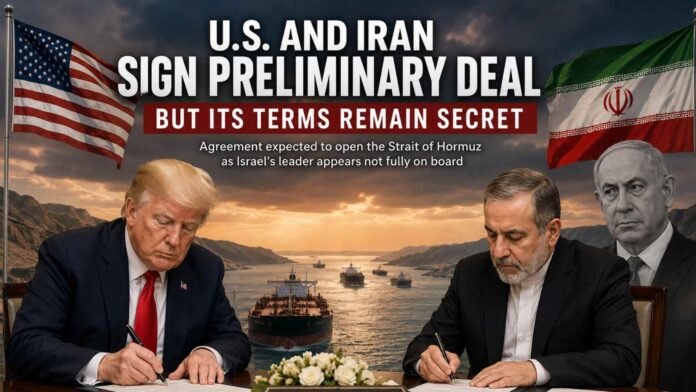
The United States and Iran have signed a preliminary peace agreement aimed at halting military hostilities and restoring maritime traffic through the strategically vital Strait of Hormuz. However, the exact terms of the agreement have not been made public, leading to uncertainty over the scope of commitments undertaken by both sides.
The agreement was signed on Monday following intense diplomatic efforts amid escalating regional tensions that had threatened global energy supplies and maritime security. While officials from Washington and Tehran confirmed the signing of the deal, both sides offered differing interpretations of its provisions, fueling speculation about the concessions made during negotiations.
Focus on Ceasefire and Strait of Hormuz
The immediate objective of the agreement appears to be ending ongoing military attacks and ensuring the reopening of the Strait of Hormuz, one of the world’s most important energy transit routes. Nearly a fifth of global oil shipments pass through the narrow waterway, making any disruption a major concern for international markets.
Recent hostilities in the region had raised fears of prolonged disruptions to shipping, resulting in volatility in global oil prices and concerns over supply chains. The preliminary agreement is expected to provide temporary relief to international shipping companies and energy-importing nations.
Terms Remain Confidential
Despite the announcement, neither the White House nor Iranian authorities have released the full text of the agreement. Officials from both countries have provided limited details, and some statements have appeared contradictory.
According to reports, U.S. officials have portrayed the agreement as a framework for de-escalation and future negotiations, while Iranian representatives have emphasized commitments relating to sanctions relief and security guarantees. The absence of a publicly available document has made independent verification of these claims difficult.
Diplomatic observers note that secrecy surrounding such agreements is not uncommon during initial stages of negotiations, particularly when sensitive military and geopolitical issues are involved. However, the lack of transparency has also generated skepticism among regional allies and international analysts.
Israel Appears Cautious
A major uncertainty surrounding the deal is the position of Israel. Reports indicate that Israeli leadership has not fully endorsed the agreement and may have reservations regarding its implications for regional security.
Israel has long viewed Iran’s military capabilities and regional influence as major security concerns. Any arrangement that is perceived as providing Iran strategic relief without addressing broader security issues could face opposition from Jerusalem.
Analysts suggest that Israel’s response may become a key factor in determining whether the preliminary agreement evolves into a broader and more durable peace framework.
Trump Administration Claims Diplomatic Breakthrough
President Donald Trump has described the agreement as an important step toward stabilizing the region and preventing a wider conflict. Supporters of the administration argue that the deal demonstrates the effectiveness of direct negotiations in reducing tensions between long-standing adversaries.
At the same time, critics have questioned whether the agreement addresses underlying disputes, including Iran’s regional activities, sanctions, nuclear-related concerns, and the security interests of U.S. allies in the Middle East.
Global Markets Watching Closely
International markets are expected to closely monitor developments over the coming days. The reopening and uninterrupted functioning of the Strait of Hormuz is considered critical for global energy security.
Any confirmation that maritime traffic has resumed safely could help stabilize oil prices, while uncertainty regarding the durability of the agreement may continue to influence investor sentiment.
What Happens Next?
The preliminary nature of the agreement suggests that further negotiations will be required before a comprehensive settlement can be reached. Diplomatic sources indicate that discussions may continue on broader issues, including regional security arrangements, sanctions, military de-escalation mechanisms, and long-term maritime security guarantees.
Until the full terms are disclosed, significant questions remain unanswered regarding the obligations of both parties and the extent to which the agreement can prevent future confrontations.
For now, the signing of the preliminary U.S.-Iran accord marks a potentially important diplomatic breakthrough, but its ultimate success will depend on transparency, implementation, and acceptance by key regional stakeholders, particularly Israel and other Middle Eastern allies.
Read More: Mere Road Transport Without Consignment Note Not Taxable as GTA: CESTAT

