
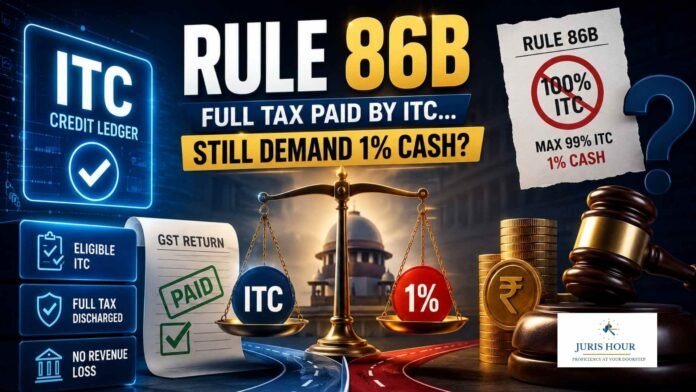
A significant legal debate has emerged among GST practitioners regarding the scope and enforceability of Rule 86B of the CGST Rules, 2017, particularly in cases where a taxpayer has discharged the entire output tax liability through Input Tax Credit (ITC) despite being subject to the restriction prescribed under the Rule.
The discussion revolves around a fundamental question:
Can the GST Department issue a Show Cause Notice (SCN) demanding 1% payment in cash merely because Rule 86B was violated, even when there is no short payment of tax and the entire tax liability stands discharged through eligible ITC?
What Does Rule 86B Provide?
Rule 86B, introduced with effect from 1 January 2021, restricts the utilization of ITC in certain cases.
The Rule provides that where the value of taxable supplies (other than exempt and zero-rated supplies) exceeds ₹50 lakh in a month, the registered person cannot use the amount available in the electronic credit ledger to discharge more than 99% of the output tax liability.
Consequently, at least 1% of the tax liability must be discharged through the electronic cash ledger, unless the taxpayer falls within one of the specified exceptions.
Key Exceptions
The restriction does not apply where:
- The registered person has paid more than ₹1 lakh as income tax in each of the last two financial years;
- The proprietor, partner, managing director or any of the directors has paid more than ₹1 lakh as income tax in each of the last two financial years;
- The registered person has received refunds exceeding ₹1 lakh in the preceding financial year;
- The registered person has discharged more than 1% of total GST liability cumulatively in cash.
The Core Legal Question
The controversy arises where a taxpayer, though covered by Rule 86B, pays 100% of the GST liability through valid ITC and no portion through cash.
In such circumstances:
- Tax liability is fully discharged.
- Eligibility of ITC is not disputed.
- No revenue loss occurs.
The question is whether the violation of Rule 86B itself creates a “short payment of tax” capable of being recovered under Section 73 (now Section 74A for relevant periods).
One View: SCN Can Be Issued
According to one school of thought, Rule 86B creates a mandatory statutory condition regarding the mode of tax payment.
Therefore, if a taxpayer utilizes 100% ITC instead of limiting utilization to 99%, there is a violation of the Rule.
Proponents of this view argue that:
- The taxpayer was legally required to pay at least 1% through cash.
- Failure to do so results in short payment to that extent.
- Consequently, proceedings under Section 73/74A can be initiated for recovery of the unpaid cash component.
Counter View: No Tax Can Be Recovered Where Liability Is Fully Discharged
The opposing view questions the very jurisdiction to initiate recovery proceedings.
The argument proceeds on the basis that:
- Section 73 applies only where tax has not been paid, short paid, erroneously refunded, or ITC has been wrongly availed or utilized.
- Where the taxpayer has fully discharged output tax liability through valid ITC, there is no tax shortfall.
- The dispute concerns the mode of payment, not the quantum of tax paid.
According to this interpretation, Rule 86B may prescribe a procedural restriction, but its violation does not automatically create a fresh tax liability capable of recovery under Section 73.
Some experts contend that, at best, a general penalty under Section 125 may be invoked for contravention of the Rules, rather than raising a tax demand.
Rule 86B and the Question of Statutory Backing
The debate becomes even more interesting when examined in light of judicial observations questioning the legal foundation of Rule 86B itself.
In A.M. Enterprises vs State of Himachal Pradesh, the Himachal Pradesh High Court observed:
“Rule 86B of the Act itself is not backed by any statutory provision.”
The Court further remarked that while the rule-making power exists under Section 164, delegated legislation must derive support from the parent statute and cannot travel beyond it.
The Court stated:
“We do find force in the petitioner’s contention that Rule 86B has no statutory backing and appears to be ultra vires the provisions of the Act.”
However, the Court ultimately did not decide the constitutional validity issue because the matter could be disposed of on other grounds.
Importantly, the Court noted that where the tax liability already stood discharged, no prejudice had been caused to the revenue.
Judicial Trends on Rule 86B
1. Aadinath Agro Industries – Rajasthan AAR
In In re: Aadinath Agro Industries, the Rajasthan Authority for Advance Ruling examined the income-tax exception available under Rule 86B.
The AAR held that where a partnership firm and its partners had collectively paid more than ₹1 lakh as income tax but neither the firm nor the partners individually crossed the threshold, the exception would not apply.
Accordingly, the Rule 86B restriction remained applicable and utilization of ITC beyond 99% was impermissible.
2. Ujjwal Garg Case – Delhi High Court
In Ujjwal Garg vs Commissioner, Department of Trade and Taxes, the Delhi High Court dealt with suspension of GST registration on account of Rule 86B violations.
The Court held that once the required amount had been deposited, continuation of suspension could not be justified considering the serious consequences such suspension has on business operations.
3. Sri Shivsakthi Mercantile Pvt. Ltd. – Madras High Court
In Sri Shivsakthi Mercantile Pvt. Ltd. vs Assistant Commissioner (ST), the assessee claimed eligibility under the income-tax exception and had utilized 100% ITC.
The department directed a reversal of 1% ITC.
The Madras High Court did not decide the substantive issue but remanded the matter because the order had been passed without granting an opportunity of personal hearing.
4. A.M. Enterprises – Himachal Pradesh High Court
Apart from questioning the statutory backing of Rule 86B, the Court also held that cancellation of GST registration merely for alleged violation of Rule 86B was disproportionate and arbitrary.
The Court observed that less drastic measures could have been adopted instead of cancellation of registration.
Larger Constitutional Issue Remains Open
While Rule 86B has survived administrative scrutiny and continues to be enforced by GST authorities, courts have not yet conclusively settled several critical questions:
- Whether Rule 86B is fully supported by the parent statute;
- Whether violation of Rule 86B results in “short payment of tax”;
- Whether recovery proceedings under Section 73/74A can be sustained where tax stands fully paid through valid ITC;
- Whether only penal consequences can follow instead of tax recovery.
Conclusion
Rule 86B may appear straightforward on its face by restricting ITC utilization to 99% in specified cases. However, the legal issues surrounding its enforcement are far from settled.
Recent judicial pronouncements suggest that courts are increasingly examining not only the proportionality of departmental actions taken for Rule 86B violations but also the very statutory foundation of the Rule. Until a higher judicial forum conclusively determines whether violation of Rule 86B creates a recoverable tax liability, the debate is likely to continue among tax professionals, industry, and revenue authorities alike.
For taxpayers facing proceedings based solely on Rule 86B violations despite full discharge of GST liability through valid ITC, the evolving jurisprudence may offer significant grounds for challenge.
INPUTS BY : S.V.S. RAGHAVENDRA RAO, RAJEEV MANIAR, FAYAZAN DHABHOIWALA , M L MAHESHWARI
Read More: BSF Jawan Wins Supreme Court Relief as Court Limits Use of ‘Forum Non Conveniens’ in Writ Petitions

