
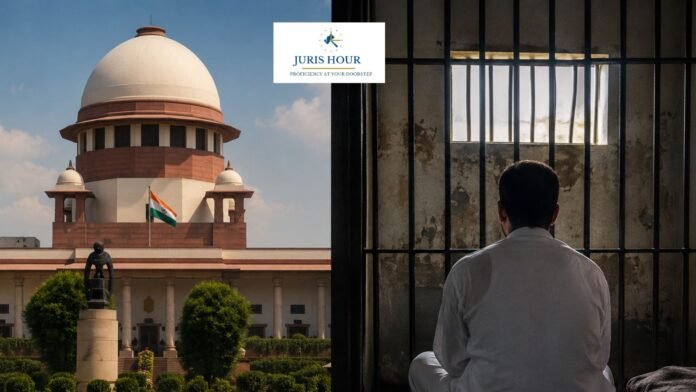
The Supreme Court has held that a prisoner cannot be kept behind bars after a valid judicial order directing his release, merely because the State is contemplating an appeal and awarded ₹11 lakh compensation to a Rajasthan convict who remained incarcerated for 24 days despite securing an order for permanent parole.
A Bench comprising Justice Sanjay Karol and Justice Augustine George Masih ruled that the State’s failure to implement the parole order amounted to illegal detention and a violation of the prisoner’s fundamental right to personal liberty under Article 21 of the Constitution.
Background of the Case
The appellant had been convicted in a criminal case and sentenced to four years of rigorous imprisonment. His conviction and sentence were ultimately affirmed by the Rajasthan High Court in 2021, following which he was arrested and lodged in prison.
In December 2023, after serving a substantial portion of his sentence, he applied for permanent parole. The authorities rejected the request on the ground that he had not availed the regular parole stages contemplated under the Rajasthan Prisoners Release on Parole Rules, 1958.
The prisoner challenged the rejection before the Rajasthan High Court. A Single Judge allowed his petition in November 2024 and directed his release upon furnishing a personal bond and sureties. However, despite compliance with the conditions and verification of sureties, he continued to remain in custody.
Faced with continued incarceration, he approached the Division Bench through a habeas corpus petition, which ordered his immediate release in December 2024. The delay between the parole order and his eventual release amounted to 24 days, leading him to seek compensation from the Supreme Court.
Can the State Ignore a Judicial Order While Considering an Appeal?
The State argued that the parole order itself was legally flawed because the prisoner had not completed the three stages of parole required under the Rajasthan Parole Rules. It also contended that officials were considering challenging the order and therefore the release process could not be completed immediately.
The Supreme Court rejected the argument in emphatic terms.
The Court noted that the State had never challenged the Single Judge’s order through appropriate legal proceedings. Therefore, it could not later justify non-compliance by claiming that the order was incorrect.
Reiterating a fundamental principle of the rule of law, the Court held that judicial orders remain binding and enforceable unless stayed, modified, or set aside by a competent court. Mere contemplation of an appeal or even filing an appeal does not automatically suspend the operation of the order.
The judgment strongly endorsed the doctrine of “obey first, appeal later,” warning that allowing authorities to selectively disregard judicial orders would undermine the administration of justice and the rule of law.
Supreme Court Defines ‘Illegal Detention’
An important aspect of the judgment is the Court’s detailed discussion on what constitutes illegal detention.
The Bench observed that illegal detention occurs when an individual’s liberty is curtailed by the State without lawful authority or in violation of constitutional safeguards. The Court stated that detention becomes illegal not only when it lacks statutory backing but also when legal procedures are not followed in a fair, just, and reasonable manner.
According to the Court:
“The deprivation of liberty by the State without lawful authority or in violation of provisions of the Constitution is illegal detention.”
Applying this principle, the Court held that once parole had been granted and the prisoner had complied with all release conditions, continued incarceration had no legal basis and therefore amounted to illegal detention.
Habeas Corpus and Protection of Liberty
The judgment contains an extensive discussion on the historical and constitutional significance of the writ of habeas corpus, tracing its roots to the Magna Carta and its evolution as one of the strongest safeguards against unlawful detention.
The Court reiterated that habeas corpus remains a vital constitutional remedy for protecting personal liberty and ensuring that no individual is deprived of freedom except in accordance with law.
Referring to landmark decisions such as Rudal Shah, Bhim Singh, Nilabati Behera, and D.K. Basu, the Court emphasized that monetary compensation has become a recognised public law remedy where the State violates fundamental rights.
Compensation for Violation of Article 21
While determining the appropriate relief, the Supreme Court acknowledged that the prisoner’s liberty had been unlawfully curtailed for 24 days after he had legally secured his release.
The Bench observed that bureaucratic indecision regarding whether an appeal should be filed cannot justify continued detention of a person whose release has already been ordered by a court.
The Court stressed that liberty cannot be subordinated to administrative convenience and that governmental processes must not operate at the cost of constitutional rights.
Significantly, the Court remarked that even a convicted person retains constitutional protections and cannot be treated as having diminished rights merely because he has been found guilty of an offence.
Key Observation of the Court
The Supreme Court underscored that:
“Once the detenue has been ordered to be released, the same has to be followed no matter what. The only scenario in which it would not be so done was if a superior Court has granted stay in the matter.”
The Bench further noted that the State must ensure that its administrative processes do not negatively impact an individual who has already secured his liberty through a judicial order.
Final Verdict
Allowing the appeal, the Supreme Court held that the prisoner had suffered 24 days of illegal custody due to the State’s failure to implement a valid parole order. As compensation for the violation of his fundamental rights, the Court directed the State of Rajasthan to pay ₹11 lakh directly into the appellant’s bank account.
Case Details
Case Title: Daudayal Versus The State Of Rajasthan & Ors.
Citation: Jurishour-1486-Sc-2026
Case No.: SLP (Crl.) 5036 of 2025
Date: 29/05/2026

