
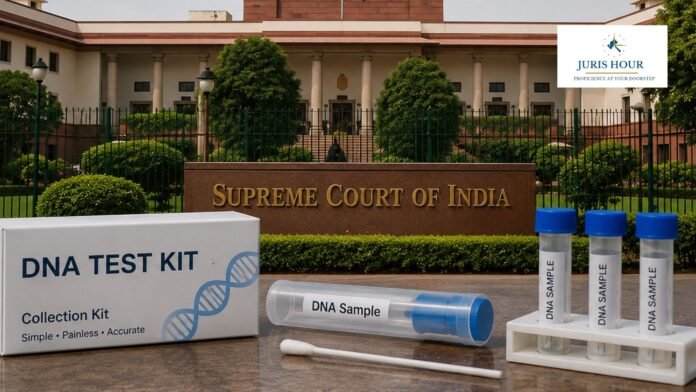
The Supreme Court has upheld orders directing a DNA test to determine the paternity of a man claiming inheritance rights, holding that the quest for truth and a child’s legitimate interest in establishing biological parentage may, in appropriate cases, outweigh objections based on privacy.
The bench of Justice Sanjay Karol and Justice Nongmeikapam Kotiswar Singh dismissed an appeal challenging concurrent orders of the trial court and the Chhattisgarh High Court directing a DNA examination in a suit where the plaintiff sought a declaration that he was the biological son of the appellant and consequently entitled to a share in his property.
Background of the Dispute
The dispute arose from a claim made by Amar Pradhan, who asserted that he was born on 10 September 1999 as a result of a consensual relationship between his mother and the appellant in January 1999. The appellant consistently denied paternity and relied, among other things, on his acquittal in a criminal case registered by Amar’s mother.
The parties had been involved in multiple rounds of litigation over the years, including proceedings relating to maintenance. In earlier proceedings, courts had observed that Amar and his mother had failed to establish the appellant’s relationship with them. However, after attaining majority, Amar instituted a civil suit seeking a declaration of paternity and claiming a one-third share in the appellant’s property.
The trial court directed a DNA test, and the Chhattisgarh High Court affirmed the order, observing that no other evidence could conclusively determine the issue of paternity.
Appellant Opposed Compulsory DNA Testing
Before the Supreme Court, the appellant argued that no person can be compelled to provide a DNA sample and that there was no compelling necessity for such testing in the present case. It was also contended that an adverse inference could not be drawn against him at that stage and that the civil suit was barred by the principle of res judicata because earlier proceedings had already dealt with related issues.
On the other hand, Amar submitted that the appellant’s continuous denial of paternity left no effective alternative for resolving the controversy. He argued that determining biological parentage was central to the dispute and that his right to establish his identity and inheritance rights justified the DNA examination.
Supreme Court Reviews Earlier DNA Test Jurisprudence
The Court undertook an extensive review of its earlier decisions governing DNA testing and paternity disputes, including the landmark rulings in Goutam Kundu v. State of West Bengal, Dipanwita Roy v. Ronobroto Roy, Aparna Ajinkya Firodia v. Ajinkya Arun Firodia, and Ivan Rathinam v. Milan Joseph.
The Bench reiterated the settled principle that courts cannot direct DNA or blood tests as a matter of routine. Such tests should be ordered only in exceptional situations where the issue of paternity is directly in dispute and cannot be effectively resolved through other available evidence.
The Court also noted that before directing DNA testing, courts must balance competing interests, including privacy, dignity, social consequences, and the individual’s right to know the truth regarding biological parentage.
Paternity Was the Core Issue in the Suit
Applying these principles, the Supreme Court found that the present case squarely involved a direct dispute regarding paternity. The Court observed that the appellant had consistently denied being Amar’s father and that no alternative evidence was available that could provide a conclusive answer to the controversy.
The Bench further noted that it was not the case of any party that Amar’s mother had maintained intimate relations with another person during the relevant period. Therefore, scientific testing could provide the most reliable means of resolving the dispute.
Importantly, the Court held that earlier observations made in maintenance proceedings could not operate as a final determination because those proceedings did not involve a full-fledged trial on the issue of paternity. Accordingly, the civil suit seeking declaration of parentage remained maintainable.
Child’s Right to Closure Prevails
A central aspect of the judgment is the Court’s balancing of privacy rights against the claimant’s interest in establishing biological identity.
The Bench observed that the appellant’s right to privacy had to be weighed against Amar’s lifelong quest for certainty regarding his parentage. The Court noted that Amar had grown up hearing his mother’s assertion that the appellant was his father, while official findings had consistently gone against him. Without a definitive determination, he could permanently lose rights that may otherwise accrue to him if his claim proved true.
The Court concluded that the balance of interests clearly favoured Amar and justified the DNA examination.
Appeal Dismissed, DNA Test to Proceed
Finding no error in the orders passed by the trial court and the High Court, the Supreme Court dismissed the appeal and directed that the matter proceed before the civil court for conducting the DNA test and taking further steps in the pending suit based on the result of the examination.
Case Details
Case Title: Chaturbhuj Pradhan Versus Amar Pradhan & Anr.
Citation: JURISHOUR-1485-SC-2026
Case No.: Special Leave Petition (Civil) No.4016 of 2026
Date: 29/05/2026
Read More: Will Revised Excise Duty Rates Impact Fuel Pricing from 1 June 2026? FinMin Notification

