
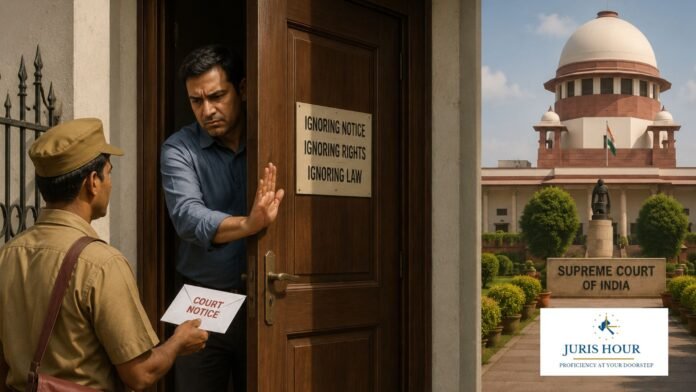
The Supreme Court has held that a party cannot avoid the consequences of limitation by claiming ignorance after consciously choosing to ignore a court-issued notice.
The bench of Justice Sanjay Karol and Justice Vipul M. Pancholi ruled that notice received in mutation proceedings constituted constructive notice regarding the underlying probate proceedings, and therefore the application seeking revocation of probate filed years later was hopelessly barred by limitation.
The dispute arose from properties inherited by Gouriprova Sen from her husband. During her lifetime, she executed a will dated July 9, 1989, appointing her nephew, Dhiraj Dutta, as the sole executor and beneficiary. She passed away shortly thereafter on October 8, 1989. Probate of the will was granted in favour of Dhiraj Dutta on September 28, 1995.
Subsequently, proceedings were initiated for mutation of the properties in revenue records. According to the appellant, notices relating to these mutation proceedings were served upon the predecessors of the respondents. The respondents, however, later claimed that they became aware of the probate only in 2019, after which they instituted a civil suit seeking declaration and injunction.
In 2022, nearly twenty-seven years after the grant of probate, the respondents moved an application under Section 263 of the Indian Succession Act, 1925 seeking revocation of the probate.
Core Legal Issue
The central question before the Supreme Court was whether the 2022 application seeking revocation of probate was within the limitation period prescribed under law.
Since the Indian Succession Act does not prescribe a limitation period for applications seeking revocation of probate, the Court noted that Article 137 of the Limitation Act, 1963 applies. Article 137 provides a three-year limitation period from the date when the “right to apply” accrues.
The controversy therefore turned on determining when the respondents acquired knowledge sufficient to trigger the limitation period.
Single Judge vs Division Bench
The Single Judge had dismissed the revocation application as barred by limitation. However, the Division Bench took a different view and held that the matter deserved consideration, effectively treating the application as maintainable.
This conflict brought the matter before the Supreme Court.
Supreme Court Examines ‘Constructive Notice’
The Court analysed the doctrine of constructive notice and referred to earlier decisions explaining its scope. It observed that constructive notice is a legal fiction whereby knowledge is attributed to a person when circumstances indicate that a reasonably prudent individual would have made inquiries and discovered the relevant facts.
The Court identified certain guiding principles:
- Constructive notice differs from actual notice and is inferred by law.
- It is based on wilful abstention or gross negligence.
- Whether constructive notice exists depends on the facts of each case.
- The test is that of a reasonably prudent person acting in Indian conditions.
Court Finds Respondents Ignored Notice
A crucial factor influencing the Court was the respondents’ own admission that notices relating to mutation proceedings had been served on them in 2013.
The respondents contended that they did not contest those proceedings because mutation entries already stood in their favour. The Supreme Court found this explanation unsatisfactory.
The Bench observed that any reasonably prudent person receiving a notice from a court would make efforts to ascertain the basis of the proceedings. This was particularly necessary because the mutation proceedings had been initiated by a third party despite existing entries in favour of the respondents.
According to the Court, a prudent person would have investigated why such proceedings had been initiated and whether the applicant possessed a superior claim to the property.
Limitation Began Long Before 2019
Rejecting the respondents’ argument that they gained knowledge only in 2019, the Supreme Court held that the notices received during the mutation proceedings amounted to constructive notice.
The Court reasoned that the respondents ought to have made inquiries into the source of the appellant’s claim. Had they done so, they would have discovered that the mutation proceedings were founded upon a probate granted in favour of the appellant.
Therefore, the limitation period could not be postponed until 2019 merely because the respondents chose not to investigate the matter earlier.
Supreme Court Restores Single Judge’s Order
Holding that the application for revocation of probate filed in 2022 was clearly beyond the prescribed limitation period, the Supreme Court concluded that the respondents’ plea was hopelessly time-barred.
Consequently, the Court set aside the judgment of the Division Bench; restored the order of the Single Judge dismissing the revocation application; allowed the appeal; and directed that all pending applications stand disposed of.
Case Details
Case Title: Dhiraj Dutta Versus Anirban Sen & Ors.
Citation: JURISHOUR-1483-SC-2026
Case No.: SLP (C.) No. 3371 of 2026
Date: 20/05/2026

