
The long-running controversy surrounding the GSTability of assignment of leasehold rights is once again set to come under the spotlight before the Supreme Court.
Following the departments unsuccessful attempt to challenge the Bombay High Court’s ruling in M/s Aerocom Cushions Private Limited v. Union of India, the Apex Court is now scheduled to hear another Special Leave Petition (SLP) on the same issue arising from the Gujarat High Court’s decision in Gujarat Chamber of Commerce & Industry.
The Bombay High Court had held that the assignment of leasehold rights does not attract Goods and Services Tax (GST). The Revenue carried the matter to the Supreme Court through an SLP. However, the Apex Court dismissed the petition at the threshold, effectively allowing the High Court’s decision to stand.
While the dismissal of an SLP in limine does not amount to a declaration of law under Article 141 of the Constitution and therefore does not create a binding precedent, the development was nevertheless viewed as a significant relief for taxpayers dealing with transactions involving transfer or assignment of leasehold rights.
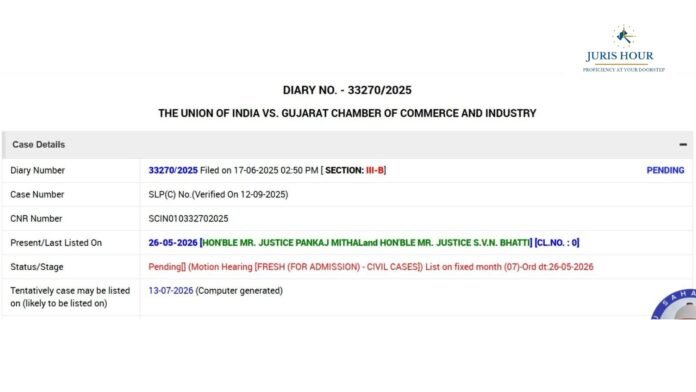
The issue has now resurfaced before the Supreme Court through the Revenue’s challenge to the Gujarat High Court’s judgment in the Gujarat Chamber of Commerce & Industry case. The matter, which also concerns the GST implications of assignment of leasehold rights, has reportedly been listed for hearing in July 2026.
The upcoming proceedings assume considerable importance because they provide the Supreme Court with an opportunity to examine the controversy in greater detail and potentially settle the law on a question that has generated substantial litigation across jurisdictions. Taxpayers, industry bodies, and legal practitioners have closely followed the issue, given the significant financial implications for businesses engaged in transactions involving leasehold interests in land and industrial plots.
The controversy largely revolves around whether the assignment of leasehold rights constitutes a taxable supply under the GST framework or whether such transactions fall outside the scope of GST, particularly in light of the nature of rights being transferred and the constitutional treatment of transactions relating to land and immovable property.
With the Revenue’s challenge to the Bombay High Court judgment having already failed, attention is now firmly focused on the Gujarat matter. Although the earlier dismissal did not conclusively settle the legal position, a detailed examination by the Supreme Court in the pending SLP could provide much-needed clarity on the issue.
The outcome of the July 2026 hearing is expected to be closely watched across the tax community. A ruling in favour of taxpayers could reinforce the emerging judicial view that assignment of leasehold rights is not liable to GST, while a contrary interpretation could reopen the debate and trigger fresh compliance and litigation challenges.
Until the Supreme Court delivers its verdict, the controversy remains alive. For taxpayers and tax professionals alike, the forthcoming hearing represents a crucial milestone in determining the future GST treatment of assignment of leasehold rights, an issue that has remained a subject of intense legal scrutiny since the introduction of the GST regime.
Read More: Courts Must Not Undermine Arbitration Through Excessive Interference: Supreme Court

