
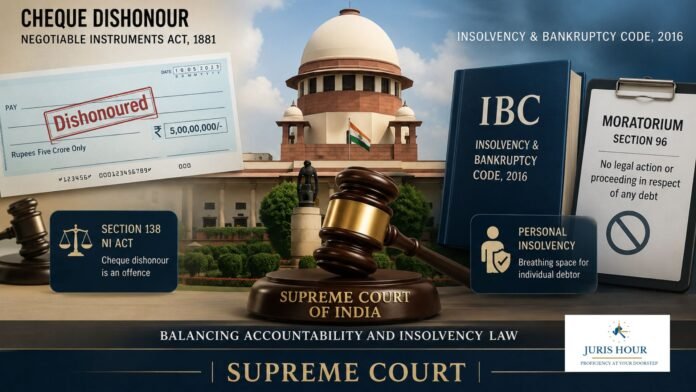
The Supreme Court has held that proceedings under Section 138 of the Negotiable Instruments Act, 1881 relating to cheque dishonour are criminal in nature and cannot be stayed merely because the accused is undergoing personal insolvency or bankruptcy proceedings under Part III of the Insolvency and Bankruptcy Code, 2016 (IBC).
The bench of Justice J.B. Pardiwala and Justice K. V. Viswanathan ruled that the moratorium provisions under Sections 96, 101, 124 and 128 of the IBC do not bar prosecution for cheque bounce offences against directors or other persons vicariously liable under Section 141 of the NI Act.
The judgment was delivered by the Supreme Court in a batch of appeals led by Dineshchand Surana v. UCO Bank. The case arose from proceedings initiated against Dineshchand Surana, former Managing Director of Surana Power Ltd., in connection with dishonour of a cheque worth more than Rs. 5 crore issued towards liabilities arising out of a letter of credit transaction.
According to the facts recorded by the Court, Surana Power Ltd. had availed financial facilities from UCO Bank for the purchase of Indonesian coal. A cheque issued towards repayment of the dues was dishonoured with the endorsement “Funds Insufficient”. Following the statutory notice, the bank initiated prosecution under Section 138 of the NI Act before the Metropolitan Magistrate, Chennai.
Subsequently, personal insolvency proceedings were initiated against the appellant under the IBC. The appellant argued that once the insolvency process commenced and the moratorium under Section 96 of the IBC came into operation, the cheque dishonour proceedings ought to remain stayed because Section 96 bars continuation of “any legal action or proceeding in respect of any debt.”
The Madras High Court rejected the plea, holding that proceedings under Section 138 of the NI Act are criminal proceedings and not merely recovery actions. Challenging this view, the appellant approached the Supreme Court.
The Supreme Court undertook an extensive examination of the nature of proceedings under Section 138 of the NI Act. The Court observed that although cheque dishonour cases originate from civil transactions involving repayment of debt, Parliament deliberately introduced a deeming fiction making dishonour of cheques a criminal offence to enhance the credibility and acceptability of cheques in commercial transactions.
The Bench explained that the offence under Section 138 stands committed the moment the cheque is dishonoured and returned unpaid by the bank. The subsequent statutory notice and failure to make payment within fifteen days merely determine whether the offence would be prosecuted.
The Court further observed that the statutory framework shows that cheque dishonour is treated as a “minor offence” with a strong compensatory element because the accused can avoid prosecution by paying the cheque amount after receipt of notice. However, this does not dilute the criminal nature of the offence itself.
While considering earlier precedents including P. Mohanraj v. Shah Bros. Ispat Pvt. Ltd. and Rakesh Bhanot v. Gurdas Agro Pvt. Ltd., the Court clarified the distinction between corporate insolvency proceedings and personal insolvency proceedings. It held that the moratorium under the IBC is intended to postpone civil recovery actions and preserve the debtor’s estate, but it does not extinguish or suspend criminal liability arising from cheque dishonour.
The Court emphasized that Section 138 proceedings are not purely debt recovery proceedings. The object of the provision is to preserve trust in commercial dealings and ensure accountability in the use of negotiable instruments. Permitting accused persons to escape prosecution merely by initiating personal insolvency proceedings would undermine the legislative purpose behind the NI Act.
The Supreme Court also clarified that directors and other individuals prosecuted under Section 141 of the NI Act continue to remain personally liable notwithstanding insolvency proceedings. The Court noted that criminal liability under Section 138 read with Section 141 arises due to the act of issuing a dishonoured cheque and not merely because of the underlying debt.
The Court reiterated that the moratorium provisions under the IBC are aimed at granting temporary breathing space for debt resolution and bankruptcy administration. However, criminal prosecutions cannot be stalled unless the statute expressly provides so.
Case Details
Case Title: Dineshchand Surana Versus UCO Bank
Citation: JURISHOUR-1455-SC-2026
Case No.: Special Leave Petition (Crl.) No. 12135 Of 2024
Date: 27/05/2026
Read More: No TIP, Doubtful Identification: Supreme Court Acquits Convicts In Rape-Murder Case

