
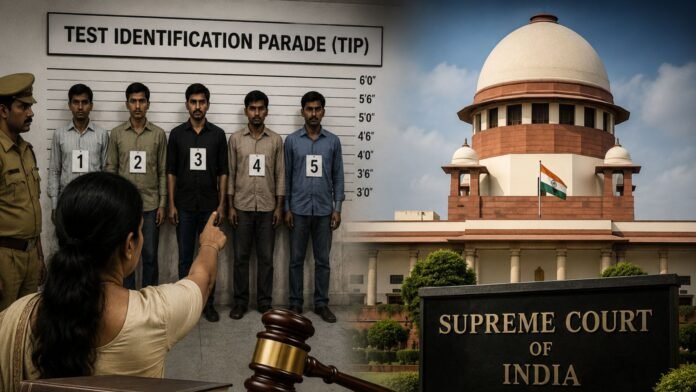
The Supreme Court has acquitted two men who had been sentenced to death in connection with the 2012 rape and murder of a woman in Uttarakhand, holding that the prosecution failed to establish a complete and reliable chain of circumstantial evidence and found multiple infirmities in the investigation, including failure to conduct a Test Identification Parade (TIP), doubtful sketch identification, non-examination of material witnesses, inconsistencies in the “last seen together” theory, and serious lapses in the handling of forensic and recovery evidence.
The bench of Justice Vikram Nath, Justice Sandeep Mehta and Justice Vijay Bishnoi has observed that both witnesses admitted the accused were previously unknown to them and that no TIP was conducted after the arrest. Instead, the accused were shown to witnesses while already in police custody, substantially diminishing the evidentiary value of subsequent dock identification before the Court.
The case arose from the murder of Munni Devi, a 55-year-old woman who had gone to a forest area on 29 December 2012 for grazing goats. According to the prosecution, two unknown youths had allegedly enquired about her whereabouts from local girls shortly before the incident. Later that evening, her body was found in bushes near a water channel in a partially unclothed condition with multiple injuries. An FIR was registered for offences under Sections 302 and 376 IPC against unknown persons.
Following investigation, the police arrested Mehtab and Sushil @ Bhura on 3 January 2013. The prosecution claimed that the accused confessed during interrogation and that recoveries were made at their instance, including a shirt allegedly matching a torn pocket recovered from the crime scene and ornaments belonging to the deceased. The trial court convicted both accused under Sections 302 and 376(2)(g) IPC and awarded death penalty for murder, while also imposing life imprisonment for gang rape.
The Uttarakhand High Court subsequently confirmed the death sentence while acquitting the accused under the SC/ST Act charge. The matter thereafter reached the Supreme Court.
Before the Supreme Court, the defence strongly challenged the prosecution’s reliance on circumstantial evidence. It argued that the entire case rested on doubtful “last seen together” evidence and unreliable identification based on sketches prepared from witness descriptions. The defence also questioned the forensic evidence, noting that no DNA examination was conducted and that semen traces found in vaginal swabs could not conclusively establish rape by the accused. The accused further highlighted contradictions in the prosecution’s story regarding recovery of the shirt pocket and the alleged recovery of the deceased’s salwar and ornaments from bushes near the crime scene.
The Supreme Court undertook an extensive analysis of the principles governing conviction based solely on circumstantial evidence. The Court reiterated that every incriminating circumstance must be firmly established and the chain of evidence must be complete, leaving no reasonable hypothesis other than the guilt of the accused. Mere suspicion, however grave, cannot substitute legal proof.
While examining the “last seen together” theory, the Court found major inconsistencies in the testimony of prosecution witnesses Anusuiya and Alka Chauhan.
The Bench observed that the prosecution’s case regarding sketch preparation was highly doubtful. The alleged sketch artist was never examined, his identity was concealed, and even the original sketches were not produced before the Court. The exhibited sketches lacked signatures of witnesses or investigating officers and did not even contain details regarding the date and time of preparation. The Court stated that these deficiencies seriously undermined the authenticity of the identification process.
The Supreme Court further criticised the prosecution for failing to examine Neha, another girl who was allegedly present with the witnesses when the accused had asked about the deceased.
The Court held that withholding such a material witness without explanation amounted to suppression of the best available evidence and cast serious doubt on the fairness and integrity of the investigation.
The Bench also highlighted contradictions regarding the physical appearance of the suspects described by witnesses and the actual sketches produced in evidence. While the witnesses claimed the suspects had long hair and moustaches, the sketches did not depict such features. The Court found these inconsistencies fatal to the prosecution’s identification case.
Significantly, the Supreme Court held that even if the prosecution evidence was accepted at face value, it merely established that two persons had enquired about an elderly woman grazing goats and proceeded toward the forest. There was no evidence that the accused were actually seen with the deceased near the time of occurrence, particularly since the forest area had multiple access routes. The Court observed that the possibility of involvement of other persons could not be ruled out.
The Court ultimately concluded that the prosecution failed to establish a complete and unbroken chain of incriminating circumstances beyond reasonable doubt. The serious lapses in investigation, doubtful recoveries, unreliable identification process, and absence of corroborative evidence rendered the conviction unsustainable.
Accordingly, the Supreme Court set aside the conviction and death sentence imposed upon the appellants and acquitted them of all charges.
Case Details
Case Title: Mehtab Versus State Of Uttarakhand
Citation: JURISHOUR-1454-SC-2026
Case No.: Criminal Appeal No(S). 1342-1343 Of 2018
Date: 27/05/2026

