
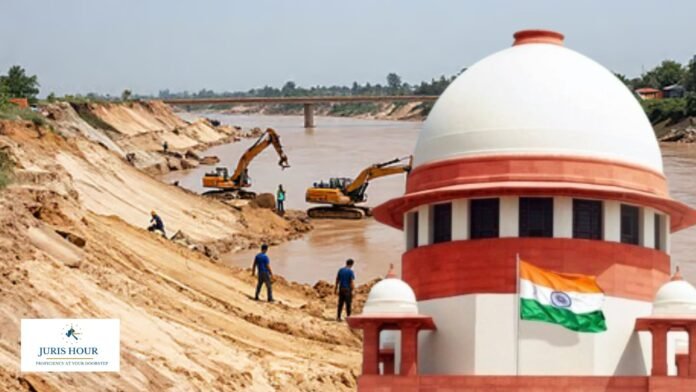
The Supreme Court has expressed serious concern over rampant illegal sand mining activities within and around the National Chambal Gharial Sanctuary, observing that the issue has resulted in ecological destruction, threats to endangered aquatic species, risks to public infrastructure and a breakdown of regulatory enforcement.
In a detailed order passed in the suo motu proceedings titled In Re: Illegal Sand Mining in the National Chambal Sanctuary and Threat to Endangered Aquatic Wildlife, the bench of Justice Vikram Nath and Justice Sandeep Mehta issued a series of stringent directions to the States of Rajasthan, Madhya Pradesh and Uttar Pradesh, while criticizing administrative lethargy and delayed implementation of earlier directions.
The Bench observed that despite repeated directions, several crucial actions appeared to have been initiated only after the Court adopted a more coercive and supervisory approach by requiring personal appearance of senior officials. The Court noted that environmental governance cannot become a reactive exercise undertaken only after judicial intervention and emphasized that constitutional obligations under Articles 21, 48A and 51A(g) require proactive steps for environmental protection.
The Court noted that while Rajasthan had subsequently initiated certain surveillance and enforcement measures, the response remained substantially delayed. Financial approvals amounting to approximately ₹65.47 crore have now been granted for installation of IT-enabled surveillance infrastructure, while 118 CCTV cameras are proposed across vulnerable routes.
Additional approvals have been granted for operational requirements and approximately 50 CCTV cameras have already become functional on transportation routes between Dholpur and Agra. Further, Rajasthan has deployed Rajasthan Armed Constabulary battalions, established permanent camps and temporary checkpoints and constituted district-level task forces for coordinated enforcement operations.
The Court examined statistical data produced by Rajasthan authorities showing extensive enforcement activity in recent years. In Dholpur district alone, 625 FIRs were registered and 688 vehicles seized between 2023 and 2025.
Similar action was recorded in Karauli, Kota and Bundi districts. However, the Court remarked that many essential measures still carried implementation timelines extending between 18 to 36 months, which it found unacceptable considering the urgency of the environmental crisis.
One of the Court’s strongest observations concerned the operation of unregistered and unidentified vehicles allegedly being used for illegal mining and transportation activities. The Bench found that the States had failed to establish an effective mechanism for identification, confiscation and prosecution of such vehicles and their operators. The Court observed that the continued use of unidentified vehicles in ecologically sensitive regions reflected serious regulatory failure and potentially facilitated organized illegal mining networks.
The Court particularly criticized the enforcement model adopted in Madhya Pradesh. Statistics indicated that over 250 vehicles were challaned within five months for registration-related violations, but were released after payment of fines of approximately ₹5,000 without meaningful action against owners or operators. The Court remarked that nominal penalties had effectively become a routine operational expense for illegal mining networks rather than a deterrent.
The Bench directed authorities to undertake immediate seizure and confiscation proceedings against vehicles including tractors, excavators, dredgers, loaders and dumpers operating without valid registration, fake number plates or other violations under motor vehicle laws. The Court further directed authorities to initiate criminal proceedings not only against drivers but also against owners, financiers, contractors and persons benefiting from organized illegal mining operations.
Another issue that attracted severe judicial scrutiny was the large number of vacancies in forest departments across the concerned States. The Court observed that frontline personnel such as Forest Guards form the first line of defence against illegal mining and environmental violations. The Court noted that substantial vacancies had remained unfilled for prolonged periods and described the situation as evidence of “administrative lethargy” and a lack of institutional urgency.
The Supreme Court directed Rajasthan, Madhya Pradesh and Uttar Pradesh to complete recruitment for vacant posts, including Forest Guards and other frontline enforcement staff, preferably within one year. It also ordered surveillance and monitoring infrastructure to be operationalized on a “war footing” and substantially completed within six months.
The Court also examined concerns surrounding illegal excavation near the bridge on National Highway-44 at the Morena-Dholpur border. It observed that indiscriminate excavation in close proximity to bridge pillars could alter river morphology and adversely affect structural stability. Although the National Highways Authority of India (NHAI) reported that the bridge remained structurally safe, the Court held that NHAI could not escape responsibility merely by claiming that regulation of mining fell within the domain of State authorities.
Consequently, the Court directed NHAI to install high-resolution CCTV cameras with night vision capability across areas extending one kilometre upstream and 500 metres downstream of the bridge. The surveillance systems are required to remain functional round-the-clock, with live feeds shared with police and forest authorities.
The Bench additionally expressed concern over waste being thrown into the Chambal River from the bridge, affecting aquatic wildlife including crocodiles and muggers. It directed installation of tamper-proof fencing and protective mechanisms to prevent dumping and safeguard the river ecosystem.
The Court also considered concerns regarding declining environmental flows in the Chambal River and its tributaries. Scientific studies cited before the Court indicated significant reductions in summer and lean-season water flows over recent decades, affecting habitats of gharials, dolphins, turtles and other species. Accordingly, the Court directed the Ministry of Jal Shakti and the Central Water Commission to file detailed affidavits concerning environmental flow management measures and future plans.
The matter has been listed for further hearing on July 22, 2026.
Case Details
Case Title: In Re: Illegal Sand Mining In The National Chambal Sanctuary And Threat To Endangered Aquatic Wildlife
Citation: JURISHOUR-1408-SC-2026
Case No.: SUO MOTO WRIT PETITION (CIVIL) NO. 2 OF 2026
Date: 26/05/2026

