
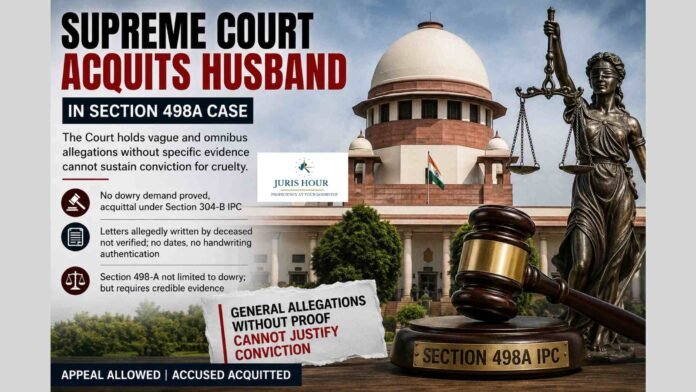
The Supreme Court has acquitted a husband who had been convicted under Section 498-A of the Indian Penal Code (IPC), holding that vague and omnibus allegations without specific evidence cannot justify a conviction for cruelty.
The bench of Justice Sanjay Kumar and Justice K. Vinod Chandran emphasized that while Section 498-A covers mental and physical cruelty beyond dowry demands, there must be clear evidence of unlawful demands or willful conduct driving the wife to suicide.
The case arose out of the death of a married woman who died by suicide after consuming pesticide. The prosecution had alleged that the deceased was subjected to continuous harassment and cruelty by her husband and in-laws over dowry demands and other unlawful demands. The trial court, however, had acquitted the accused under Section 304-B IPC relating to dowry death after concluding that there was no satisfactory evidence proving dowry demand. The court found that a letter allegedly written by the father-in-law seeking dowry had not been proved.
Despite this finding, the trial court proceeded to convict the accused under Section 498-A IPC and Section 4 of the Dowry Prohibition Act on the basis of oral testimonies and letters allegedly written by the deceased to her father and brother. The accused were sentenced to imprisonment and fines.
The Supreme Court found this approach internally contradictory. It observed that once the trial court had itself concluded that no dowry demand had been established, sustaining a conviction under the Dowry Prohibition Act became inconsistent. The Court expressed surprise at the conviction under Section 498-A on the basis of broad allegations lacking concrete details.
The High Court had partially modified the sentence while affirming the conviction. Although it discarded the conviction under the Dowry Prohibition Act, it still sustained the conviction under Section 498-A on the ground that some particulars regarding cruelty had emerged from evidence.
Examining the evidence afresh, the Supreme Court first noted that the fact of suicide itself was undisputed. Medical evidence and witness testimony established that the deceased had consumed pesticide. However, the crucial question before the Court was whether the conduct of the husband had driven her to take the extreme step.
The Court scrutinized the testimonies of family members and found that the allegations regarding dowry demands and harassment lacked specifics. Witnesses referred generally to demands and torture but failed to identify precise incidents, dates, persons involved, or particular acts constituting cruelty. The Court noted that most witnesses were relatives of the deceased and their statements remained broad and unspecific in nature.
The Court also carefully examined the letters allegedly written by the deceased. It observed significant evidentiary defects surrounding those documents. There were inconsistencies regarding who produced the letters before the investigating agency, no dates appeared on the letters, and no effort was made during investigation to verify whether the handwriting actually belonged to the deceased. The Court observed that even if the letters were accepted at face value, they merely suggested strained relations between the two families and did not clearly establish harassment or cruelty.
The Bench reiterated an important principle concerning Section 498-A. It clarified that the provision is not restricted to dowry-related harassment alone. Unlawful demands of any kind or deliberate acts causing severe mental or physical suffering capable of driving a woman to suicide may also amount to cruelty. However, the Court emphasized that such allegations still require proof through credible evidence.
Finding that the oral evidence and documentary material fell substantially short of proving cruelty under Section 498-A, the Supreme Court held that the conviction could not stand. Consequently, it allowed the appeal and acquitted the husband of all charges.
The ruling reinforces the principle that criminal convictions under Section 498-A cannot rest on generalized allegations or unsupported accusations and that courts must insist upon specific, reliable and legally admissible evidence before recording guilt.
Case Details
Case Title: Sridhar V Naidu Versus Commissioner of Customs
Citation: JURISHOUR-1401-SC-2026
Case No.: Service Tax Appeal No. 54731 OF 2023
Date: 25/05/2026

