

The Article “From Strict Rigours to Quantity-based Classification: Section 37 Bail Jurisprudence under NDPS Act, 1985” is written by SRINIVASAN GOPAL, ASSISTANT DIRECTOR(RETD.) NATIONAL ACADEMY OF CUSTOMS INDIRECT TAXES AND NARCOTICS. Srinivasan Gopal is a distinguished retired Assistant Director of the National Academy of Customs, Indirect Taxes and Narcotics (IRS), recognized for his doctrinal scholarship and global outreach in narcotics law enforcement.
The Narcotic Drugs and Psychotropic Substances Act, 1985 (Act No. 61 of 1985) (for short, ‘the Act’) came into force on 16 September 1985 as India’s legislative response to its obligations under the Single Convention of 1961 and the Convention on Psychotropic Substances of 1971. In its early form, the Act mirrored the provisions of these international instruments, dividing the regulatory field into two categories: narcotic drugs and psychotropic substances.
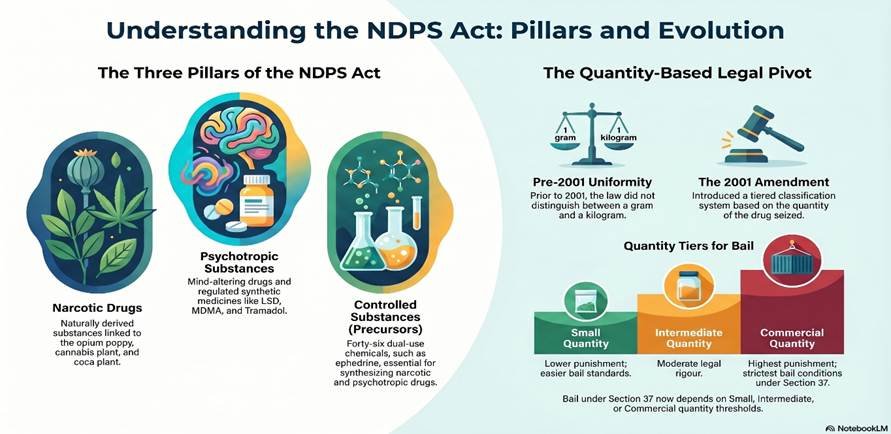
With the passage of time, a third limb was added: precursor chemicals, which India has consciously labelled as “controlled substances.” Thus, the Act today rests on three pillars: narcotic drugs, psychotropic substances, and controlled substances—each with its own doctrinal and operational significance.
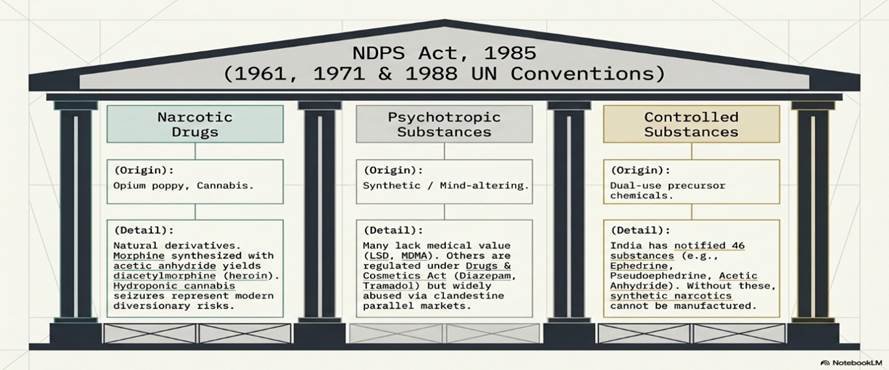
Narcotic drugs were originally linked to three plants permitted for medical and scientific use: the cannabis plant, the opium poppy, and the coca plant. The coca plant does not grow in India due to unsuitable climate, though its derivatives are encountered in seizures. Enforcement focus, therefore, lies on opium poppy and cannabis. Licit cultivation of opium poppy is permitted under license in Rajasthan, Madhya Pradesh, Uttar Pradesh, and experimentally in parts of Uttarakhand. The plant yields nearly forty alkaloids, of which morphine, codeine, and thebaine are principal. Morphine serves as a painkiller, codeine as a cough suppressant, while thebaine is synthesized into buprenorphine, a drug used in de‑addiction therapy for heroin addicts. Morphine, when reacted with acetic anhydride—a notified controlled substance—produces diacetylmorphine, locally known as heroin. Cannabis, on the other hand, has been cultivated for centuries, including in Ayurvedic traditions, and now even through hydroponic methods. It contains over four hundred cannabinoids, with tetrahydrocannabinol (THC) being the most psychoactive, found in ganja, charas, hashish, and hashish oil. Recent seizures of hydroponic cannabis at airports across the country underscore the diversionary risks posed by legalization trends abroad.
Psychotropic substances are mind‑altering drugs, many without medical value, such as LSD and MDMA. Yet several are legally manufactured and regulated under the Drugs and Cosmetics Act, 1940, appearing in Schedules X and H1. Medicines like diazepam and cetirizine have legitimate therapeutic use, while tramadol—a synthetic opioid—has become one of the most abused substances despite its medical utility. Diversion occurs through clandestine labs or siphoning from legitimate production, creating a parallel illicit market. Controlled substances, internationally termed precursor chemicals, are dual‑use chemicals employed in the manufacture of narcotic drugs and psychotropic substances. India has notified forty‑six such substances, including ephedrine, pseudoephedrine, and potassium permanganate, to prevent diversion. Without these precursors, narcotic and psychotropic drugs cannot be synthesized.
The international dimension was reinforced by the 1988 UN Convention against Illicit Traffic in Narcotic Drugs and Psychotropic Substances, which expanded obligations to include money laundering, freezing of property, and precursor control. India amended the NDPS Act accordingly, making it a comprehensive statute. The institutional framework rests on the Narcotics Control Bureau as the nodal enforcement agency and the Central Bureau of Narcotics as the licensing authority for opium cultivation and import‑export regulation.
Seen through this prism, the NDPS Act is a statute of classifications—plants, substances, precursors, licit and illicit streams, medical and non‑medical uses. Out of these, quantity has emerged as a decisive axis. Prior to the 2001 amendment, the Act made no distinction between a gram and a kilogram; the rigours of punishment and bail applied uniformly. The amendment introduced the crucial differentiation between small, intermediate, and commercial quantities, thereby altering the landscape of bail jurisprudence under Section 37. It is this shift—from draconian uniformity to quantity‑based classification—that frames the doctrinal journey of bail under the NDPS Act.
One of the few Acts in India are extremely in draconian in nature. During the initial years of the enactment, India was seen as a transit country with the drug flowing through the country, particularly through the air route and maritime route. With the passage of time, we see that the country has become a consuming country with flow of drugs coming through different routes – passenger routes (ingestion by pax; concealments in checked-in baggage; hand carry baggage), cargo route, sea route (in containers), courier route, Foreign Post Office route, porous borders of Indo-Nepal, Indo=Bhutan, Indo-Myanmar, LCS, drones, tunnels, pipes, UAVs, floating objects, rivers, maritime route, etc. Article 36 of the 1961 Convention explicitly states that offences shall be “punishable offences when committed intentionally, and that serious offences shall be liable to adequate punishment particularly by imprisonment or other penalties of deprivation of liberty.” We see that the Convention only says that the offences should be suitably punished. During the first two decades of the implementation of this draconian Act, the offences of a gram was equal to 1000000 grams with no distinction made. Consequently, we had overflowing undertrials, particularly in the State of Punjab. The Government took a serious look into it and we had to devise some means to overcome this serious problem. Accordingly, in late 2001, the Government amended the Act and the introduced the concept of small quantity and commercial quantity came to be inserted into the parent by Section 3 of Act 9 of 2001 and this came in to effect from 02 October 2001 and the Notification using the provisions of the amended Act was issued classifying the seized contraband into to two distinct segments – small quantity and commercial quantity. Column 5 and 6 of the Notification dated 20 October 2001 prescribe the small quantity and commercial quantity.
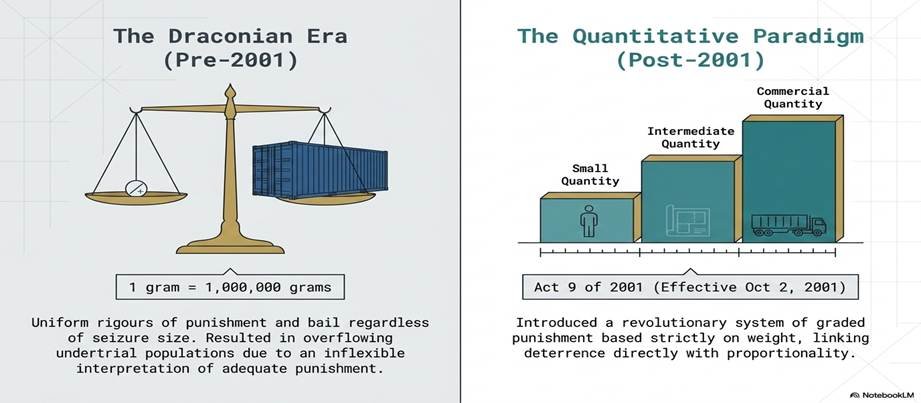
The Quantity-Based Punishment Framework (Post-2001)
The 2001 amendment to the NDPS Act was inserted into the NDPS Act by Act 9 of 2001 and came into effect with effect from 02.10.2001. The amendment introduced a revolutionary concept: classification of offenses based on quantity seized:
- Small
- Commercial
Graded Punishment – Small and Commercial Quantity
The NDPS Act employs a graded punishment system that links deterrence with proportionality, sharply distinguishing between simple users and large-scale traffickers. This system is governed by the definitions of ‘Small Quantity’ (SQ) under Section 2(viia) and ‘Commercial Quantity’ (CQ) under Section 2(xxiiia), which are notified by S.O. 1055 (E) dated 19 October 2001, as amended.
Judicial Interpretation – Defining the Intermediate Quantity
The attached Table in the Notification dated 19 October 2001 defines the thresholds for Small Quantity (SQ) and Commercial Quantity (CQ) (Columns 5 and 6 respectively). However, a critical legal nuance arises from their interpretation:
- SQ/CQ Defined: The Notification specifies quantities up to a certain point for SQ and above a certain point for CQ.
- The Nuance: If the quantity seized is exactly equal to the threshold for Small Quantity (Column 5) or exactly equal to the threshold for Commercial Quantity (Column 6), it does not fall into those categories.
| Quantity Range | Legal Classification | Section 37 Applicability (Bail) |
| Exactly 5 grams | Intermediate Quantity | Not Applicable (Bailable) |
| > 5 grams and < 250 grams | Intermediate Quantity | Not Applicable (Bailable) |
| Exactly 250 grams | Intermediate Quantity | Not Applicable (Bailable) |
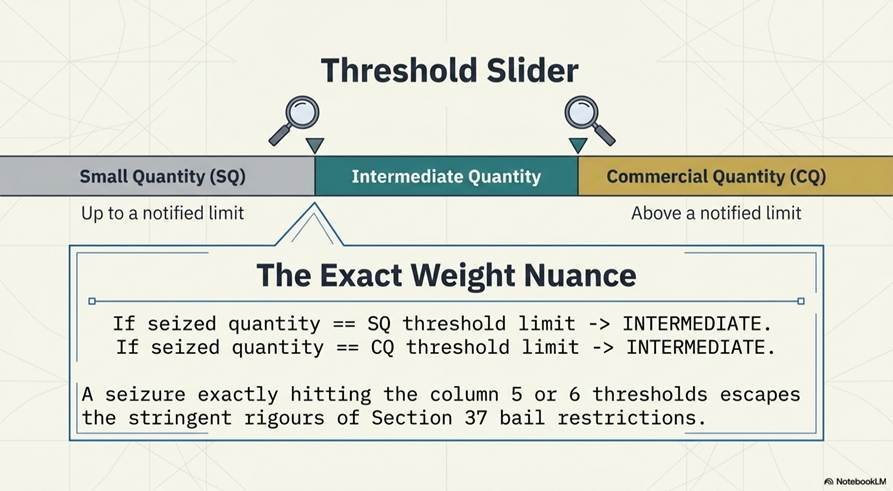
Quantities greater than small but less than commercial have been termed “intermediate quantity,” a term coined by the Courts. Its importance cannot be overstated, as the strict rigours of Section 37 of the Act are not applicable to cases involving Small or Intermediate Quantities.
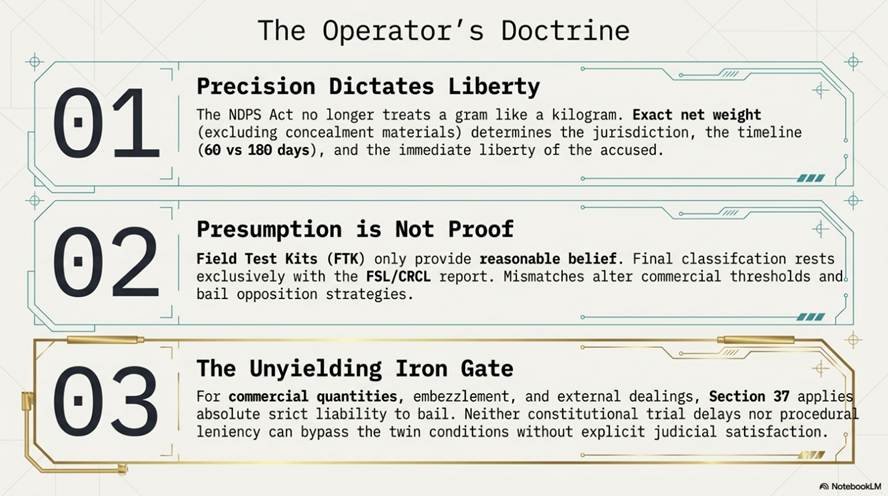
Empowered officers must always keep this precise quantitative difference in view, as the exact weight—down to the gram—immediately affects the statutory classification, the charges pressed, and the bailability of the offense. This also helps them in filing the charge sheet well within the period of 60 days and in the Special Court for NDPS Offences as the accused can be inflicted punishment up to 10 years.
Growth of bail applications under the Act
A study of bail applications filed under Section 37, as available on 23 May 2026 at 1930 hours, reveals a disturbing trend1. The graph, which is self‑explanatory, shows a steady rise in bail applications and their disposal by the High Court. Beginning with a single case in 1996, the number peaked at 3,345 cases in 2025. In just the first five months of 2026, 1,731 applications have already been disposed of, representing 51% of the previous year’s total.
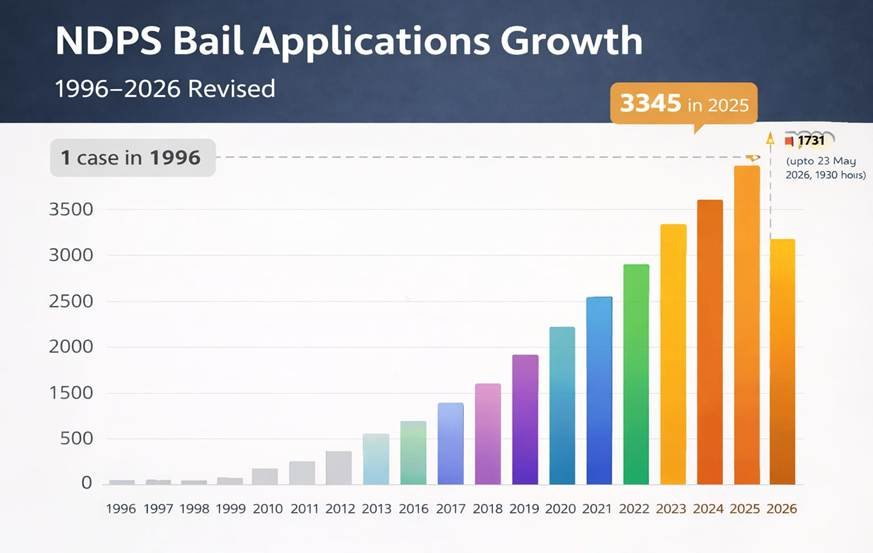
Since the database records the disposal from 1996, a study of the bail applications disposed of by the High Courts reflect a growing concern with the growth of the bail applications and too steadily pointing a sharp growth in the year 2022 onwards.
Importance of Section 37
This is one of the most important Sections of the Act. This Sections deals with cases against persons accused of an offence punishable for
- Commercial quantity of narcotic drugs , as duly notified
- Commercial quantity of psychotropic drugs, as duly notified
- Cases involving invocation of Section 19 [embezzlement of opium by cultivator]
- Section 24 covering punishment for external dealings in narcotic drugs and psychotropic substances in contravention of Section 12.
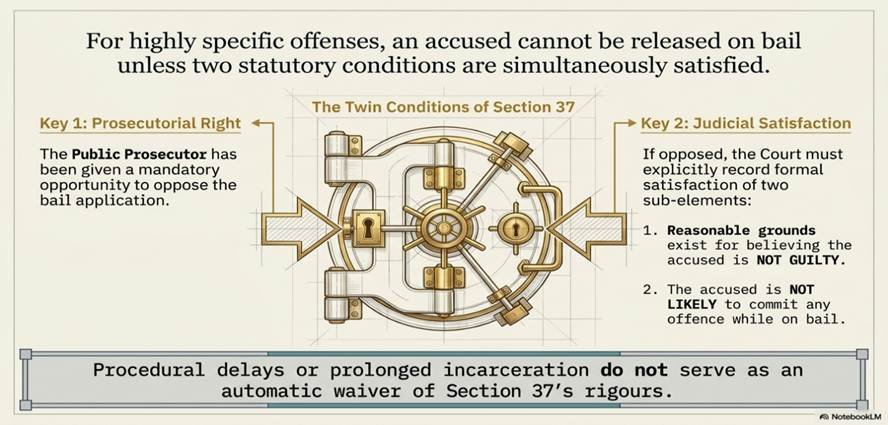
In respect of the offences noted herein above, no person accused of an offence(s), shall be release on bail or on his own bond unless the following twin conditions are satisfied simultaneously:
“(i) the Public Prosecutor has been given an opportunity to oppose the application for such release, and
(ii) where the Public Prosecutor opposes the application, the court is satisfied that there are reasonable grounds for believing that he is not guilty of such offence and that he is not likely to commit any offence while on bail.”
So, in respect of the offences enumerated above, it is very difficult to obtain bail unless twin conditions are satisfied.
Apart from commercial quantity cases in narcotic drugs and psychotropic substances, there are no other provisions which have been made part of the Section 37 proceedings. They are embezzlement by the opium cultivator and persons indulging in external dealing under Section 12, which is punishable under Section 24.
At the outset, it is required to be understood as to why the term embezzlement has been used. It may be noted that the licences are issued by the Narcotics Commissioner, Central Bureau of Narcotics, Gwalior for licit cultivation on the opium poppy on the earmarked land of the cultivator. The land belongs to the cultivator and standing crop, grown on account of the Central Government, is the property of the Central Government. Standing crops are movable property in terms of the Transfer of Property Act, 1882, Sales of Good Act, 1930, Registration Act, 1905, the ownership of the opium poppy rests with the Central Government through the District Opium Officer, functioning under the administrative control of the Narcotics Commissioner, Gwalior, the sole officer to grant licence for licit cultivation. Since the property belongs to the Central Government and any opium gum yield is diverted into the market for pecuniary gains, the same is legally termed as embezzlement. In other words, it can be termed as Criminal Misappropriation of Property and Criminal Breach of Trust and such an offence being serious, it has been placed under the purview of Section 37. Since the Act recognizes the embezzlement as a distinct offence, the prosecution is launched under the Act by invoking the provisions of Section 19. The parallel provision under Bhartiya Naya Sanhita, 2023, the successor to the IPC, 1860, is Section 314 and Section 316.
External dealings requiring a proper understanding. The terms does not mean that an Indian citizen is required to be stationed in a foreign country to be proceeded under the stringent Indian Act. By this term we mean that a person sitting in India, directly or indirectly, implicitly or explicitly, can engage himself in illicit drug trafficking.
To understand this, it is required to be understood how it operates.
- A person, say X, stationed in a Metro B, runs a clandestine lab in Sydney, Australia without touching the shores of Australia.
- Another example could be, say a person B, a citizen of India and presently residing in X city in Nepal, directs a person C stationed in Nepal, to ship drugs obtained an online application(may be darknet/deepweb or through encrypted APP) to ship it person D, a citizen of the USA. Now, sitting in India, he has utilized the services of a person C, stationed in Nepal to ship drugs to person D, a USA citizen.
In terms of Section 1 of the Act, Section 12 applies to all the Indian citizens (example 1) and to all the Indian Citizens wherever they are located(example 2).
Inapplicability of Section 37 of the Act
The provisions of Section 37 are inapplicable to the following:
(i) Small quantity of narcotic drugs;
(ii) Small quantity of psychotropic substances;
(iii) Controlled substances, irrespective of the quantity involved
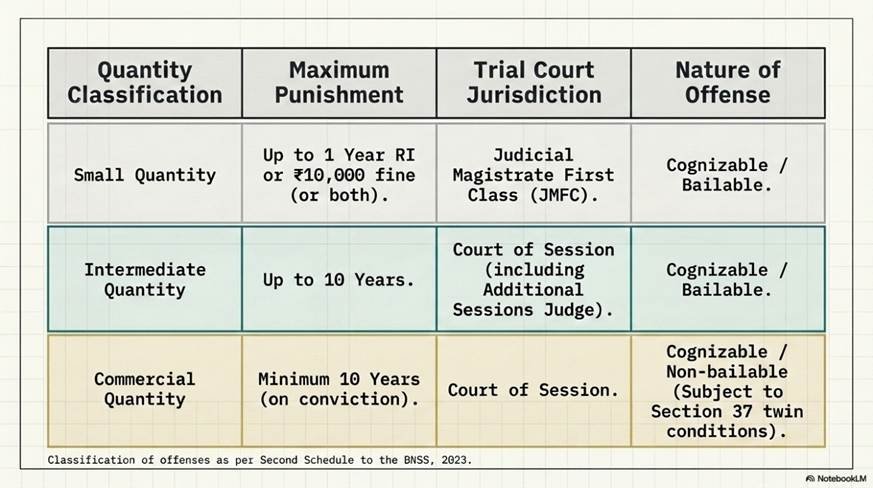
Based on the quantity, the hierarchy of Courts would also differ. In respect of small quantity, the quantum of punishment that can be inflicted on an accused is one year, or with fine which may extend to ten thousand rupees, or with both. We see this in Section 15(a), 17(a), 18(a), 20(b)(ii)(A), 21(a), 22(a), 23(a), etc. In these cases, maximum punishment is one year. Intermediate quantity gets covered under 15(b), 17(b), 18(b), 20(b)(ii)(B), 21(b), 22(b), 23(b). Commercial quantity cases get covered under 15(ac, 17(c), 18(c), 20(b)(ii)(C), 21(c), 22(c), 23(c).
The heading of Section 37 states that all offences are cognizable and non-bailable. It will be extremely useful to refer to the Classification of offences against other laws as per the Second Schedule to the BNSS, 2023, which is extracted as under:
| II.—CLASSIFICATION OF OFFENCES AGAINST OTHER LAWS Offence | |||
| Offence | Cognizable or non-cognizable | Bailable or non-bailable | By what court triable |
| If punishable with death, imprisonment for life, or imprisonment for more than 7 years. | Cognizable | Non-bailable | Court of Session |
| If punishable with imprisonment for 3 years and upwards but not more than 7 years. | Cognizable | Non-bailable | Magistrate of First Class |
| If punishable with imprisonment for less than 3 years or with fine only | Non-cognizable | Bailable | Any Magistrate |
It may be seen that in respect of intermediate quantity cases, the maximum punishment may be upto 10 years, while in commercial quantity cases, the minimum punishment on conviction is 10 years. Since, the punishment in intermediate quantity can exceed 7 years and in commercial quantity cases, it is a minimum of 10 years, the cases would be tried in a competent jurisdictional Court of Session. However, “where the contravention involves small quantity, with rigorous imprisonment for a term which may extend to one year, or with fine which may extend to ten thousand rupees, or with both;” Hence, in small quantity cases, the maximum punishment is one year RI or fine up to ₹10,000, or both. A Judicial Magistrate of First Class tries these.
In respect of intermediate and commercial quantity cases, they are tried by the Court of Session and that include Additional Sessions Judge.
Time Limit for filing of charge sheet/complaint
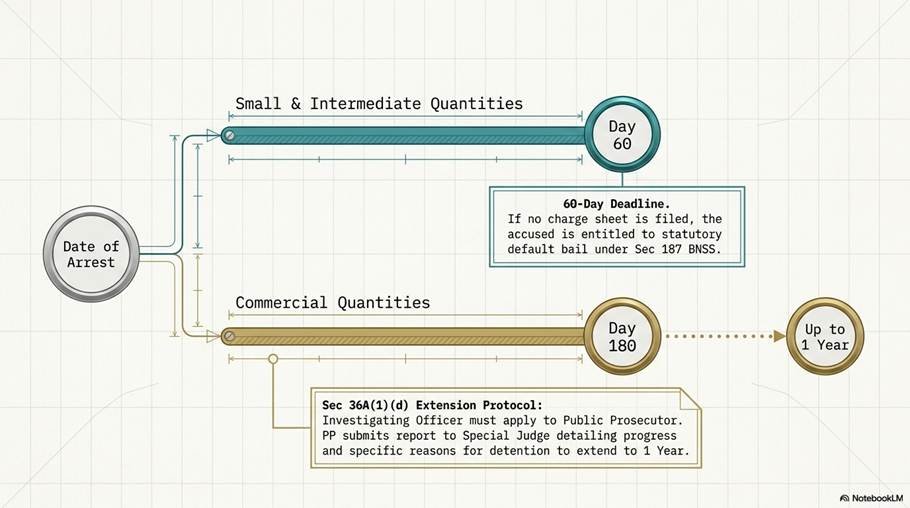
Based on the above, it can be further classified that in intermediate and small quantity cases, the time limit for filing the charge sheet/complaint is 60. But in case of commercial quantities, under Section 36A(1)(d), the time limit prescribed is 180 days. Proviso to this Section further provides that if it is not possible to complete the investigation within the said period of 180 days, the Special Court may extend the said period up to one year on the report of the Public Prosecutor indicating the progress of the investigation and the specific reasons for the detention of the accused beyond the said period of one hundred and eighty days. The Investigating Officer, in such cases, must apply to the Public Prosecutor well in advance citing all reasons as to why the investigation cannot be completed in 180 days and the Public Prosecutor shall, after going the same, shall apply to the Special Judge praying for an extension. The prayer for extension by the Public Prosecutor is parallel to the Commissioner of Customs extending the time limit of issuance of SCN upto one year.
Default bail
If the prosecution fails to file the charge sheet/complaint by 60th day or 180th day or as extended, and the accused avails of the default bail under Section 187 of BNSS, he shall be enlarged on statutory bail or known as default bail.
Classification of contraband into small quantity and commercial quantity
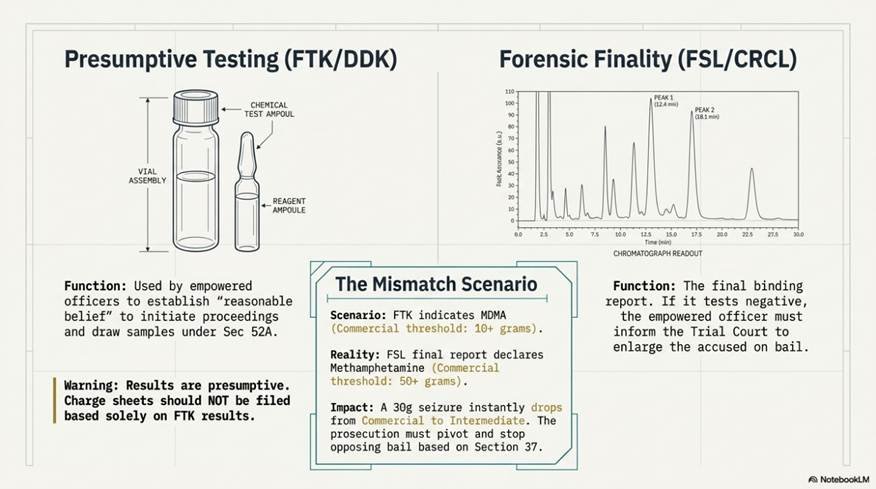
The empowered officer is required to use the Field Test Kit (FTK) or Drug Detection Kit (DDK) to come to a reasonable belief that the contraband falls under the ambit of the Act, If the contraband fails to answer the test, no case is made out. Hence, there would be no reasonable belief at that point of time. However, the proceedings can continue and the drawal of samples in the presence of the Magistrate, in terms of the mandate under section 52A of the NDPS Act, 1985 read with the Narcotic Drugs and Psychotropic Substances (Seizure, Storage, Sampling and Disposal) Rules, 2022 can be initiated.
Classification of the contraband using Field Test Kit/Drug Detection Kit
Classification of the contraband is one of the prime tasks of the officer. The use of Field Test Kit/Drug Detection Kit is of prime importance. Primarily, the FTK/DDK can be categorised into the following:
| Sl. No. | Type of kit |
| (i) | Narcotics Drug Detection Kits (to test traditional drugs like ganja, charas, opium, heroin, cocaine, and the like) |
| (ii) | Precursor Chemicals Detection Kits (to test acetic anhydride, ephedrine, pseudoephedrine, etc.) |
| (iii) | Ketamine Detection Kits (to test ketamine) |
The results of the test reports are presumptive in nature and do not necessarily tally with the forensic report of the Forensic Science Laboratory (FSL) or the Central Revenues Control Laboratory (CRCL). The empowered officer should act upon the report of the final test report sent by FSL/CRCL, failing which trial may be vitiated
Importance of FTK results of suspected drugs or substances recovered during the search operations.
It should be ensured that the investigating officer does not file the charge sheet or complaint, based on test report obtained using Field Test Kit/Drug Detection Kit.
The FTK report may answer positive for MDMA but the FSL/CFSL/CRCL report declares the substances to be methamphetamine. The commercial quantity for MDMA is 10+ grams while in respect of methamphetamine is 50+ grams. As there is a mis-match between the FTK vis a vis Final Test Report of CRCL/FSL/CFSL, the commercial quantity would change and accordingly, the prosecution should not waste energy in opposing bail application.
It is stressed that it is only the final FSL report which will prevail over the initial presumptive test results obtained through the FTK/DDK.
In cases, where ever there is a report stating that the substance does not fall within the ambit of the NDPS Act, 1985, it is duty of the empowered investigating officer to inform the Ld. Trial Court that the contraband seized has tested negative and hence the person in judicial custody may be enlarged on bail.
Neutral Substances and Concealment
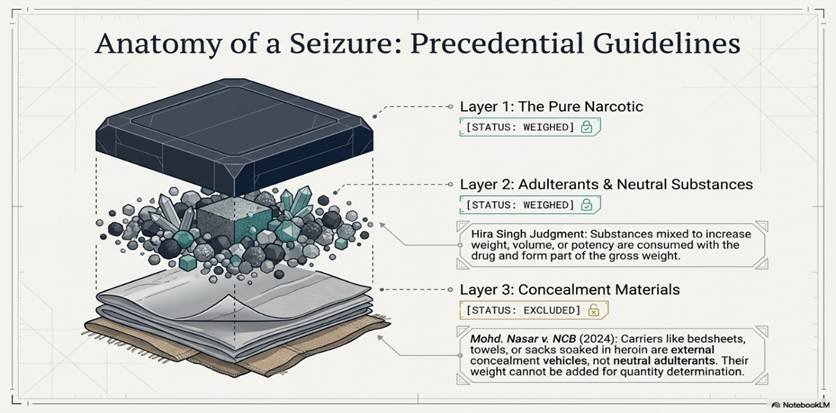
With the change in modus operandi adopted for illicit trafficking it has been noticed that the drug traffickers used carriers like towels, bedsheets, jute sacks, or yarn soaked in heroin. In the context of the Hira Singh judgment, it was held that neutral substances shall be forming part of the gross weight. However, it may be noted that the entire quantity came to be included because they were adulterants and they were also consumed. The Delhi High Court in Mohd. Nasar v. NCB -2024 SCC OnLine Del 771), carriers like towels, bedsheets, jute sacks, or yarn soaked in heroin, in the context of held that such items are not neutral substances; their weight cannot be added to contraband for quantity determination. Neutral substances are only those mixed with the drug to increase weight or potency, not external concealment material.
Weighment Discrepancies
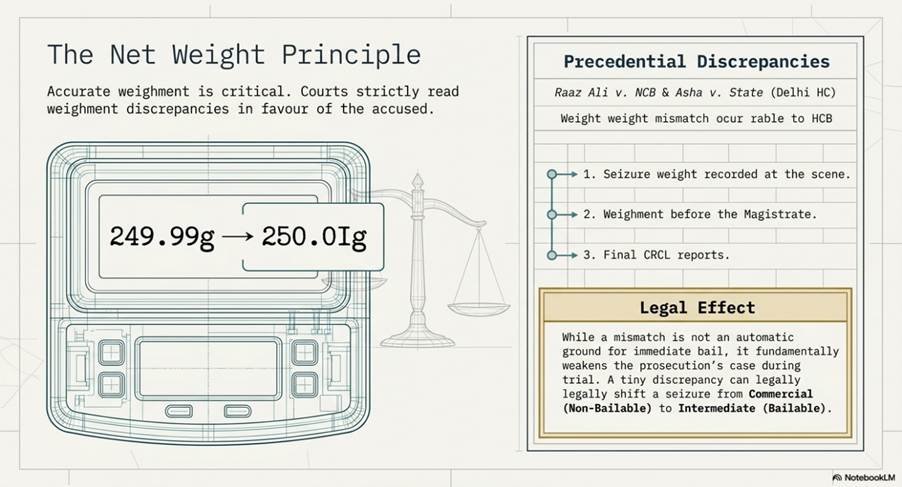
Accurate weighment is critical. Courts have repeatedly read discrepancies in favour of the accused. It is the net weight which is the determinant. The importance of net weight cannot be overstated as it will change the bailability from non-bailable under commercial quantity to bailable in respect of intermediate quantity. In Raaz Ali v. NCB – Neutral Citation – 2024:DHC:5080, the Delhi High Court noted unexplained differences between seizure weight, weighment before the Magistrate, and CRCL reports. While not an automatic ground for bail, such mismatches weaken the prosecution and are considered at trial. Similar observations were made in Asha v. State -2023 SCC OnLine Del 4302
Commercial quantity vs. Speedy trial
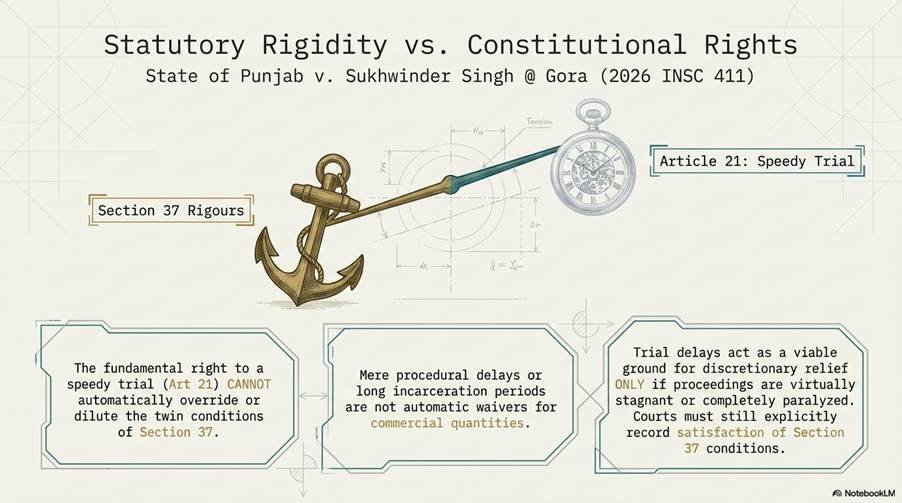
In the landmark judgment State of Punjab v. Sukhwinder Singh @ Gora – 2026 INSC 411, the Supreme Court of India ruled that the fundamental right to a speedy trial under Article 21 of the Constitution cannot automatically override or dilute the stringent statutory twin conditions for bail mandated under Section 37 of the Act. Setting aside a Punjab & Haryana High Court order that had granted regular bail to an accused facing trial for a commercial quantity of heroin, it was re-emphasized that a court cannot grant bail without formally recording explicit satisfaction that there are reasonable grounds to believe the accused is not guilty and is unlikely to commit any offense while out on bail. The Apex Court explicitly clarified that mere procedural delays or a long period of incarceration do not serve as an automatic waiver of Section 37’s rigors, clarifying that trial delays only act as a viable ground for discretionary relief if the proceedings are virtually stagnant or completely paralyzed. Consequently, the Supreme Court cancelled the regular bail granted to the accused and directed him to surrender before the trial court.
Conclusion
The Act has moved from a uniform, harsh regime to a more nuanced framework where liberty depends on classification by quantity, purity, and neutral substance. Section 37 of the Act continues to be strict for commercial quantity and serious offences, but small and intermediate cases remain outside its rigours. For enforcement officers, the lesson is clear: weighment must be precise, classification must be correct, and every gram counts for the purpose of bail.
Read More: JURISHOUR | TAX LAW DAILY BULLETIN : 25 May, 2026

