
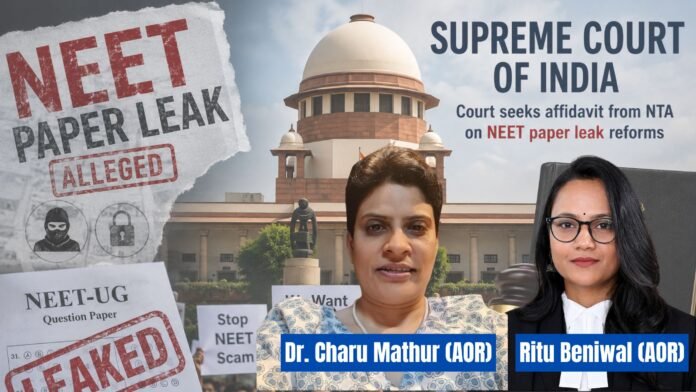
The Supreme Court on Monday expressed serious concern over recurring irregularities surrounding the National Eligibility-cum-Entrance Test (NEET), observing that it was “sad” that the National Testing Agency (NTA) appeared not to have learnt lessons despite earlier judicial intervention and reform directions issued after the previous examination controversy.
The matter was listed before a Bench of Justices P.S. Narasimha and Alok Aradhe, where the Court issued notice on a plea filed by the United Doctors Front (UDF) and Federation of All India Medical Association (FAIMA).
The Bench directed the NTA to file an affidavit by Thursday detailing the steps taken to comply with recommendations made by the court-appointed monitoring committee constituted following the earlier NEET paper leak controversy.
During the hearing, the Court noted that the issue had previously reached the Supreme Court and that a monitoring committee had been constituted to examine systemic shortcomings and recommend corrective measures. Referring to the earlier proceedings, the Bench remarked that despite those directions and accepted recommendations, concerns continued to emerge.
The Court observed: “It is sad that they have not learnt their lessons. The matter travelled to this court earlier also. There was a committee, a monitoring committee, which made some recommendations, and they were accepted. We want NTA to file an affidavit on the steps taken for compliance of recommendations suggested by the committee.”
The Bench also directed that copies of the petitions be served upon Solicitor General Tushar Mehta and other respondents. The matter has been listed for further consideration on Friday. It was also indicated that all connected matters raising similar concerns would be tagged together for consolidated consideration.
The Court further sought a status report regarding the implementation of recommendations made by the committee headed by former Indian Space Research Organisation (ISRO) Chairman K. Radhakrishnan. The Centre-appointed committee had earlier been tasked with examining and restructuring the functioning of the NTA, including introducing reforms aimed at ensuring transparency, accountability and secure examination processes.
Appearing in the matter were Dr. Charu Mathur, Advocate-on-Record, along with Ritu Reniwal as Advocate-on-Record and Advocate Mahender Kumawat as counsel on behalf of United Doctors Front (UDF).
One filed by the United Doctors Front (UDF) has sought dissolution of the NTA in light of its “systemic failure” in conducting NEET-UG 2026. She stated that over 23 lakh students appeared in the exam. The petition, filed through Advocate Ritu Reniwal, seeks the creation of a statutory national testing body through legislation enacted by Parliament with defined legal powers, transparency norms, and direct accountability to the Legislature. The petitioner has also sought a court-monitored committee to oversee the transition of upcoming national examinations to ensure “zero-leak” integrity.
FAIMA, through its petition filed by advocate Tanvi Dubey, has raised concerns over what it described as a serious failure of the existing examination mechanism. The association argued that recurring incidents of paper leaks and procedural irregularities amounted to a direct infringement of the fundamental rights of lakhs of aspirants who rely upon NEET for admission to medical institutions.
The medical body has urged the Supreme Court to consider restructuring or replacing the NTA with an autonomous and more robust institutional framework for conducting NEET-UG examinations. According to the plea, the present system has repeatedly failed to ensure fairness and credibility in one of the country’s most significant entrance examinations.
FAIMA has additionally sought the appointment of a high-powered monitoring mechanism until a fresh institutional structure is established. It proposed that such a committee should be chaired by a retired Supreme Court judge and include a cybersecurity expert and a forensic scientist so that future examinations can be conducted under closer scrutiny and with enhanced safeguards against leaks and manipulation.
The controversy arises in the backdrop of allegations of paper leaks in the undergraduate-level NEET examination conducted by the NTA on May 3 for admissions to medical courses. The examination was subsequently cancelled on May 12 following allegations of irregularities. Investigations into the matter are currently being conducted by the Central Bureau of Investigation (CBI).
The Supreme Court‘s latest observations indicate that the focus of the proceedings may extend beyond individual instances of malpractice and move towards a broader institutional review of the NTA’s functioning and accountability framework.

